- Wed, September 30, 2026

Parenting On The Nights It All Goes Wrong
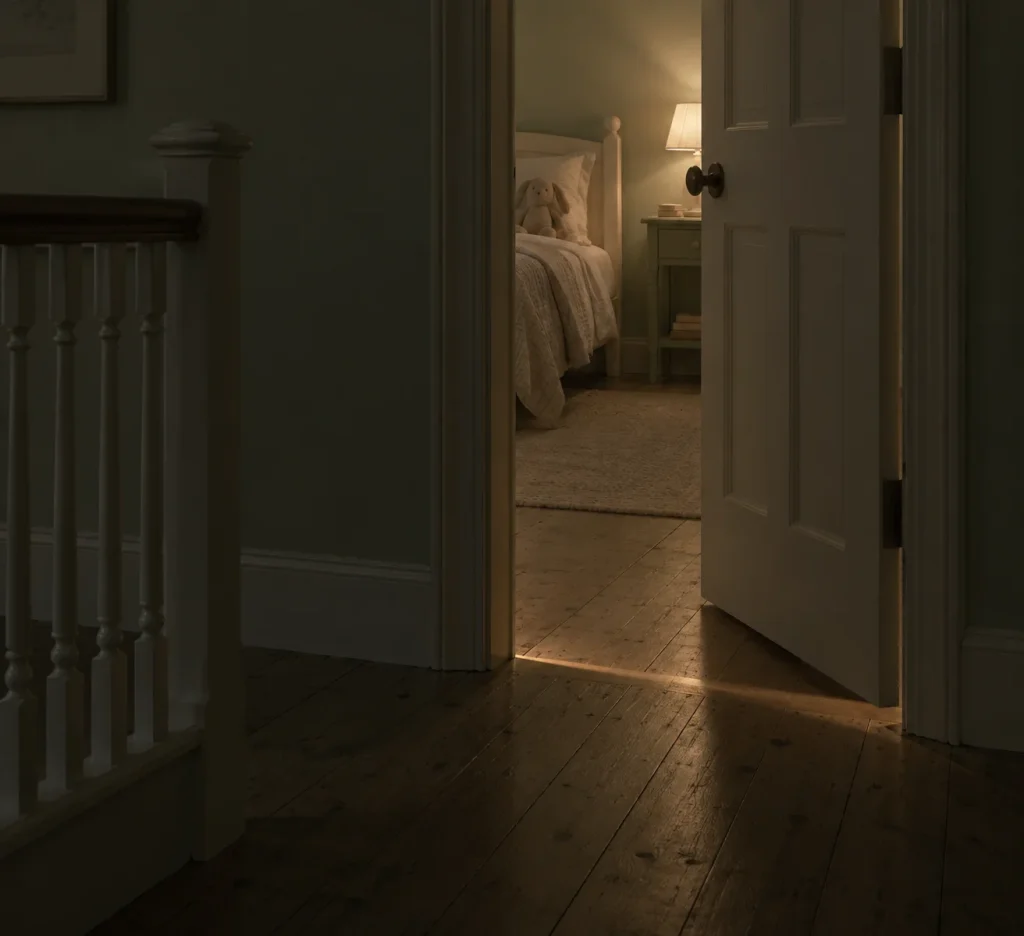
It is 7:40 on a Tuesday. You have been home eleven minutes.
Something small happened. A cup on the wrong surface. A shoe you asked for twice.
Your voice went up. Higher than you have ever heard it.
You watched your child’s face change, and you kept going for another four seconds anyway.
Now the tap is running and you are not washing anything.
You are already searching. Not for parenting tips. For an answer to one specific question, and you want the honest version of it.
Almost every page written about this was written for the parent you meant to be tonight.
This one was written for the parent you were.
Parental shouting is the last event in a sequence, not the first. This section covers the build-up, the moment, the repair, and the evidence on lasting effect.
WHO THIS IS FOR
This is for you if:
You already shouted tonight, and you cannot stop replaying it.
You want to know why it happened. Not to be told it was wrong. You know it was wrong. That is why you are awake.
You want words you can say out loud, not a philosophy you have to adopt first.
You have about four minutes before somebody needs you again.
This is not for you if:
You want a discipline system. This section is about the parent, not about how to make a child behave.
You want somebody to promise you your child is fine. Nobody can promise that. Any page that does is selling you something.
You want to be told it does not matter. It matters.
That is different from saying you have ruined anything, and this section holds both of those at once.
If tonight is more than a hard night
If things at home feel unsafe for you or for your child right now, this is not the page you need.
In the United States, call or text 988 for the Suicide and Crisis Lifeline. For concerns about a child’s safety, call 1-800-422-4453, the Childhelp National Child Abuse Hotline.
Both are free. Both are open all night.
Please go there first. This page will still be here.
What happens in the seconds before a parent shouts
The shout is the last event in a sequence, not the first.
Before it there is a build, usually somewhere between forty and ninety seconds long, and almost all of it happens below the level you can watch.
By the time you hear your own voice, the decision was already made.
You have probably noticed this without having language for it. The moment does not feel like a choice. It feels like something that arrives.
That is worth sitting with, because it changes what you are trying to fix.
If shouting were a decision, then willpower would work, and by now yours would have. It has not, and that is not evidence about your character.
What is actually happening in those seconds has a name and a shape.
It involves your body making a threat judgement faster than your reasoning can catch up, and it involves how depleted you were when the judgement was made.
We have written that sequence out in full, second by second, in its own piece.
Why it is almost never about the thing that happened
You did not shout about the cup.
You know this. It is part of why the guilt lands so hard. If the cup had been worth it, you could at least defend yourself.
Here is the more useful way to look at it.
The cup was not the cause. The cup was the last thing on top of a load you were already carrying, and loads are invisible in a way that cups are not.
Ask yourself what was actually on you at 7:40. Not what happened. What was on you.
An unfinished thing at work. A message you have not answered. A conversation with your own parent from Sunday.
Nine hours of holding a voice steady for people who are paying you to hold it steady.
None of that is visible in the kitchen. So when your voice goes up over a cup, everybody in the room, including you, reads the cup as the reason.
This matters for a practical reason, not a philosophical one.
If you believe the cup caused it, the only fix available to you is to care less about cups. That will not work, and it will not last.
If you can see the load, you get a second place to intervene.
You cannot always control what lands on you during the day. You can sometimes control what you are still carrying when you walk through the door.
That is the next section.
Why the time of day matters more than the child
Ask a parent when they shout and they will usually name a behaviour. Ask them what time it happened and something more useful appears.
It is 5:40. It is 7:40. It is eleven minutes after you walked in.
The pattern is not about your child. It is about a transition, and there is research on transitions that almost nobody in parenting has picked up.
Sophie Leroy, then at the University of Minnesota, published a study in 2009 in Organizational Behavior and Human Decision Processes on what she named attention residue.
She found that when people switch from one task to another, part of their attention stays behind on the first task. Performance on the second task drops.
The effect was worse when the first task was left unfinished, and worse again under time pressure.
Leroy studied office work. She was not studying parents, and she did not claim to be.
Applying her finding to a doorway at 6pm is an inference, and you should hold it as one.
But the shape fits what parents describe so exactly that it is worth naming.
Your workday almost never finishes. It stops.
You carry the unfinished part through the door, and then a five-year-old asks you a question, and you answer it with a fraction of the attention you think you are giving.
Which is how you arrive at 7:40 with less left than you thought you had.
The intervention is small and it happens before you go inside.
Why the child you love most gets the loudest version of you
This is the part parents rarely say out loud, so let us say it here.
You do not do this at work. You have sat through meetings with people who were wrong, rude and slow, and you kept your voice level for an hour.
Then you came home and lost it over a shoe.
That contrast is not evidence that you love your child less than you love your colleagues. It runs the other way, and it is worth understanding why.
You perform for people who might leave. You do not perform for people who cannot.
Your child is the one relationship in your life you experience as unconditional.
So it is the one place where the mask comes off, because at some level you have decided it is safe to take off.
That is a compliment your child did not ask for and cannot use.
There is a harder layer under it too.
Your child is the only person whose reaction you cannot walk away from, whose needs do not pause when you are empty, and whose behaviour you feel personally responsible for in front of everybody.
Powerlessness and responsibility in the same room is a very specific pressure.
None of this makes it acceptable. It makes it explicable, which is different, and more useful at eleven o’clock at night than being told again that it is not okay.
What a child actually hears when a parent’s voice rises
Not the words. That is the first thing to understand.
A raised voice arrives as volume and tone before it arrives as content.
In a young child, the part of the brain that reads tone is far ahead of the part that processes the sentence.
So the sentence you meant to deliver, the one about the cup, mostly does not land. The alarm lands.
This is why shouting so often fails on its own terms. You were trying to make a point. What was transmitted was that something is wrong and it is loud.
Then there is the second thing, and it is the one that undoes parents completely.
Children frequently conclude that the shouting was their fault.
Not “my parent got angry.” Something closer to “I am the reason my parent is like this.”
One mother writing publicly about this described asking her son whether he ever felt scared of her, and hearing him say that when she got scary, it was usually their fault.
She had spent the whole conversation trying to take responsibility. He handed it back.
Children do this because they are the centre of their own explanations.
Someone they depend on became frightening, and the least frightening available explanation is that they caused it, because a cause they control is safer than a parent who is unpredictable.
Which means repair is not a courtesy. It is the correction to a conclusion your child has already drawn without telling you.
Why the guilt arrives after the anger, and not during
The timing is the strangest part. During the shouting you felt certain. Ten minutes later you feel sick.
Nothing new happened in those ten minutes. Your child did not do anything else.
What changed is that the part of you that weighs consequences came back online, and it came back into a room where the shouting had already finished.
Almost every article about parental guilt tells you to release it.
Before you do, it is worth knowing what kind of feeling it is, because two very different feelings get called guilt.
The psychologist June Tangney and colleagues have drawn this distinction for years.
Guilt points at the behaviour. Shame points at the self.
Guilt says: what I did was wrong. Shame says: I am the kind of person who does that.
They lead to opposite places.
Guilt tends to push toward repair, apology and change, because the behaviour is a thing that can be addressed.
Shame tends to push toward hiding, defensiveness and withdrawal, because the self cannot be fixed tonight.
So the feeling in your chest right now is not automatically your enemy.
If it points at what you did, it is the machinery that gets you back into your child’s room.
If it has slid into a verdict about who you are, it will keep you standing at the sink instead.
The difference is a sentence. What I did was wrong, or I am wrong.
Does shouting at a child cause lasting harm
This is the question you actually came for, and you have already found two internet answers that contradict each other.
One set of pages says your child will not remember and you should relax. Another says raised voices change brain structure.
Both cite research. Neither tells you which one describes your Tuesday.
Here is the honest version.
On memory. Patricia Bauer and Marina Larkina at Emory University published a study in the journal Memory in 2014.
They recorded children describing events at age three, then went back at ages five, six, seven, eight and nine.
Children aged five to seven recalled over sixty per cent of those events. Children aged eight and nine recalled under forty per cent, but what they did recall had far more adult-like detail.
The forgetting of early childhood begins around age seven.
On lasting effect. Ming-Te Wang and Sarah Kenny published a longitudinal study in Child Development in 2014, following around 976 two-parent families.
Harsh verbal discipline by mothers and fathers at age thirteen predicted more conduct problems and more depressive symptoms over the following year.
Parental warmth did not cancel the effect. The relationship also ran both ways.
On brain structure. Akemi Tomoda, Martin Teicher and colleagues published imaging work in NeuroImage in 2011, comparing twenty-one young adults with histories of parental verbal abuse against nineteen controls.
They found differences in grey matter volume in the auditory region of the left superior temporal gyrus.
Now the part almost nobody prints.
The Tomoda sample was defined by a scale measuring swearing at, insulting, threatening and humiliating a child, repeatedly, over years.
That is not the same event as raising your voice about a cup, and the study cannot be read as though it were. It is also forty people.
The distinction that matters is not volume. It is whether this was an incident or a climate.
What repair actually is, and what it is not
Repair is not the apology you are rehearsing. The one you are rehearsing is too long.
Watch what happens in a long apology. You explain that you were tired. You explain about work.
You say you love them so much, and you ask whether they know that.
Somewhere in the middle it stops being an apology and becomes a request.
Your child is now managing your feelings. That is the exact reversal repair is supposed to correct.
A repair does three things and then stops.
It names what you did, with no but attached. The moment a but enters, the apology is gone and what remains is a complaint with an apology on the front.
It confirms your child’s reading of the moment. They felt something. Telling them they were right to feel it is what stops the conclusion from setting.
It states what is yours. Your feelings were yours to handle.
That is not self-punishment. It is information a child needs, because the alternative explanation they have already reached is that they caused you.
It asks for nothing. No forgiveness, no hug, no reassurance that you are still a good parent.
You may not get any of those tonight.
That is not a failed repair. A repair is something you give, and a child gets to take their own time picking it up.
Why apologising too soon can make it worse
There is a version of repair that goes wrong, and it goes wrong because of timing rather than wording.
You know it is bad. You want it fixed immediately.
So you go back in four minutes later, and you say the right sentences with the wrong voice still in them.
Children read tone before content. You have already seen that above.
So what arrives is not the apology. It is a parent who is still activated, standing in the doorway, saying words that do not match.
Then your child gives you a flat answer, or shrugs, or says nothing.
And you read that as rejection, which lands on a nervous system that is already raw, and the whole thing can go up a second time.
The test is not whether you feel calm. It is narrower than that.
Can you say what you did without defending it? If a because is still trying to get into the sentence, you are not ready.
Waiting is allowed. Ten minutes is fine. After bedtime is fine.
The next morning is fine, and the next morning is often better, because both of you have slept.
Late repair works. There is no window that closes at midnight.
The thing that does damage is not delay. It is silence, where nothing is ever said and your child is left to decide alone what it meant.
The difference between a boundary and a threat
Most of what gets shouted in a kitchen is a threat, and most parents have never been shown the difference.
A threat is written in the moment, at volume, and is usually enormous.
No screens for a month. We are cancelling Saturday. I will turn this car around.
You did not decide any of that. It arrived because you were out of options and needed the sentence to be big enough to work.
Then one of two things happens, and both cost you.
You do not follow through, and your child learns that the size of your voice does not predict anything.
Or you do follow through, and you spend a month enforcing a punishment you never actually chose, resenting it more each day.
A boundary is different in one way that matters. It was decided before the moment.
It is small enough to hold, specific enough to be clear, and you can carry it out without needing to be angry.
Screens go off at seven. That is it.
It does not need volume, because it does not depend on volume. It was true at four o’clock.
The practical value is not that boundaries are gentler. Some are stricter.
It is that a boundary can be delivered by a tired parent at 7:40, and a threat requires you to be furious to be credible.
When shouting is a pattern and not an incident
This is the section you have been reading toward, and we are not going to soften it.
A hard night and a pattern are not the same thing, and the whole meaning of everything above depends on which one you are in.
Most pages avoid drawing the line, because drawing it risks upsetting a reader.
Not drawing it leaves you doing the assessment alone at midnight with worse information.
So here it is, in three parts.
Content. What is said matters more than how loudly it is said. Volume passes.
Being called stupid, worthless, or the reason this family is like this does not.
Name-calling, insults, threats aimed at a child’s sense of safety, and anything about who they are rather than what they did are a different category.
That category is the one the research on verbal abuse is actually about.
Frequency. Once in a hard fortnight is a hard fortnight.
Most evenings is the tone of a household, and a household tone is something a child adapts to.
Direction. Ask whether it is getting louder over time, and whether it takes less to start it now than it did a year ago.
An incident is a spike. A pattern has a slope.
If you read those three and something in you went quiet, that is worth taking seriously.
It is not a verdict. It is a reason to talk to somebody who can see your actual situation, which no website can.
When this needs more than a website
There is a limit to what any article can do, and this is it.
Everything above is education. None of it is diagnosis, treatment, or a plan built for your household.
That takes a person who can ask you questions and hear your answers.
Talk to someone if any of these are true.
You cannot stop once you have started, and you have tried.
It has become physical, or you can feel that it is getting closer to physical.
Your child has changed around you. Quieter, more careful, watching your face when you come in.
You are frightened of yourself in those moments.
You grew up in a house like this and can feel yourself standing in your own parent’s shoes.
Where to start. Your family doctor is a reasonable first call and will not report you for asking.
A therapist who works with parents is the more direct route.
In the United States, right now. Call or text 988 for the Suicide and Crisis Lifeline. Call 1-800-422-4453 for the Childhelp National Child Abuse Hotline.
Both are free and both are staffed overnight.
Asking is not an admission. It is the thing a parent does.
A hard night
| What gets said | Volume rises, about a thing that happened |
| How often | Rarely, and it stands out to you because it is rare |
| Direction over time | Roughly the same as a year ago |
| Can you stop | You catch yourself and pull out of it |
| Afterwards | You repair, usually the same day |
| Your child around you | Same as ever within the hour |
| How you feel reading this | Uncomfortable and recognised |
A pattern
| Words about who your child is. Names, insults, comparisons |
| Most weeks. You have stopped counting |
| Louder, or starting faster than it used to |
| It runs to the end on its own |
| Nothing is said. Everyone moves on |
| Careful. Watching your face when you come in |
| Something went quiet |
Most parents reading this page are in the left column on a bad week.
If you are reading the right column and recognising your house, that is not a verdict on you.
It is information, and it points at a conversation with a real person rather than another article.
THE TRADEOFF
Here is what this page cannot do for you.
It cannot tell you that your child is fine.
Nobody can tell you that, not from the outside, not from research, not from forty scans of forty young adults.
Any page that promises it is selling something, and you would not believe it anyway.
What it can do is narrower and more useful. It can tell you what the evidence actually separates.
Incident from climate. Volume from content. One bad Tuesday from the tone of a house.
That is a smaller answer than you wanted at 11pm. It is also the only one that will still be true in the morning.
The parent who wants certainty will leave here unsatisfied. The parent who wants to know where they stand will not.
CLOSE
You are not going to fix this tonight.
You are going to go back into that room, say one short sentence, and get it slightly wrong.
Then you will do it again next week, a little better.
That is the whole method. There is no version where you become a parent who never raises their voice.
There is a version where the gap between the shout and the repair gets shorter, until one day it closes almost as it opens.
Your child will not remember the sequence. They will remember that you came back.
You already thought the worst of yourself tonight, alone, in the dark, for free. You did not need a website for that part.
One page a week. Nothing else.
The next piece in this series, sent when it goes live. No course, no funnel, no daily email.
Unsubscribe in one click. We do not share your address.
FAQ
Is it normal to yell at your child? It is extremely common. Surveys consistently find that the large majority of parents have raised their voice at a child in the past year. Common is not the same as harmless, and it is not the same as harmful either. What matters is what was said, how often, and what happened afterwards.
Will my child remember me yelling at them? Bauer and Larkina found in 2014 that the forgetting of early childhood events begins around age seven. A single incident before then is unlikely to be recalled as an episode. That is a different question from whether a repeated household tone shapes a child, which it can.
How soon should I apologise after yelling? When you can name what you did without defending it. That may be ten minutes or the next morning. Repairing while still activated often fails, because children read tone before words. There is no deadline that closes overnight. Silence does more harm than delay.
Does yelling damage a child’s brain? Research on parental verbal abuse, including Tomoda and colleagues in 2011, has found structural differences in adults with those histories. Those studies measure sustained insulting, swearing and humiliating over years, in small samples. They are not measurements of a raised voice on a hard evening.
How do I know if I have a real problem? Look at content, frequency and direction. Words about who your child is rather than what they did. Most weeks rather than rarely. Getting louder or starting faster than a year ago. If those describe your house, speak to your doctor or a therapist rather than another article.
REFERENCES
Bauer, P. J. and Larkina, M. (2014). The onset of childhood amnesia in childhood: a prospective investigation of the course and determinants of forgetting of early-life events. Memory.
Choi, J., Jeong, B., Rohan, M. L., Polcari, A. M. and Teicher, M. H. (2009). Preliminary evidence for white matter tract abnormalities in young adults exposed to parental verbal abuse. Biological Psychiatry, 65, 227–234.
Leroy, S. (2009). Why is it so hard to do my work? The challenge of attention residue when switching between work tasks. Organizational Behavior and Human Decision Processes, 109(2), 168–181.
Tangney, J. P., Stuewig, J. and Mashek, D. J. (2007). Moral emotions and moral behavior. Annual Review of Psychology. VERIFY BEFORE PUBLISH.
Tomoda, A., Sheu, Y.-S., Rabi, K., Suzuki, H., Navalta, C. P., Polcari, A. and Teicher, M. H. (2011). Exposure to parental verbal abuse is associated with increased gray matter volume in superior temporal gyrus. NeuroImage, 54(Suppl 1), S280–S286.
Wang, M.-T. and Kenny, S. (2014). Longitudinal links between fathers’ and mothers’ harsh verbal discipline and adolescents’ conduct problems and depressive symptoms. Child Development, 85, 908–923.
AUTHOR BOX
Written by Muhammad Zubair Sarwar. Engineer, twenty-two years at a national power utility in Lahore. Father.
Completed Yale University’s Introduction to Psychology and the University of Sydney’s Positive Psychiatry and Mental Health, both online non-credit courses through Coursera, 2025.
Not a licensed clinician, and nothing on this site is diagnosis or treatment.
See our editorial standards and medical disclaimer.