
Why the meltdown fires the moment the screen goes dark, and what to do in the minute after, when every part of you wants to hand it back.
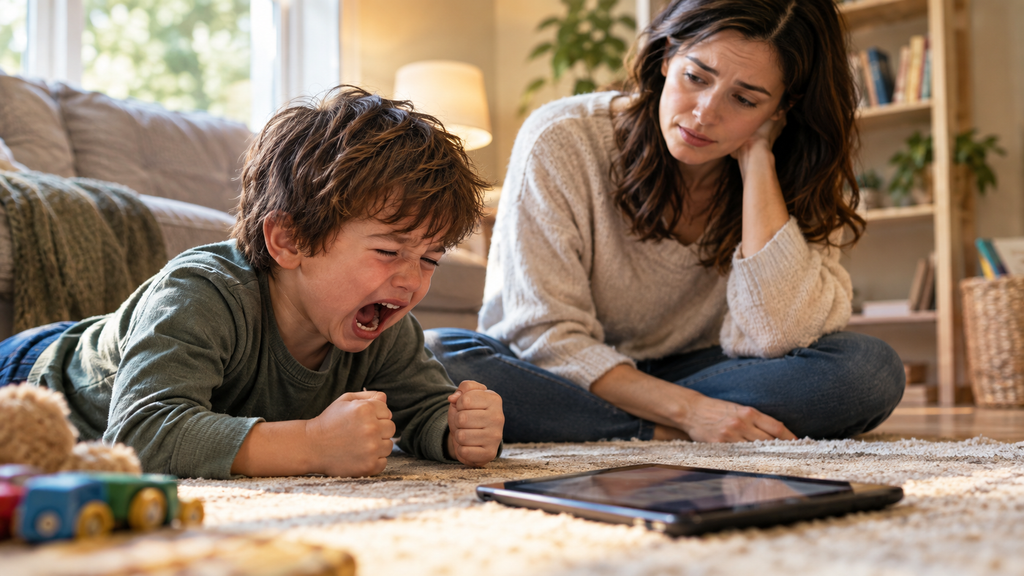
It is 6:40. The pasta water is boiling over, and you have already said “two more minutes” twice.
You reach for the tablet. He grips the edge with both hands.
Then the scream. The one that makes the neighbor’s dog start barking.
You hold one corner, and he holds the other. For one long second you think about letting go, just to make the noise stop.
Later, standing at the sink, you will wonder why the ending is always the worst part.
You have already tried the timer. This is about what happens after it rings.
What is a screen time tantrum?
A screen time tantrum is the crash that comes when something holding all of your child’s attention stops at once. It is common, and it does not happen every night. In a 2016 University of Washington study of families with children aged one to five, most screen endings went calmly.
What you do in the first minute after shapes how tomorrow’s ending goes.
Why does my child have a tantrum when screen time ends?
When the fun stops, the brain’s reward signal drops fast. The American Academy of Pediatrics (AAP, 2024) explains that this drop can leave anyone grouchy, and young children have not yet learned to manage the feeling.
Sometimes the screen was also holding off boredom or upset. When it goes dark, those feelings come back all at once.
Watch his hands the next time it happens. His fingers go white on the edge of the case before a single sound comes out.
That grip is the whole story. For twenty minutes, every part of his attention was pointed at one bright rectangle. Then the rectangle went black, and his body had nowhere to put all that attention.
I have worked inside a power utility for twenty-two years, and we have a name for this. It is called load rejection.
A generator runs hard to feed a big load. If that load drops off all at once, the machine does not settle quietly. The power that was feeding the load has nowhere to go. The generator speeds up, and the voltage jumps. Protection gear has a fraction of a second to catch it.
Your son was running at full output for that show. You cut the load. The scream is the surge.
There is a second reason, and it is about control. In 2016, researcher Alexis Hiniker and her team at the University of Washington studied how families ended screen time with children aged one to five. They found that children were often more upset when they were warned the end was coming. Hiniker’s view was that a warning reminds a child that he is not the one in charge.
One parent described the moment the TV goes off as “like the world’s ending.” To a small child, in that moment, it is.
That explains his scream. It does not explain why your own face goes hot.
Why do I lose my temper when the tablet comes off?
You lose your temper at the off-switch because it almost always lands at the end of your own long day. Stress builds up over hours, the way heat builds in a cable. A scream at 6:40 hits a system that has been running hot since morning, so it trips at a lower point than it would at ten in the morning.
Your shoulders are up near your ears. You only notice when they finally drop, an hour later, in the bathroom.
On the grid, many circuits are guarded by a thermal overload relay. It does not trip on one big spike alone. It trips on heat that has built up. A cable that has carried a heavy load all afternoon will trip at a smaller extra load than a cool one.
Nobody calls that relay weak. It is doing what it was built to do.
You spent the day carrying a load. Work, the drive, the lunch you forgot to eat, the pot on the stove. By the time the tablet comes off, there is very little room left before you trip.
You are far from the only one. In a 2024 advisory, the US Surgeon General reported that 48% of parents say their stress is completely overwhelming on most days. One mother, writing about the nightly fight over a game console, said she was “beyond exhausted after a long day” before it even started.
So when your voice comes out louder than you meant, that is a hot relay tripping on a small fault. It tells you about the load you were carrying. It says very little about who you are.
Raising your voice was a thing that happened at 6:40. You can do something different at 6:41.
Which brings up the question you have probably asked yourself at the sink. Did you make him like this?

Did I cause this by handing him the tablet?
Probably not in the way you fear. Research finds that screens and big feelings feed each other in both directions. Children who melt down more often get handed screens more often, and screens used to calm can make later meltdowns bigger. A loop that runs both ways can be turned at either end, including at tonight’s off-switch.
Here is what the research actually found.
- Calming with devices (Radesky, University of Michigan, 2022). Jenny Radesky’s team followed 422 parents of children aged three to five. Children who were often calmed with a phone or tablet showed more emotional reactivity months later, especially boys. More reactive children were also handed devices more often.
- Tablet use and anger (Fitzpatrick, Université de Sherbrooke, 2024). Caroline Fitzpatrick’s team followed 315 preschoolers in Nova Scotia from 2020 to 2022. About an extra hour a day of tablet use at age 3.5 was linked to 22% more anger and frustration a year later. Children who were angrier at 4.5 then used tablets about 17 more minutes a day at 5.5.
Both studies relied on what parents reported, and the Nova Scotia study ran during the pandemic. What they show is a loop, with no proof that your tablet made your child angry.
If you hand over the screen to buy quiet, you have plenty of company. A 2025 Pew Research Center survey found that 65% of parents whose child under five uses a smartphone say calming the child is one reason they allow it. Most parents call that survival mode, and they mean it.
Radesky put her finger on why it is so hard to stop. The relief for the parent is immediate. The scream stops right now, and the cost arrives weeks later, where nobody can see it.
Now the part that should loosen your chest a little.
In Hiniker’s 2016 diary study, parents logged every screen ending for two weeks. Children were fine with the ending about 59% of the time and happy about it about 19% of the time. Only about 22% of endings brought tears or anger.
The meltdown is not every night. It only feels that way because the bad endings are the ones you remember.
So the question gets practical. What do you do before the screen goes off?
How do I end screen time without a meltdown?
End screen time with as little of you in the moment of loss as possible. Let a show’s ending or the device itself say stop. Then find out whether your child does better with a warning or without one, because the research and the expert advice disagree on this.
These are the first four of nine strategies. All four happen before the screen goes off.
1. Let the device say no
In Hiniker’s study, endings set by the technology went better than endings set by a parent. A timer in the tablet’s settings works. So does a battery that runs flat. None of them has your face or your tired voice attached.
The AAP (2024) suggests the same thing. Most tablets and consoles have built-in time limits. Tell him the limit before he starts, then let the device remind him.
Parents have found their own versions. One mother of a two-and-a-half-year-old hung a curtain over the TV, and the begging mostly stopped. Another parent with a projector loved that when it is off, it is gone, and “the wall just isn’t on right now.”
2. Choose shows that end
Autoplay is built so there is never a good place to stop. Turn it off. Pick one episode or a saved playlist so the content ends on its own. Common Sense Media recommends recorded shows and “watch later” lists for exactly this reason.
Hiniker’s team found that natural stopping points made transitions easier. The credits do the hard part for you.
3. Make screen time part of the routine.
Children in Hiniker’s study handled endings better when screen time was part of the daily routine. A treat that might vanish feels worth fighting for. A show that happens every day after a bath and ends every day before stories gets less of a fight.
Pick one slot and keep it boring. Same time and same ending, every day.
4. Find out if he is a warning kid.
This is where most advice gets it wrong, because it gives you only one answer.
The AAP (2024) says warnings help some children, especially a timer the child sets himself. Hiniker (2016) found that warnings made many young children more upset. Common Sense Media notes that some children react better with no warning at all, perhaps because they have learned to expect a fight.
Both can be true. Your child is one kind of child, and only you can find out which.
| Signs he may do better WITH a warning | Signs he may do better WITHOUT one |
| He calms down faster when he sets the sand timer himself. | He starts arguing the moment you say “two more minutes.” |
| He handles leaving the park well when you give notice. | He bargains harder after every warning. |
| He can read a clock or watch a timer run down. | He melts down at the warning, then again at the end. |
| The warning gives him time to finish a level or a song. | He is very young and lives inside the current minute. |
Try one way for a week, then the other way for a week. Keep a note on the fridge. The note will tell you more than any article, including this one.
None of this works every single time. So here is what to do when it blows anyway.
What do I do when the tantrum has already started?
Once the tantrum has started, steady yourself first, then say as little as possible, and keep the screen off. The AAP (2024) warns that a child in a meltdown cannot think logically, so this is no time for rules or reasons. Short words and a tablet out of sight do most of the work.
These are strategies five to seven. All three happen inside the storm.
5. Notice your own body first
Before you say anything, check your jaw. Then your hands. Put the tablet face down on the counter so neither of you can see the glow.
When a breaker trips on a fault, the first job on the grid is to find out why before closing it again. Closing it straight back onto the fault is how equipment gets damaged. Your first job is the same. One slow breath before you answer him.
The AAP (2024) puts it plainly. When children have tantrums, parents need to avoid having one too.
6. Use the fewest words you can.
Every extra word is something for him to argue with. A lecture about fairness lands on a brain that cannot take it in right now.
One short line, said once, in a flat and tired voice. Then quiet. The script box below gives you the exact words.
7. Do not hand it back, and know why that is so hard.
This is the hardest one, and it is honest to say so.
Giving the tablet back would stop the noise in two seconds. Radesky’s work shows that relief is real, which is exactly why it pulls so hard. Clinical psychologist Gabrielle Izralson, speaking for the nonprofit Children and Screens in 2026, warned that extending screen time to end a tantrum teaches a child that screaming works.
One mother wrote that she couldn’t “let him win” or she would be “back to square one.” She was right about square one. The win part is the trap. Nobody wins at 6:40. You are holding a door shut while he learns that the door stays shut.
The night you hold it, it may get louder. That is the door being tested.
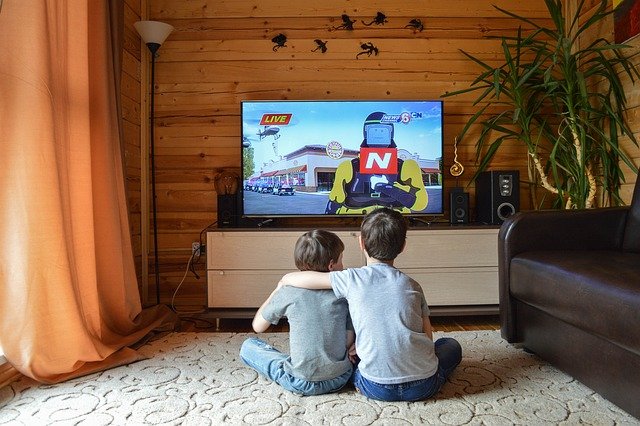
When the screen goes off and he falls apart
- First line, said once: “I know you wanted more. The tablet is done for today.”
- If he keeps screaming: Stop talking. Sit down near him, lower than his eyes if you can. Say one thing only: “I’m right here.”
- If he grabs for it: Put the tablet up high or in a drawer. “I’m putting it away so you don’t have to fight it.”
- If he hits or kicks: Step back or gently hold his wrists. “I won’t let you hit me. I’m staying close.”
- If none of it works tonight: That is normal. Wait it out with your mouth closed. A storm with nothing feeding it ends sooner.
You will probably get some of these words wrong. Say them anyway. He is listening to your voice far more than to the words.
What should I do after a screen time meltdown?
After a screen time meltdown, give your child a bridge back into the real room, then repair once you are both calm. The AAP (2024) suggests offering something he likes almost as much as the screen. Repair later takes one sentence and no lecture.
These are the last two strategies.
8. Build a bridge to the next thing.
A screen pulls a child into another world. Coming back out is a trip, and he needs something to land on.
The AAP calls this trading up. You offer a thing he likes almost as much: the bath with the blue cup, or five minutes with the dog. The French psychologist Isabelle Filliozat suggests going one step further. Before the show ends, sit down beside him and ask about it. When he starts telling you about the character, he is already halfway back.
Put the tablet face down in a drawer while you do this. Out of sight helps more than any speech about it.
If the meltdown happened anyway, the bridge still works. It just starts ten minutes later, on the kitchen floor.
9. Repair, once, later
Wait until he is in pajamas or nearly asleep. Then one short sentence.
“That was a hard ending, and I got loud too. Tomorrow the show ends after one episode.”
Leave out the part about getting loud if you didn’t. He does not need a speech. He needs to hear that the adult who held the door shut is the same adult tucking him in.
Repair also does something for you. It closes the night. Without it, you carry 6:40 to bed with you, and it is still there when you check on him at ten.
Where I have stood
It was 7:15 on a Tuesday. My son was on the tablet, watching a cartoon series. I said, “Dear, please stop watching; it is too late.” His face fell. Then I went deep into my own thoughts.
What will this cost me?
Holding the line usually gets louder before it gets quieter. Common Sense Media notes that when handing over the phone has become a habit, it takes time to curb the outbursts. The first week may be harder than the week before you started.
There is a second cost. When you let the device say no, the rule lives inside the tablet for a while instead of in your voice. That buys you calmer nights now. One day, when he is older and the settings come off, you will have to own the rule yourself.
And the warning test means some bad endings on purpose, so you can learn which kind of child you have.
Those are real costs. A nightly negotiation costs more.
When should I worry about screen time tantrums?
Most screen time tantrums are an ordinary part of learning to handle disappointment. The AAP (2024) says that trouble switching away from a screen does not, by itself, mean a child is hooked. It suggests talking with your child’s pediatrician if you notice any of these:
- Meltdowns nearly every time he is asked to stop, however carefully you handle it
- Changes in his sleep, eating, hygiene, or friendships that seem tied to screen use
- He cannot get through a short car ride or a few minutes of waiting without demanding a device
- He pulls further into the screen and away from family and friends
This post is for understanding and everyday ideas. It cannot tell you what is going on with your own child. Your pediatrician can.
Tonight
Tonight the tablet may come off at 6:40 again. He may still scream.
This time you might turn it face down before you speak. You might say one sentence instead of ten, then sit on the kitchen floor while the noise runs out.
Somewhere after eight, the house goes quiet in the ordinary way. The pot is washed. His shoes are by the door where he kicked them off.
The tablet is in the drawer, and he is asleep.
Sources
- AAP, Jenny Radesky, MD, Screen Time and Temper Tantrums, updated March 13, 2024 (opened)
- Pew Research Center, How Parents Manage Screen Time for Kids, October 8, 2025 (opened)
- Hiniker et al., CHI 2016, via UW News and Mental Floss (open in Pass 1)
- Radesky et al., JAMA Pediatrics 2022, via Michigan Medicine (open in Pass 1)
- Fitzpatrick et al., JAMA Pediatrics 2024, abstract and HealthDay (open in Pass 1)
- US Surgeon General parent stress advisory, August 2024, via Fox News (swap for HHS)
- Common Sense Media on ending screen time, 2020
- Children and Screens, Gabrielle Izralson, PsyD, April 22, 2026
- Motherly on Isabelle Filliozat’s approach
One Response