
You don’t have to choose between kind and in charge.
By Muhammad Zubair Sarwar · Founder of FamilyBloomHub · Updated November 7, 2026 · 19 min read

The short answer
Gentle parenting and authoritative parenting share the same core: warmth plus clear limits. Psychologist Diana Baumrind’s research, starting in 1966, linked that mix to better outcomes for kids. The difference shows up at home. Gentle parenting can slide into endless negotiating. A hybrid approach keeps the empathy and adds calm follow-through. You name the feeling. You keep the limit.
Key takeaways
- Same roots. Gentle and authoritative parenting both join warmth with limits.
- Strongest evidence. Authoritative parenting has the most research behind it. A 2017 review of 1,435 studies linked it to fewer behavior problems.
- Why you’re tired. Gentle parenting burnout usually comes from limits that move, not from too much love.
- The hybrid rule. The feeling is welcome. The limit stays.
- Tonight’s move. Say the limit once. Then act. Repair if you yell.
Free tool · Parenting · Wellness · Mental health
The Say It Once Script Builder
Pick the hard moment. Get the exact words. Hold the limit, kindly, without the guilt.
Gentle vs authoritative vs hybrid, at a glance
| Gentle parenting (as often practiced) | Authoritative parenting (as researched) | Hybrid parenting | |
| Core idea | Connection first | Warmth plus structure | Empathy plus follow-through |
| Feelings | Always welcome | Welcome | Always welcome |
| Limits | Often open to debate | Clear and consistent | Clear and few |
| Explaining | Long and repeated | A reason is given | One short reason, once |
| When a child pushes | More talking | Calm consequence | Calm action, fewer words |
| When it slips | Into permissive | Into rigid | Repair, then reset |
| Research base | Very little on the label | Decades | Built from the authoritative research |
| Cost to the parent | High | Medium | Lower |
Jump to:
- Scripts by age, word for word
- How to hold boundaries calmly
- What to say after you yell
- The free printable card
- Questions parents ask
You did everything right. So why are you so tired?
You said the script. Word for word.
“I see you’re upset. It’s time to go.”
Your child kicked the sand and said no.
So you said it again. Softer this time.
Then you offered five more minutes. Then two.
Then you carried a screaming kid to the car anyway. And you cried at the red light.
You were not too harsh. You were not too soft.
You were stuck in the middle with no map.
Here is the map.
From my own house
It was 9:50. I had been home for ten minutes.
My son held up the blue book with the torn corner.
“One more, Dad.”
I read it. He held it up again. I read it again.
The third time, I had my hand on the lamp switch.
“Because I said so,” I said.
I heard my father’s voice come out of my mouth. Same words. Same flat tone.
My son pulled the blanket over his head.
I stood there with my thumb on the switch. I did not press it.
The book slid off the bed. I left it on the floor.
That night I failed twice.
First I gave in. Then I snapped.
That swing is the real problem. Not gentle versus strict. The swing between them.
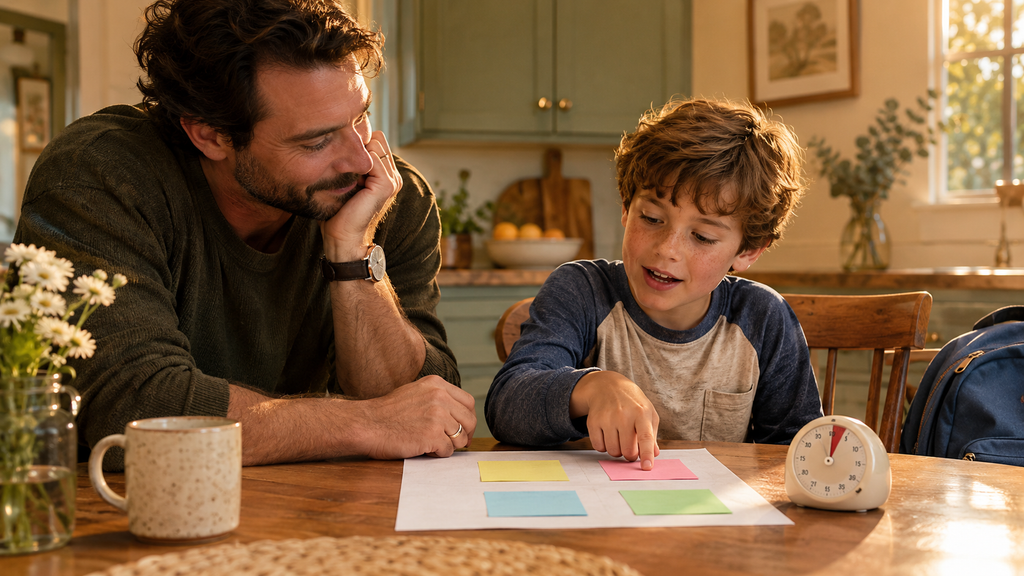
Is gentle parenting the same as authoritative parenting?
The answer: At the core, yes. Both join warmth with limits. Psychologists call that mix authoritative parenting, and it has the strongest research behind it. Gentle parenting is a newer, popular name for the same idea. The trouble starts when the limits get soft, and the warmth turns into bargaining.
What is authoritative parenting?
Authoritative parenting is a style that pairs high warmth with clear, consistent limits.
Psychologist Diana Baumrind named it in a 1966 paper in Child Development. She studied how preschool families raised their kids.
What is gentle parenting?
Gentle parenting is an approach built on empathy, respect, understanding and boundaries.
British author Sarah Ockwell-Smith made the term popular in The Gentle Parenting Book in 2016. Social media spread it from there.
Read those four words again. The last one is boundaries.
Gentle parenting was never meant to mean no limits.
The two dials behind every style
In 1983, researchers Eleanor Maccoby and John Martin turned Baumrind’s work into two dials.
- Warmth: how loved, heard and safe your child feels with you.
- Structure: how clear your limits are, and whether you follow through.
Turn both up, and you get authoritative parenting.
Table 1. The four parenting styles
| Style | Warmth | Limits | What it sounds like | What research links it to |
| Authoritative | High | Clear and kept | “You’re mad. We’re still leaving.” | Fewer behavior problems (Pinquart, 2017) |
| Permissive | High | Soft or missing | “Okay, five more minutes. Please don’t cry.” | More behavior problems (Pinquart, 2017) |
| Authoritarian | Low | Harsh and rigid | “Because I said so.” | More behavior problems (Pinquart, 2017) |
| Uninvolved | Low | Missing | Silence, or no one there | More behavior problems (Pinquart, 2017) |
What the biggest review found
In 2017, psychologist Martin Pinquart combined 1,435 studies in Developmental Psychology.
Kids with authoritative parents showed fewer behavior problems, like hitting and defiance.
Harsh control and guilt-based control showed the strongest links to more problems.
One honest note. The links were small. Your parenting is one force in your child’s life. Temperament, sleep, school and friends matter too.
Does it hold across cultures?
In 2018, Pinquart and Rubina Kauser looked at 428 studies from around the world.
Authoritative parenting was linked to at least one good outcome in every region. Authoritarian parenting was linked to at least one poor outcome in every region. The size of those links varied by culture.
So this isn’t only an American idea. But your family’s culture shapes how it looks at home.
By the numbers
| Figure | What it means | Source |
| 1,435 studies | Authoritative parenting linked to fewer behavior problems | Pinquart, Developmental Psychology, 2017 |
| 428 studies | Authoritative parenting linked to good outcomes in every world region | Pinquart and Kauser, 2018 |
| Over one third | Gentle parents showing uncertainty and burnout | Pezalla and Davidson, PLOS ONE, 2024 |
| 48% vs 26% | Parents vs other adults who say most days their stress is overwhelming | US Surgeon General, 2024 |
| 62% | Parents who say parenting is harder than they expected | Pew Research Center, 2023 |
| 37% | Parents of young kids who call themselves cycle-breakers | Talker Research for Kiddie Academy, 2025 |
| Average of 3 | Parenting styles a parent blends | Talker Research for Kiddie Academy, 2025 |
| Almost half | Parents who have disagreed with a grandparent about parenting | C.S. Mott Children’s Hospital Poll, 2020 |
Gentle parenting burnt out? Here’s why it feels so exhausting.
The answer: Because the limits keep moving. When a “no” can turn into a “maybe,” your child keeps testing it. Each round of talking keeps both of your stress systems switched on. You end up calming two nervous systems all day, with nothing left for yourself.
You are not imagining this.
In 2024, researchers Annette Pezalla and Alice Davidson published the first study of gentle parents in PLOS ONE.
They surveyed 100 US parents of kids aged 2 to 7 in 2023. About half called themselves gentle parents.
More than a third of those gentle parents showed signs of uncertainty and burnout.
One parent wrote, “I’m hanging on for dear life.”
The researchers also found that gentle parents valued boundaries but enforced them very differently. Some held them. Some let the child lead.
That gap is where the exhaustion lives.
It’s a small study. Most of the parents were White and college educated. Treat it as a first look, not the final word.
But it matches the bigger picture. In 2024, the US Surgeon General called parent stress an urgent public health issue. 48% of parents said most days their stress is completely overwhelming.
Why the loop drains you
Here’s what’s happening inside your child.
The part of the brain that handles patience and planning is called the prefrontal cortex. The National Institute of Mental Health notes it keeps developing into the mid-twenties.
So your child can’t reason their way out of a meltdown. They borrow calm from your body.
When you keep talking, they keep arguing. Their stress stays high. So does yours.
When the limit stays put, the argument has nowhere to go. Things settle sooner.
Signs you’re stuck in the negotiation loop
- You explain the same rule three or more times.
- “Five more minutes” turns into fifteen.
- You say “okay?” at the end of every limit.
- You feel you need your child’s permission to say no.
- You hold it together all day, then snap at 9 pm.
- You lie awake replaying what you said.
If three or more sound familiar, nothing is wrong with you.
Your method has a leak. We can patch it.
Am I too soft, or am I turning into my parents?
The answer: Probably neither. Firm is not the same as harsh. Authoritarian parenting means rules without warmth. Authoritative parenting means rules with warmth. You can hold a limit and still hold your child. The warmth is what keeps you from becoming your parents.
This is the fear under everything.
You heard “because I said so” a thousand times. You promised you’d never say it.
So every time you get firm, an alarm goes off. Here I go. I’m turning into them.
You’re not alone in this. In 2025, Talker Research surveyed 2,000 parents of kids up to age 6 for Kiddie Academy. 37% called themselves cycle-breakers.
That alarm is a good alarm. It just goes off at the wrong times.
Table 2. Harsh vs firm
| Harsh (what you’re avoiding) | Firm (what you’re aiming for) |
| “Stop crying or I’ll give you something to cry about.” | “You can cry. We’re still going.” |
| “Because I said so.” | “Because bodies need sleep.” |
| Shames the child | Names the behavior |
| Threatens love | Keeps love steady |
| Loud and scary | Low and slow |
| Punishes the feeling | Allows the feeling, stops the action |
| Ends the talk | Comes back to reconnect |
Look at the right column.
Nothing in it would have hurt you as a child.
That’s your test. If the words would have felt safe to the kid you were, you’re on the right side.
What is the hybrid parenting style in 2026?
The answer: Hybrid parenting keeps the empathy of gentle parenting and adds the follow-through of authoritative parenting. The rule is simple. Every feeling is allowed. Not every action is. You name what your child feels, then you keep the limit calmly, without a debate.
Two sentences sum it up.
The feeling is welcome. The limit stays.
One honest note. “Hybrid parenting” is a media term, not a research term. No study tests it by that name.
What it describes is old and well studied. It’s authoritative parenting, with gentle parenting’s focus on feelings kept in.
Where the feelings part comes from
In 1996, John Gottman, Lynn Katz and Carole Hooven published a study in the Journal of Family Psychology.
They studied parents who noticed their child’s feelings, named them, and helped the child through them. They called this emotion coaching.
Kids of emotion-coaching parents did better socially in the years that followed.
So the feelings work you’ve done is real. Keep it.
Table 3. What you keep, what you drop, what you add
| Keep from gentle parenting | Drop | Add from authoritative parenting |
| Naming feelings | Asking “okay?” after every limit | One clear limit |
| Getting down to eye level | Explaining the same reason five times | A short reason, said once |
| No spanking, no shaming | Bargaining at the door | Follow-through with your hands |
| Repair after conflict | Guilt when your child is upset | Letting your child be upset |
| Respect for your child | Believing calm means never saying no | Being the adult in charge |
Is gentle parenting dead in 2026?
The answer: The label is fading. The ideas aren’t. In 2025, Talker Research found 32% of Gen Z parents used gentle parenting, while 41% focused on cycle-breaking. Parents blended an average of three styles. Warmth and emotion coaching stay. Endless negotiating goes.
You’ve seen the headlines. Gentle parenting is over. FAFO is in.
The data tells a quieter story.
Parents aren’t throwing out warmth. They’re adding back structure.
That’s not the death of gentle parenting. It’s gentle parenting growing up.
Authoritative parenting examples by age: positive discipline scripts
The answer: Every hybrid script has three parts. Name the feeling in a few words. State the limit in one sentence. Say what happens next. Keep it under fifteen words when you can. The younger the child, the shorter the script. Older kids get a reason, but only once.
Positive discipline means teaching instead of punishing. Educator Jane Nelsen made the term popular in her 1981 book Positive Discipline.
Here are positive discipline examples for eight hard moments.
Table 4. Hybrid scripts by age
| Moment | Toddler (2 to 4) | School age (5 to 9) | Tween (10 to 12) |
| Leaving the park | “You love the slide. Time to go. Walk or I’ll carry you.” | “You wanted more time. I get it. We’re leaving now.” | “I know it’s annoying. We said 5:30. Grab your bag.” |
| Bedtime | “Two books. All done. Lights off.” | “Book time is over. I’ll check on you in ten minutes.” | “Phone goes on the charger at 9. See you in the morning.” |
| Screens off | “Show’s over. Let’s turn it off together.” | “Timer’s done. Pick a show for tomorrow.” | “Screen time’s over. You can be mad and still put it down.” |
| Hitting a sibling | “I won’t let you hit. You’re mad. Stomp your feet.” | “You’re angry. Hitting is not okay. Sit with me.” | “You’re furious. Hands off. Talk to me when you’re ready.” |
| Store meltdown | “You want it so much. We’re not buying it. I’m here.” | “It’s hard to leave it. The answer is no. Let’s go.” | “I hear you. Not today. Add it to your birthday list.” |
| Getting dressed | “Shirt time. You pick red or blue.” | “Clothes on by the timer. I’ll help with socks.” | “We leave at 7:40. Dressed or not, you’re coming.” |
| Homework | “Let’s sit together for five minutes.” | “Homework first, then play. I’ll sit with you.” | “It’s due tomorrow. Want help or space?” |
| “I hate you” | “You’re so mad at me. I still love you.” | “You’re angry. That’s okay. The answer is still no.” | “You can hate the rule. I’m still keeping it.” |
Try this, word for word: leaving the park
Instead of: “I know you’re sad. Five more minutes? Okay, just five more. Please don’t cry.”
Try: “You’re mad it’s time to go. It’s okay to be mad. We’re still leaving. Walk with me, or I’ll carry you.”
Then walk. Don’t wait for agreement.
Try this, word for word: bedtime
Instead of: “Just one more story? If you promise to sleep after this one?”
Try: “We did our two stories. Your body needs rest. I’m going now. I’ll check on you in ten minutes.”
Then check in ten minutes. Exactly ten. Your words start to mean something.
Try this, word for word: screens off
Instead of: “Can you please turn it off now? Okay? Please?”
Try: “Time’s up. I’m turning it off. You can be upset. I’ll stay right here.”
Look at what’s missing from every “try” line.
No question marks. No “okay?” No promises.
A question gives your child a vote. A limit isn’t a vote.
Free printable: When the script stops working
Keep this on the fridge. Read it before the hard hour.
- Name it. “You’re mad.”
- Limit it. “We’re still going.”
- Say it once.
- Use your hands, not more words.
- Stay close.
- Reconnect later. “That was hard. I love you.”
The feeling is welcome. The limit stays.

How to hold boundaries calmly when your child keeps pushing
The answer: Stop talking and start doing. Say the limit once, then follow through with calm action. Turn off the screen. Pick up the shoes. Carry your child to the car. Stay close while they’re upset. Talk about it later, when everyone is calm. More words feed the fight.
This is where most gentle parenting advice goes quiet.
It tells you what to say the first time. Not the fourth time.
The five-step ladder
- Name the feeling. One sentence. “You really want to stay.”
- State the limit once. One sentence. “We’re leaving now.”
- Follow through with action. Don’t repeat yourself. Take their hand. Turn off the TV. Lift them up.
- Stay close. Let them cry, kick the air, yell. You’re the calm one nearby. “I’m here.”
- Reconnect later. A hug, a snack, a story. No lecture.
Why step 3 works
Mid-meltdown, your child can’t process long sentences.
But they can feel your body. Your slow breath. Your low voice. Your steady hands.
Psychologists call this co-regulation. Your calm nervous system helps settle theirs.
Words are for later. Bodies are for now.
Your calm-body checklist
- Drop your voice lower and slower.
- Breathe out longer than you breathe in.
- Soften your hands and shoulders.
- Get lower than your child, or sit down.
- Say less than feels natural.
What to skip during a meltdown
- Explaining why the rule exists
- Asking “why are you doing this?”
- Threats about tomorrow
- Bribes to make it stop
- Treating the meltdown as proof you failed
Table 5. The ladder at the park
| Step | What you say | What you do |
| 1. Name | “You love it here.” | Kneel to their level |
| 2. Limit | “Time to go.” | Hold out your hand |
| 3. Act | Nothing new | Pick them up gently |
| 4. Stay | “I’ve got you.” | Walk slowly, breathe slowly |
| 5. Reconnect | “That was hard. Want a song in the car?” | Let them pick the song |
Expect it to be loud the first few times.
A limit your child has learned can bend gets tested hard before they believe it holds.
That noise isn’t failure. It’s your child checking the new rule.
How do I stop over-explaining to my child?
The answer: Use the one-reason rule. Give one short reason, once, at a calm moment. Then stop. If your child asks again, say, “I already told you. The answer is still the same.” Long explanations feel kind, but they turn a limit into a debate.
Over-explaining feels respectful.
You were never given reasons. So you give your child all of them.
But a child mid-protest isn’t asking for information. They’re asking, “Will this move?”
Every new reason says, “Maybe.”
Table 6. Over-explaining vs the one-reason rule
| Over-explaining | One-reason rule |
| “We have to leave because Daddy has to cook, and you need a bath, and it’s getting dark, and remember last time…” | “We’re leaving. It’s dinner time.” |
| “Sugar isn’t good for your teeth, and you already had a cookie, and the dentist said…” | “No more sweets today.” |
| “If you don’t sleep, you’ll be grumpy, and school will be hard, and I need time too…” | “Bedtime. Bodies need rest.” |
Three lines for when they ask “why” again
- “I already told you. It’s still no.”
- “Good question. Ask me at breakfast.”
- “You want a different answer. This is the answer.”
Say them calmly. Then go quiet.
Silence isn’t cold here. It just shows the limit isn’t moving.
What should I say after I yell?
The answer: Come back, own it, and reconnect. Say what you did, without excuses. Tell your child it wasn’t their fault. Say what you’ll try next time. Keep it short. Repair after a rupture rebuilds trust, and it works even after a bad night.
You will still yell sometimes.
So will I. You read about my lamp switch.
This section is for the morning after.
What the research says about repair
In 1986, psychologists Edward Tronick and Andrew Gianino studied how babies and parents fall out of sync, then find each other again.
Their work found that falling out of sync is normal, even in loving families.
What matters is coming back. Repair is how trust gets built.
A rupture isn’t the end of the story. It’s the middle.
Try this, word for word: after you yell
“I yelled at you. That wasn’t okay. You didn’t deserve that. I was frustrated, and I’m working on staying calm. I love you. Can we try again?”
Table 7. What repair is, and isn’t
| Repair is | Repair isn’t |
| Short | A long apology speech |
| About your action | About their behavior |
| Calm | Crying until they comfort you |
| Followed by connection | Followed by a lecture |
| Done once | Done over and over for one night |
Repair isn’t taking back the limit
You can say, “I’m sorry I yelled.”
You don’t have to say, “Okay, you can stay up.”
The yelling was the mistake. The bedtime wasn’t.
If the yelling nights are piling up, read our guide to parenting from the couch on a no-patience night.
What do I say when grandparents say I’m too soft?
The answer: Keep it short and kind, and don’t defend your whole approach. Try, “I know it looks different from how you did it. This is what works for us.” Then change the subject. Agree on the few rules that matter most, like safety and bedtime, and let small things go.
You’re getting it from both sides.
Your parents think you’re too soft. The internet thinks you’re too firm.
In 2020, the C.S. Mott Children’s Hospital National Poll surveyed 2,016 US parents. Almost half had disagreed with a grandparent about parenting. Discipline was one of the top topics.
Here’s the good news. Hybrid parenting closes part of that gap. Grandparents often want more structure. Now you have some. You just do it with more warmth.
Table 8. What to say, and to whom
| Who | What they say | What you can say |
| Your parent | “You’re spoiling that kid.” | “I know it’s different from how you did it. It’s working for us.” |
| Your in-law | “Just give him a smack.” | “We don’t hit in our house. I’ve got this.” |
| Your partner | “You always give in.” | “Let’s pick three rules we both hold. Can we talk tonight?” |
| A stranger in the store | Silent stares | Nothing. You don’t owe them a speech. |
If your partner isn’t on board
You don’t need to match on everything.
You need to match on a few things. On a calm night, pick three limits you’ll both hold every time.
Kids handle two different parents fine. They struggle when the same parent keeps changing the rules.
A note for dads
If you’re the parent who gets home late, you walk into a house that has run all day without you.
You don’t need to arrive and lay down the law. You need to hold the same three limits your partner holds.
That’s what backing them up looks like.
How do I switch styles without the guilt?
The answer: Start small. Pick three non-negotiables, like safety, sleep and screens. Hold only those firmly at first. Let everything else stay flexible. Begin with one hour of the day, often bedtime. Expect pushback while your child tests the new limits. Pushback isn’t a sign you’re doing it wrong.
You don’t need a family meeting or a new rulebook.
You need three steps.
Step 1. Choose your three non-negotiables
These are the limits you hold every single time. Everything else can bend.
Table 9. Fixed vs flexible
| Hold firm (non-negotiable) | Let it bend (flexible) |
| Car seats and seat belts | Which pajamas |
| No hitting or hurting | Which book to read |
| Bedtime | Order of the routine |
| Screens off at the set time | What to wear on weekends |
| Holding hands near roads | Which snack, from two options |
Fewer rules held every time beat many rules held sometimes.
Step 2. Drop the extra words
Use the one-reason rule. Say the limit once.
Step 3. Let your child be upset
This is the hardest step for a cycle-breaker.
Your child’s tears can feel like proof you did something wrong. They’re not.
A child upset about a fair limit is practicing how to handle disappointment.
Your job isn’t to stop the feeling. It’s to stay with them while they have it.
Start with one hour
Pick bedtime. It’s where the “one more” bargaining is loudest.
Hold the ladder at bedtime and leave the rest of the day alone.
When bedtime gets calmer, move to the next hour.
What you might notice at first
No study gives a set timeline. Here’s a common pattern, not a rule.
- The first few nights: louder protests. Your child is checking whether the limit holds.
- The next few nights: shorter tears, some testing.
- After that: the limit starts to feel normal.
Some children settle faster. Some take longer. If you’re holding steady for several weeks and nothing changes, see the section on talking to someone below.
What do experts still disagree on?
The answer: Experts agree that warmth plus limits works best on average. They disagree on how strong the effects are, how much culture changes the picture, and whether “gentle parenting” can be studied as its own style. The honest view is that the core ingredients are well supported, but no single method guarantees results.
Table 10. What we know and what we don’t
| Question | What we know | What we don’t know yet |
| Is authoritative parenting best? | Linked to fewer behavior problems across 1,435 studies (Pinquart, 2017) | The links are small. Other factors matter too. |
| Does it work in every culture? | Linked to good outcomes in every region studied (Pinquart and Kauser, 2018) | How much the size of the effect changes by culture |
| Does gentle parenting work? | Its core ingredients have strong support | The label itself has one small study (Pezalla and Davidson, 2024) |
| Is hybrid parenting proven? | It describes authoritative parenting in new words | It hasn’t been tested under that name |
| Does one style fit every child? | Temperament shapes how kids respond | Exactly how to match a style to a child |
If anyone promises one method will fix your child, be careful.
The research offers better odds, not guarantees.
When should I talk to someone?
The answer: Talk to your child’s pediatrician if limits never seem to land after weeks of steady effort, if your child often hurts others or themselves, or if their behavior worries you. Talk to your own doctor if your stress feels unmanageable. Asking for help is part of good parenting.
This post is education. It isn’t a diagnosis or a treatment plan.
Reach out to your child’s pediatrician if:
- Meltdowns are getting longer or more frequent, not shorter
- Your child often hurts people, animals or themselves
- Sleep, eating or school are falling apart
- Something just feels off to you
Reach out for yourself if:
- You feel overwhelmed most days
- You’re scared of your own anger
- You can’t find any joy in your days
If you or anyone in your home is in crisis, call or text 988, the Suicide and Crisis Lifeline, any time in the US.
Questions parents ask
Is gentle parenting permissive?
Not when it’s done as designed. Gentle parenting is meant to include firm boundaries. A 2024 study by Pezalla and Davidson found gentle parents valued boundaries but enforced them very differently. When limits aren’t held, it can slide into permissive.
Is gentle parenting backed by research?
Its core ingredients are. Warmth, emotion coaching and clear limits have decades of research behind them. Gentle parenting as its own label has very little. The first study on it was published in 2024.
What is the best parenting style?
Research points to authoritative parenting: high warmth plus clear, consistent limits. A 2017 meta-analysis by Martin Pinquart of 1,435 studies linked it to fewer behavior problems. The effects were small, and no style guarantees outcomes.
What are examples of authoritative parenting?
“You’re mad. We’re still leaving.” “Two books, then lights off.” “You can hate the rule. I’m still keeping it.” Each one names the feeling, keeps the limit, and stays warm.
What is positive discipline?
Positive discipline means teaching children instead of punishing them. Educator Jane Nelsen made the term popular in her 1981 book. It pairs kindness with firmness, which puts it close to authoritative parenting.
Is hybrid parenting the same as authoritative parenting?
Very close. Hybrid parenting is a media term for authoritative parenting with gentle parenting’s focus on feelings kept in. It hasn’t been studied under its own name.
What is FAFO parenting?
FAFO is a social media term for letting kids face natural consequences. It pushes back against gentle parenting. Used safely, natural consequences can teach. Used alone, it can drift into low warmth.
Can I mix parenting styles?
Yes. A 2025 Talker Research survey found parents blend an average of three styles. What matters is that your core limits stay consistent.
Is authoritative the same as authoritarian?
No. Authoritarian parenting is strict with low warmth: “Because I said so.” Authoritative parenting is firm with high warmth: “You’re upset. The answer is still no. I’m right here.”
Does hybrid parenting work for toddlers?
Toddlers need it most. Their brains can’t handle long reasons, so short limits and calm follow-through suit them. Use fewer words and more physical help, like guiding their hands or carrying them.
Tonight, one small thing
You don’t have to change your whole parenting style tonight.
You don’t have to read another book.
Pick one limit. Just one.
Say it once. Name the feeling. Then let your hands do the rest.
If you get it wrong, come back and repair. That counts too.
Your child doesn’t need a perfect parent. They need one who stays.
Kind and in charge were never two different parents. They were always you.
Keep reading
- No Patience Left Tonight? How to Parent From the Couch
- Physical Symptoms of Parental Burnout
- Do I Have to Be a Perfect Parent?
- From our shop: Big Feelings, Small House
How we wrote this
This article was written by a parent, not a clinician. Every study was checked against its published source before publishing. Numbers are dated so you can see how current they are. We update this page every quarter. Last reviewed November 7, 2026.
Sources
- Baumrind, D. (1966). Effects of authoritative parental control on child behavior. Child Development, 37(4).
- Maccoby, E. E., & Martin, J. A. (1983). Socialization in the context of the family. Handbook of Child Psychology, Vol. 4.
- Nelsen, J. (1981). Positive Discipline.
- Gottman, J. M., Katz, L. F., & Hooven, C. (1996). Parental meta-emotion philosophy and the emotional life of families. Journal of Family Psychology, 10(3), 243 to 268.
- Tronick, E. Z., & Gianino, A. (1986). Interactive mismatch and repair. Zero to Three.
- Ockwell-Smith, S. (2016). The Gentle Parenting Book.
- Pinquart, M. (2017). Associations of parenting dimensions and styles with externalizing problems of children and adolescents: An updated meta-analysis. Developmental Psychology, 53(5), 873 to 932.
- Pinquart, M., & Kauser, R. (2018). Do the associations of parenting styles with behavior problems and academic achievement vary by culture? Cultural Diversity and Ethnic Minority Psychology, 24(1), 75 to 100.
- Pezalla, A. E., & Davidson, A. J. (2024). “Trying to remain calm…but I do reach my limit sometimes”: An exploratory study of the gentle parenting approach. PLOS ONE.
- Office of the US Surgeon General (2024). Parents Under Pressure.
- Pew Research Center (2023). Parenting in America Today.
- C.S. Mott Children’s Hospital National Poll on Children’s Health (2020). When parents and grandparents disagree.
- Talker Research for Kiddie Academy (2025). Survey of 2,000 parents of children aged 0 to 6.
- National Institute of Mental Health. The Teen Brain: 7 Things to Know.
About the author
Muhammad Zubair Sarwar is a dedicated family wellness researcher, content creator, and the founder of familybloomhub.com.
Passionate about bridging the gap between clinical behavioral science and everyday parenting, he specializes in creating actionable, evidence-based frameworks that help parents navigate early childhood dynamics, toddler behavior challenges, and modern digital boundary-setting.
To ensure the highest level of authoritativeness and accuracy for the Family Bloom Hub community, Muhammad has built a robust foundation in behavioral sciences.
He successfully completed the foundational Introduction to Psychology curriculum from Yale University and holds a formal certification in Positive Psychiatry and Mental Health from the University of Sydney through Coursera.
By blending positive psychology principles with practical, real-world tools, his mission is to empower global parents to foster emotional regulation, build resilient relationships, and raise thriving children.