- Wed, September 30, 2026

Wellness For The Parent Who Has Nothing Left
Wellness For The Parent Who Has Nothing Left
You counted the minutes until bedtime tonight. You still love them. This section is about what happened to you between the school run and nine o’clock. Not baths, not candles. What actually drains a parent, why it does not answer to sleep, and what to do about it tonight.
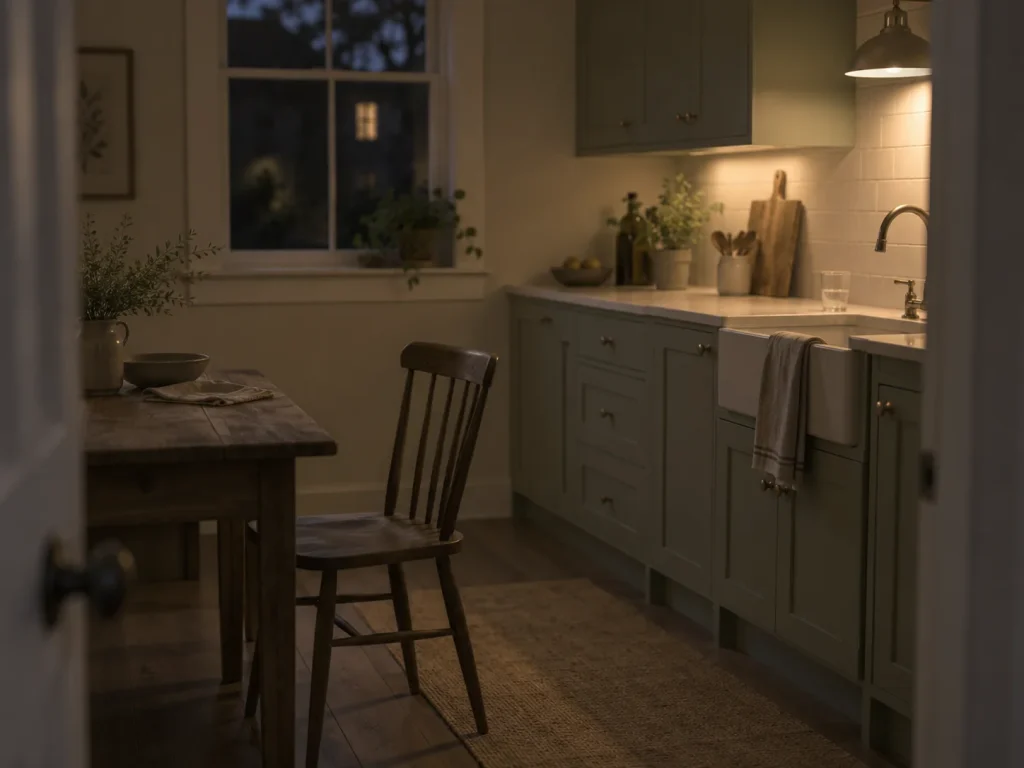
It is 8:52. He is finally down. You are standing at the sink with the tap running and you are not washing anything.
You are just standing there.
Ten minutes ago he asked for one more story and you said no in a voice that came out flatter than you meant.
He did not cry. He rolled over and faced the wall. That is the part you keep going back to.
You keep waiting to feel something about it. Nothing comes.
You made the lunches, signed the form, found the second shoe, said good job. Somewhere in the middle of all that, the sound went out of you.
You have been told to take a bath. To get an early night. To ask for help. To pour from a full cup.
That is not what happened to you today. Something else happened. It has a name, it has a mechanism, and it is not a flaw in your character.
Nothing on this page is going to tell you to try harder.
WHO THIS IS FOR
This is for you if:
You are tired in a way that sleep has stopped touching.
You go through bedtime correctly and feel almost nothing while you do it.
You have tried the evening off, the early night, the walk. None of it held.
You want to know what is happening to you before anybody hands you a routine.
This is not for you if:
You want a morning routine or a habit tracker. This section is about load, not optimisation.
You want somebody to tell you this is just a phase and it passes on its own. It sometimes does. Often it does not, and pretending otherwise costs you a year.
If tonight is heavier than a hard week
If you are having thoughts of harming yourself, or of not being here, stop reading and speak to a person tonight.
In the United States, call or text 988 for the Suicide and Crisis Lifeline. It is free and staffed overnight.
What parental burnout actually is
Parental burnout is a specific syndrome, not a mood. Researchers Isabelle Roskam, Maria Elena Brianda and Moïra Mikolajczak built the first proper measure of it in 2018.
They found the same four things showing up together, over and over, in exhausted parents.
| The four parts | What it feels like at home |
| Exhaustion in the role | You can work a full day and still have nothing left at the door of your own house. |
| Contrast with who you were | You remember being warmer than this. You cannot find that version of yourself. |
| Saturation | You have had enough. Not of him. Of the doing of it. |
| Emotional distancing | You go through the routine correctly and feel almost nothing while you do it. |
Most parents recognise themselves in row one and assume that is the whole thing.
The rows that keep people awake are three and four. Those are the ones nobody says out loud, because saying them sounds like a confession.
They are not a confession. They are a measurement, taken from thousands of parents, and they behave the same way in all of them.
Why am I so tired when I actually slept?
This kind of tired does not answer to sleep. You are not short of hours. You are short of recovery.
A body can run at full output for a burst without any harm at all. What it cannot do is run at full output every day, with nothing in between, and stay the same body.
You know the specific version of this. It is 11:20, the house is quiet, and you are not going to bed.
You are sitting on the edge of it with your phone. Too tired to sleep, which makes no sense, and you do it again the next night.
That hour is not a bad habit. It is the only part of the day nobody wants anything from you.
Your body is taking it back the only way it can.
Here is the part that helps.
I have spent twenty-two years inside a power utility. Every piece of equipment on a grid carries two numbers.
One is what it can handle in a surge. The other is what it can carry continuously, day after day, without degrading.
The surge number is always the bigger one. It is also the number that means nothing, because nothing on a real network gets to live at surge.
When a system is run at its surge number as though it were its continuous number, it does not fail loudly on the first day.
It runs hot. It keeps working. It keeps looking fine to anyone walking past.
You have been running at your surge number since he was born.
Look at what your week actually contains. There is no hour in it where nobody wants anything.
The commute is planning. The lunch break is messages. The shower has a child talking through the door.
Even the parts that look like rest are being spent listening for something.
A day like that has no gap in it, and recovery only happens in gaps.
Sleep pays back one kind of debt. It does not pay back the other kind.
The other kind accumulates when there is no point in the day where nothing is being asked of you, and it builds whether you slept eight hours or four.
So if you have been going to bed early and waking up just as empty, nothing is wrong with you and nothing is wrong with sleep.
You were treating a shortage of recovery as a shortage of hours.
Which raises the harder question, the one you have probably typed into a phone after midnight.
Is this parental burnout or am I depressed?
Parental burnout sits on the parenting role and leaves the rest of you working. That is the clearest difference.
You can be sharp in a meeting at two in the afternoon and empty in your own hallway at six. Depression does not usually let you be fine somewhere else.
This is the detail that makes people cry when they first read it, so take a second with it.
You have been assuming that because you can function at work, and be pleasant to your neighbour, and hold a normal conversation with your sister on the phone, the flatness at home must be about your family.
About whether you actually wanted this. About whether you are the kind of person who should have had children.
That reasoning is wrong at the first step.
Moïra Mikolajczak and Isabelle Roskam published a framework in 2018 that explains why.
They found that parental burnout develops when the risks in the parenting role chronically outweigh the resources available to meet them.
What matters here is that they tested it against job burnout, and the two came apart.
Factors specific to parenting predicted parental burnout on their own. A parent could be entirely fine at work and burnt out at home, and the numbers did not find that strange at all.
The role is the thing that is saturated. Not the love. Not the wanting. The role.
There is one more thing here, and this page will say it plainly, because a page that pretends to be a doctor is worth nothing to you at eleven at night.
Burnout and depression can happen together. This page cannot tell you which one you have, and any page that offers to is selling something.
If the flatness has spread past the parenting role, into food and sleep and the things you used to like, that is a conversation with a doctor.
Making that appointment is not an admission of anything. It is the same as calling someone when your car makes a sound you do not recognise.
But if you read that and thought, no, I am fine everywhere else, I only go blank in my own house, then you have just answered a question you have been carrying for a long time.
Which leaves the thing you have never told anyone.
Why do I feel nothing for my child at 7pm?
Emotional distancing is not the absence of love. It is a system reducing the load it is carrying so the whole thing does not go down.
Your feeling did not leave. It got shed, on purpose, by machinery that did not ask you first, because the alternative was worse.
You know exactly the moment being described.
He is telling you about something that happened at school. You are loading the machine. You are saying mm-hm at the right gaps.
You are getting every single one of them in the right place, and you could not repeat one word of what he said.
Then at eleven o’clock, when he has been asleep for two hours, it arrives. All of it.
You stand in the doorway and look at him and you feel everything you did not feel at seven, and you decide you are a fraud.
Take the grid again, because it explains this better than anything borrowed.
When demand on a network goes higher than what the network can supply, the system does not politely slow down everywhere at once.
It sheds. It takes whole sections offline, deliberately, in a chosen order, so the rest of the network survives.
Load shedding is not the grid failing. Load shedding is the grid protecting itself from the failure that comes next.
Emotional distancing is the same event, run in a person.
Somewhere below the level where you get a vote, something totalled the demand against what you had, found the gap, and started shedding.
It sheds the expensive things first. Feeling is expensive. Attention is expensive.
The routine is cheap, so the routine stays on. That is why you can complete every step of bedtime perfectly and be nowhere in the room while you do it.
And it is why the feeling comes back at eleven. Demand dropped. The section came back online.
Nothing was gone. It was offline.
So the sentence you have been carrying, the one about being cold now, was written by someone who saw the lights go out in one section and concluded the power had never been there.
He got the routine done and got kissed goodnight by someone running on reduced capacity. That is not a small thing to sit with.
It is also nothing like the thing you thought it was.
There is a second symptom that travels with the distancing, and it does more damage, because it does not present as a symptom. It presents as a fact about who you are.
Why am I not the parent I used to be?
You are comparing yourself to a version of you who still had reserves.
That parent was not kinder or more patient than you. That parent was less depleted.
The gap you keep measuring is a gap in capacity, and you have been reading it as a gap in character.
This is the second of the four parts, and the researchers gave it a plain name. Contrast.
Most parents can date it roughly. There was a stretch, two or three years back, when you were softer.
You said yes to things. You got down on the floor. You did not count the hours until bedtime, because you were not counting anything.
You probably have proof on your phone. A video from a birthday, where the child is small and you are off camera saying something in a voice you no longer use.
That voice is the one you have been holding against yourself.
Two things are true about that video, and only one of them has occurred to you.
The first is that you were warmer. That is real, and there is no point pretending otherwise.
The second is that you were also two years less tired, and something in your life then was carrying weight nobody is carrying now.
A grandmother in the house. A job with an actual end to it. A younger body. A partner who was home more.
Nobody wrote any of that down, so when it went away, nothing recorded the change except your behaviour.
Contrast is a comparison between two people in two entirely different conditions, and you have been scoring it as though the conditions were the same.
There is a technical version of this.
A machine at the end of a long, overloaded line does not perform the way it did on the day it was installed. Nobody looks at it and says it has become a worse machine.
They go and find out what happened to the supply.
The output is a symptom of the network. Treating it as a defect in the equipment is how a fault gets missed for years.
You have been treating the output as a defect in the equipment.
This matters more than it looks, because contrast turns into a story about yourself, and the story makes everything else heavier.
If you were simply tired, you would rest. If you have become a colder person, there is nothing to rest, so you stop trying and carry the story instead.
You are not a colder person. You are the same person, running with less behind you.
Why did it hit me on an ordinary day?
It did not hit. It accumulated, and the ordinary day is only where the count happened to land.
Nothing broke on the Tuesday. The Tuesday was the first moment a total that had been building for two years became visible from outside.
Every parent tries to work backwards from the day it showed up.
You go looking for the cause in the last twenty-four hours, and the last twenty-four hours are almost always boring. School, work, the same argument about shoes.
That is what makes it frightening. If the day was ordinary and you fell apart anyway, then it must be you.
Transformers do not fail during the storm.
They fail on a mild afternoon in the middle of the week, months after the storm, because what actually kills them is accumulated heat.
Every heavy load leaves a little damage behind. None of it is dramatic on its own.
It stacks, silently, for a very long time. Then one perfectly normal load lands on a machine that had nothing left, and the thing that was supposed to hold does not hold.
Nobody who investigates that failure blames the mild afternoon.
You have been blaming the mild afternoon.
Here is the cost, said once, and then this page will not say it again.
The version of you your children have been meeting most evenings is the flat one. Not the shouting one. The flat one.
That is what you are actually trying to get back, and it is worth naming so you know what you are working on.
Why doesn’t self-care work for parental burnout?
Self-care is a resource. Burnout is a balance.
Adding one bath to a week where nothing on the demand side has moved changes the arithmetic by almost nothing.
Then the failure of the bath becomes one more thing you have failed at, which puts you further down than when you started.
You have run this experiment. Probably several times.
Someone told you to take an evening for yourself, so you did.
You came home and everything you left was still there, plus the guilt about having gone, plus two hours of catching up.
By Wednesday you could not tell the evening had happened. You concluded you are the sort of person self-care does not work on.
The framework from Mikolajczak and Roskam is useful here in a practical way.
Their finding was about a balance, with risks on one side and resources on the other. Burnout develops when the risks stay heavier for long enough.
Not when resources are absent. When the balance leans.
Every piece of advice you have been given lives on the resource side. Sleep more. Take a walk. See a friend.
All of it is real, and all of it is trying to lift a heavy side by adding weight to the light side one teaspoon at a time.
The other side of the balance is almost never discussed, because there is nothing to sell there and the answer is unpleasant.
To take weight off the risk side, something real has to be put down. Not delegated in theory. Put down, by you, in a way somebody will notice.
That is why self-care sells and load reduction does not. One is a purchase. The other is a decision you have to defend.
Watch what the failed evening off actually does to you, because this is the part that makes the advice worse than useless.
You go. You spend the first forty minutes running the house in your head from a distance.
You come back to a kitchen that waited for you.
Nothing on the demand side moved while you were gone, so the whole thing arrives at once on your return, on someone who has also spent money and taken up somebody else’s evening to make it possible.
The rest is silent. You do not conclude that the intervention was aimed at the wrong side of the balance.
You conclude that you cannot even do the easy part right.
A parent who has been through that cycle four or five times stops believing anyone who talks about wellness.
Which is a completely reasonable position, and it is why this page waited until now to suggest anything at all.
There is one more reason the advice keeps missing. You do not know what is actually draining you.
You think you do. Almost nobody does, and there is a good technical reason for that.
What is actually draining me?
The fault is never where the noise is.
On a network, the breaker that trips is usually downstream of the actual problem. That is why you can spend a whole shift at the panel that is screaming and find nothing wrong with it.
The 6pm snap is the breaker. It is not the fault.
You have been auditing the wrong day. Here is where the load usually is.
| What looks like the drain | What the load actually is |
| The evening | The whole day arriving at the evening. Rena Repetti, studying air traffic controllers in 1989, found that after high-load workdays people withdrew socially at home. The withdrawal was not about home. It was the tail of the day before it. |
| The tasks | The holding of the tasks. Somebody in the house carries the running list of every date, size, deadline and permission slip. That list never gets put down, and it does not look like work from outside. |
| Being tired | Being on call. There is no end of shift. You are the person who gets woken, and even on the nights nobody wakes you, part of you stayed at the door listening. |
| Being with him | Being with him while being somewhere else. Matthew Killingsworth and Daniel Gilbert, in 2010, tracked people through ordinary days and found the mind wanders often, and that the wandering costs something. You have been in the room and not in it, and both halves are tiring. |
There is a fifth one, and it belongs to a lot of parents at exactly this hour.
The bright voice.
You get to the door and something switches on. Cheerful, warm, ready.
Not because you feel it. Because he needs it and you can produce it, and you are good at it now.
Arlie Hochschild gave that its name in 1983, studying flight attendants. She called it emotional labour.
Her point was that producing a feeling you do not have, on demand, over and over, is work.
Real work, with a real cost, that never appears on anyone’s list of what you did that day.
You have been charging yourself for the shouting and taking the bright voice for free. It was never free.
So the answer to what is draining you is usually not the thing that made you snap.
It is four or five loads that never get counted, running continuously, none of which look like anything.
When is this more than burnout?
Some of what is on this page belongs with a doctor rather than a website, and the line is not subtle.
If the flatness has spread past parenting into the rest of your life, if you cannot eat or cannot sleep or cannot want anything at all, that is a medical appointment this week.
Not an emergency. An appointment.
Researchers looking at severe parental burnout have found that some parents reach the point of wanting to escape their lives entirely.
If your thoughts have gone anywhere near there, stop reading a website tonight and speak to a real person.
A doctor, or a crisis line, or one human being you trust who is awake right now.
In the United States, call or text 988 for the Suicide and Crisis Lifeline. It is free and staffed overnight. [Insert the correct service and number for your primary audience territory before publishing.]
Wanting out is a symptom of how long you have been carrying this.
It is not a verdict on you, and it is not a thing you have to hold alone until it passes.
What to do tonight. Nothing here fixes burnout. Burnout came in over months and it goes out the same way.
What these do is take one thing off the risk side tonight, which is the only side that moves the balance.
Put down one thing, visibly. Not the important one. The one you have been doing anyway because it is quicker than asking.
Let it be undone. Let it be seen to be undone. The discomfort you feel watching it sit there is the actual work.
Take the gap before the door, not after bedtime. Two minutes in the car with the engine off, before you go in, is worth more than an hour at midnight.
It lands in front of the load instead of behind it.
Stop producing the bright voice for the first ten minutes. Not flat. Not cold. Just not performed.
Say the true sentence out loud once. To your partner, a sister, a friend at work. It is doing more damage inside your head than it will do in the air.
To him, when he asks for the thing you have nothing left for:
“I have run out for tonight. I am not cross with you. I am going to sit here with you and be quiet for a bit.”
If he pushes, and he will:
“I know. I am still here. We can do the long one tomorrow.”
If it comes out wrong anyway:
“That came out sharp. That was me being empty, not you being bad.”
To an adult who asks how you are:
“I am not coping well at the moment. I do not need it fixed. I just did not want to keep saying I am fine.”
None of these assume he cooperates. That is on purpose.
A script that only works on an agreeable child is why parents stop trusting parenting websites.
One note about tomorrow. You will do the same routine and feel exactly the same.
A balance that took two years to tip does not come back level because you read something at midnight.
What changes first is not the feeling. It is the sentence you say to yourself at 6pm when the flatness arrives.
THE TRADEOFF
One honest thing before the end, because a page that costs you nothing is a page you should not believe.
Taking weight off the risk side means something gets dropped, and somebody in your life is going to feel it.
The list will be shorter and someone will notice which item is missing.
The person who has been relying on you doing that thing quietly will have to be told.
You may be seen as less capable by people whose opinion of your capability has been holding you up.
That is the real price, and it is why most parents choose the bath instead. The bath asks nothing of anyone.
You are allowed to decide it is not worth paying this month.
Just decide it on purpose, knowing what the other option costs, rather than defaulting into another year of running at the surge number.
CLOSE
You will get up tomorrow and do the school run and it will not feel different in the morning.
That is not a sign the reading was wasted. Nothing that took two years to build comes off in one night.
But there is a sentence you came in carrying, about being cold now, about having lost something you cannot get back.
It was not true. It was a reasonable conclusion drawn from bad information.
The feeling was never gone. It was offline, and it comes back on, and it came back on at eleven o’clock last night while you stood in his doorway.
You have been treating that eleven o’clock feeling as evidence against yourself.
It was the opposite.
The lights are still on in there. You just cannot feel the heat.
One page a week. Nothing else.
The next piece in this series, sent when it goes live. No course, no funnel, no daily email.
Unsubscribe in one click. We do not share your address.
FAQ
What is parental burnout? A syndrome specific to the parenting role, measured by Roskam, Brianda and Mikolajczak in 2018. It has four parts: exhaustion in the role, contrast with the parent you used to be, saturation, and emotional distancing from your children. Exhaustion alone is not the whole condition.
Is parental burnout the same as depression? No. Parental burnout sits on the parenting role and often leaves the rest of a person functioning. The two can occur together. No website can tell you which you have, and if the flatness has spread across your whole life, that is a conversation with a doctor.
Why doesn’t sleep fix parental burnout? Because the shortage is recovery, not hours. Recovery happens in gaps where nothing is being asked of you, and most parenting weeks contain no such gap. Eight hours of sleep inside a day with no gaps still leaves the balance where it was.
Why does self-care not work for burnout? Self-care adds to the resource side of a balance that is heavy on the risk side. Mikolajczak and Roskam’s 2018 framework describes burnout as a chronic imbalance. Adding small resources rarely shifts it. Reducing the load does, and nobody sells that.
Is emotional distancing from my child normal in burnout? It is one of the four measured parts of the syndrome, so it is common in burnt-out parents. It is not evidence that you have stopped loving your child. Feeling usually returns when demand drops, which is why it arrives late at night.
REFERENCES
Hochschild, A. R. (1983). The Managed Heart: Commercialization of Human Feeling. University of California Press.
Killingsworth, M. A. and Gilbert, D. T. (2010). A wandering mind is an unhappy mind. Science, 330(6006), 932.
Mikolajczak, M. and Roskam, I. (2018). A theoretical and clinical framework for parental burnout: the balance between risks and resources (BR²). Frontiers in Psychology, 9:886.
Repetti, R. L. (1989). Effects of daily workload on subsequent behavior during marital interaction: the roles of social withdrawal and spouse support. Journal of Personality and Social Psychology, 57(4), 651–659.
Roskam, I., Brianda, M. E. and Mikolajczak, M. (2018). A step forward in the conceptualization and measurement of parental burnout: the Parental Burnout Assessment (PBA). Frontiers in Psychology, 9:758.
AUTHOR BOX
Written by Muhammad Zubair Sarwar. Engineer, twenty-two years at a national power utility in Lahore. Father.
Completed Yale University’s Introduction to Psychology and the University of Sydney’s Positive Psychiatry and Mental Health, both online non-credit courses through Coursera, 2025.
Not a licensed clinician, and nothing on this site is diagnosis or treatment.
See our editorial standards and medical disclaimer.