
I went looking for the woman behind the famous parenting tips. What I found was stranger than I expected and far more hopeful. Here is what is real, what the research says, and what to do on the night you have already snapped.
By Muhammad Zubair Sarwar · Published [September 22, 2026] · 14 min read
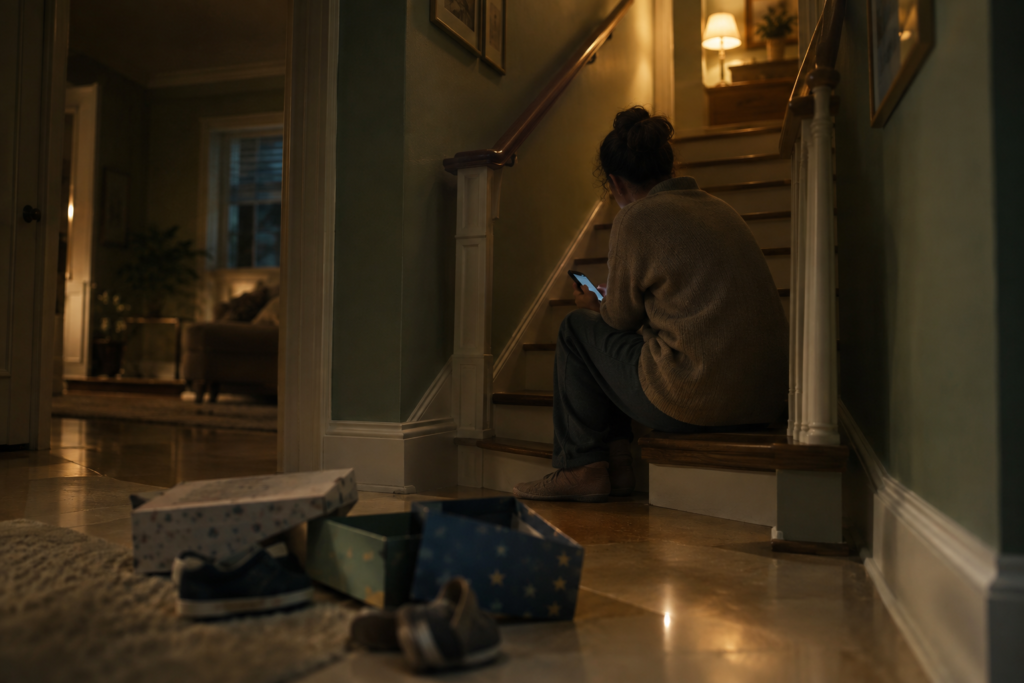
It is late. The house has gone quiet, and the quiet feels loud.
You typed a name into your phone because you wanted someone to tell you what to do. Someone who sounded kind. Someone who sounded sure.
So let me give you the honest answer first. I could not verify who Chelsea Acton is.
The ideas under her name are real, though. Some of them rest on sixty years of research. And one of them can help you before breakfast tomorrow.
Stay with me. We will sort what is true from what is borrowed, and you will leave with something you can use tonight.
The short answer
Chelsea Acton is the author’s name on many parenting articles at famousparenting.com. I could not find independent proof of her credentials, and her biographies across the internet contradict each other. The ideas credited to her, such as warmth with firm limits, do have strong research behind them. They come from decades of child development science, not from one person.
In this post
- Who is Chelsea Acton?
- Is Chelsea Acton a real parenting expert?
- How can you tell if an online parenting expert is real?
- What is the Chelsea Acton parenting method?
- Does gentle parenting actually work?
- Why do parenting tips make you feel worse?
- What happens in your body right before you shout?
- What to do after you yell at your child
Who is Chelsea Acton?
Chelsea Acton is the name on many articles at famousparenting.com. The site presents her as its lead author. It says she studied writing, psychology and journalism and is raising three children. Beyond that one site, her story splits in many directions, and the versions do not agree.
I read the pages that rank for her name. One by one. Here is what they claim.
- One site says she first became famous as an actress, and later for the way she raised her children.
- Another gives an exact birth date, a Stanford degree in child psychology, a husband’s name, and the names of three children.
- Another says she has written books called Parenting with Heart and The Balanced Parent.
- A more careful writer noticed that, depending on the page, she is called a parenting coach, a former teacher, a child psychology professional, a family therapist, a journalist or a public speaker.
Then I went looking for the ground under those claims. A licence. A university record. A book listing. A published paper. A talk with a date and a venue.
I found none of them.
That does not prove she isn’t real. It means I could not check. And on a page about your child, I will not ask you to trust something I cannot check.
Why are there so many pages about her? When a name starts getting searched, websites rush to publish on it. Many of them copy each other. A small claim on one page becomes a “fact” on the next, and a biography grows out of nothing but repetition.
You were not wrong to search for her. You were caught in an echo.
Is Chelsea Acton a real parenting expert?
No source I could find shows that she is. Her bios disagree about her job, her degree, and even why she is famous. None of them name a licence, a clinic, or a study. Even one friendly page about her admits there is no rulebook or academic theory called the Chelsea Acton method.
Here is why that matters to you in particular.
When you are tired, a warm voice feels like a hand on your back. It says what you hoped to hear. It asks for nothing.
That is exactly the moment you deserve to know who is talking.
Parenting advice is not like a recipe. If a recipe fails, you lose one dinner. If parenting advice fails, you lose sleep, confidence, and sometimes a little more faith in yourself. You deserve advice with a name, a record, and a reason behind it.
And here is the part nobody else will say.
The fact that you went looking at all tells me something about you. People who do not care about their children do not search for help at midnight. You were looking for someone who understood. That is not foolish.
That is love, looking for a map.
How can you tell if an online parenting expert is real?
Ask five quick questions before you trust any parenting voice online. Can you find their licence? Do they name their research? Does their story match across sites? Do they tell you what their advice costs? Do they tell you when to see a professional? Real experts pass all five without effort.
Keep these questions. They will protect you long after this post.
- Can you find a licence? Every US state runs a free online lookup for licensed psychologists, counselors, and social workers. A real clinician will show up there under their own name.
- Do they name their research? “Studies show” is not a source. A real expert tells you who did the study, and when.
- Does their story match? Search their name with the word “biography.” If one page says actress and another says therapist, stop there.
- Do they tell you the cost? Every approach costs something. Time, patience, a harder evening before an easier year. Advice that promises only benefits is selling you something.
- Do they tell you when to get help? Honest writers draw a line between general advice and your child’s health. They send you to a pediatrician when it matters.
This site holds itself to the same five questions. You will find the answers on our editorial standards page.
What is the Chelsea Acton parenting method?
The ideas credited to her are empathy, gentle discipline, time-ins, open talk, and limits on screens. None of them is new. Together, they match what psychologist Diana Baumrind described in 1966 as authoritative parenting, which means being warm and being firm at the same time.
Baumrind watched how parents and children behaved together. She noticed that some parents were warm but made few demands. Some made firm demands with little warmth. And some managed both. Decades of later, research followed children raised in that third way, and they tended to do well.
Here is each “Chelsea Acton” idea, traced back to where it really came from.
- Empathy. This is the warm half of Baumrind’s model. Your child feels seen before being corrected. A child who feels understood has less reason to fight you.
- Gentle discipline. This means teaching instead of hurting. In 2016, Elizabeth Gershoff and Andrew Grogan-Kaylor pooled decades of studies on spanking. They found it was linked to worse outcomes for children, not better ones.
- Time-ins. Instead of sending your child away when they fall apart, you stay close while they settle. A small, upset body calms faster next to a larger, calmer one.
- Open talk. Your child learns that feelings can be said out loud, and that saying them does not end the world.
- Firm limits. This is the half most online versions forget. “No” stays “no,” said kindly, without a lecture attached.
So here is the good news, and I want you to feel it land.
You do not need her.
The good parts were never hers to give. They already belong to you.
Does gentle parenting actually work?
The core does. Warmth with clear limits is one of the best-supported ideas in child development. The online version often keeps the warmth and quietly drops the limits. That version is hard on children, who lose the edges they need, and harder still on parents trying to live it.
A 2024 study in the journal PLoS ONE listened to parents who called themselves gentle parents. Most were happy with the approach overall. Even so, about a third described burnout and doubt about whether they were doing it right. One mother said she was barely hanging on.
The researchers noticed who struggled most. Parents who treated gentle parenting as permissive, rather than as empathy with limits, were the most likely to feel drained and unsure.
So here is the honest verdict. Here is what the evidence supports, what it doesn’t, and what it costs.
- What the evidence supports: warmth, clear limits, calm follow-through, and coming back after conflict.
- What it does not support: endless negotiation, never saying no, or treating every tear as an emergency you must fix.
- What it gives you: a child who feels safe, and a relationship built to last into the teenage years.
- What it costs you: time, patience, and a calm you will not always have at seven in the evening.
All of it is true. You are allowed to hold all of it.
And one more thing. Gentle parenting was never supposed to mean perfect parenting. The parent who snaps and then comes back is still doing it. Maybe doing it best.
Why do parenting tips make you feel worse?
Perfect advice sets a bar no tired person can clear. When you fall short, you don’t blame the advice. You blame yourself. And a parent who feels like a failure has even less calm left for the next hard moment, so the cycle feeds itself.
You know the hour. You could draw it with your eyes closed.
Dinner is late. Someone needs their shoes on, for the fifth time. Someone else is crying about the wrong cup. The phone is buzzing with something from work. Your body has been on duty since morning, and it has not been thanked once.
Then your voice climbs. It is not the voice you planned. It is not the voice from the videos.
You are far from alone in this. In the Surgeon General’s 2024 advisory, 48% of US parents said most days their stress is completely overwhelming, compared with 26% of other adults. 41% said most days they are too stressed to function.
The loneliness is real too. About two-thirds of parents, and 77% of single parents, reported feeling isolated and lonely.
And the advisory named something you may feel on your phone every night. Parents described feeling burned out and “perpetually behind” from comparing themselves with what they see online.
You scroll past a calm mother kneeling at eye level with a calm toddler. You don’t see the take she threw away. You don’t see her at six o’clock. You only see yourself.
If parenting feels harder than you ever expected, you are in the majority. Pew Research found in 2023 that 66% of mothers and 58% of fathers say it is harder than they thought it would be. Mothers were more likely to call it tiring most of the time, 47% against 34% of fathers.
Now hold on to this. In that same survey, around eight in ten mothers and fathers said parenting is enjoyable and rewarding all or most of the time.
The hard part and the love live in the same house. One does not cancel the other.
What happens in your body right before you shout?
Under strain, your brain’s alarm system speeds up and the calm, planning part of your brain slows down. Yale neuroscientist Amy Arnsten showed in 2009 that stress weakens the prefrontal cortex, the area that helps you pause and choose. The shout often arrives before the thinking can catch up.
That is why your best intentions vanish at the worst moment. You did plan to stay calm. The plan was stored in the part of your brain that stress switched off first.
Exhaustion makes it worse. Ohio State researchers Kate Gawlik and Bernadette Melnyk surveyed working parents in 2021. Two-thirds met the criteria for burnout. Burnout was strongly linked to parents screaming at, insulting, and criticizing their children.
Read that again, slowly.
The shouting is not proof that you are a bad parent. It is often proof that you are an empty one.
That does not make shouting harmless. It makes it understandable. And what you can understand, you can start to change.
We go much deeper into those few seconds and how to slow them down, and what happens in a parent’s brain in the seconds before they shout.
What to do after you yell at your child

Go back. Name what you did. Name what your child felt. Then reconnect with something ordinary. Research on parents and babies suggests that coming back after a rough moment matters more than never having one. Repair is the skill. Perfection was never the goal.
Psychologist Edward Tronick spent decades watching parents and infants face to face. His “still face” research, first published in 1978, showed how quickly babies become upset when a parent goes blank. His later work with Andrew Gianino, in 1986, found that ordinary, loving pairs fall out of step often, all through the day. What mattered was how they found their way back.
Your child does not need a parent who never breaks the connection. Your child needs a parent who always comes back to mend it.
Here is how to come back.
- Calm your own body first. A glass of cold water. Three slow breaths out. Repair from panic sounds like more panic.
- Go to your child. Don’t wait for them to come to you. You are the grown-up, so you walk first.
- Say what you did. Keep it short and plain. “I yelled.” No speech, no excuses.
- Say what they felt. “That was scary” reaches deeper than “I’m sorry you got upset.”
- Don’t hand them your guilt. Skip “Do you forgive me?” It asks a child to take care of your feelings.
- Come back to normal. A snack. A story. A silly voice. The ordinary is how a child knows it is really over.
Adjust the words for your child’s age.
- Toddlers: Fewer words, more closeness. “Daddy was loud. I’m sorry. Hug?”
- School-age children: Name it and ask one question. “I yelled about the shoes. How did that feel?”
- Teenagers: Keep it brief and respectful. They notice an honest adult more than you think.
One honest note, because you deserve the whole picture. The worry is not one bad night. In 2014, Ming-Te Wang and Sarah Kenny followed families with young teenagers. They found that harsh verbal discipline repeated over time was linked to later behavior problems and low mood.
So if shouting has become the everyday sound of your house, take that seriously, with care rather than shame. Talking to your family doctor or a licensed counselor is a strong step, not a weak one. If you ever fear you might hurt your child, call the National Parent Helpline at 1-855-427-2736.
The words to say tomorrow morning
“Last night I yelled. That was not okay, and it was not your fault.
I was tired, and I let it spill onto you.
I’m working on staying calmer.
You can always tell me when I scare you.
Now. Pancakes or toast?”
Chelsea Acton: what’s claimed vs. what I could verify
| Claim found online | Where it appears | Could I verify it? |
| Lead author at famousparenting.com | famousparenting.com | Yes, as a byline only |
| Former actress | babykidstips.com | No |
| Stanford child psychology degree | bioartbites.com | No |
| Author of two parenting books | iprovpn.com | No book listing found |
| Coach, teacher, therapist, journalist | Several sites | Descriptions contradict each other |
| A named parenting method | Several sites | One site admits no formal method exists |
A night from my own house
I got home after nine. The fan was ticking in the hallway. He had built a tower of shoe boxes by the door and wanted me to see it before it fell. I stepped around it with my bag still on my shoulder. It fell anyway. I said something sharp about the mess. He went quiet, which was worse than crying. Later I sat on the stairs with my phone, the screen too bright, typing how to fix it. The first name that came up was a stranger’s. I read three of her articles before I noticed I had not gone upstairs.
What this costs you
Real evidence is less comforting than a warm persona. It says “we don’t know yet.” It won’t promise you a calm child by Friday. It asks you to hold two things at once: that you are a good parent and that some nights you get it wrong.
Repair has a cost too. You have to stand in front of a small person and admit you were wrong. That feels exposed. For many of us, it is the opposite of how we were raised. Nobody came back to us.
That cost is the whole point. Every time you pay it, your child learns something no article can teach. Love can take a hit and still be standing in the morning.
You were never really looking for her
You came here looking for a name.
What you were really looking for was permission. Permission to be tired. Permission to get it wrong. Permission to still be the one your child runs to at the end of the day.
You have it.
Not from a famous expert. Not from a stranger with a perfect bio. From the plain fact that you are still here, late, reading every word, trying to do better for someone small.
So close this page gently. Let your shoulders drop. Tomorrow morning, walk first, say the few plain words, and pour the cereal.
The parents who lie awake worrying about the damage are rarely the ones doing it.
You were never looking for Chelsea. You were looking for proof that you could come back.
Seven calmer evenings, one small step at a time
Get the free Calm Evenings Kit. It’s 17 pages, with one short, doable plan for each of seven nights, written for the parent who already feels stretched.
Frequently asked questions
Is Chelsea Acton a real person?
Chelsea Acton appears as an author name on famousparenting.com. I could not find independent records of her credentials, books, or career. Her biographies across different websites contradict each other on her job, education, and background. That does not prove she doesn’t exist, but her expertise cannot be verified from public sources.
Has Chelsea Acton written any books?
Some websites say she wrote books titled Parenting with Heart and The Balanced Parent. I could not find listings for these books under her name. Before buying any parenting book, check the author’s credentials and whether the book names the research behind its advice.
Is famousparenting.com trustworthy?
The site offers general parenting tips in a warm, friendly tone. Its articles don’t consistently name studies or show verifiable author credentials. Treat it as light reading rather than expert guidance. For decisions about your child’s health or development, talk to your pediatrician or a licensed professional.
Is gentle parenting bad for parents?
The core idea, warmth with firm limits, is well supported by research. A 2024 PLoS ONE study found that about a third of self-described gentle parents reported burnout or self-doubt. Struggles were most common when parents dropped the limits and kept only the warmth.
What does “rupture and repair” mean?
A rupture is a moment when you and your child fall out of step, such as yelling, snapping, or shutting down. Repair is coming back afterward to reconnect. Edward Tronick’s research with parents and infants suggests these breaks are normal in loving families and that coming back afterward matters more than never falling out of step.
Sources
- U.S. Surgeon General. Parents Under Pressure: The U.S. Surgeon General’s Advisory on the Mental Health and Well-Being of Parents. 2024. hhs.gov
- Minkin, R. and Horowitz, J. Parenting in America Today. Pew Research Center, 2023. pewresearch.org
- Gawlik, K. and Melnyk, B. Pandemic Parenting: Examining the Epidemic of Working Parental Burnout. The Ohio State University, 2022. osu.edu
- Gentle parenting study, PLoS ONE, 2024. [Author names and link to add after verification]
- Baumrind, D. “Effects of Authoritative Parental Control on Child Behavior.” Child Development, 1966.
- Arnsten, A. “Stress Signalling Pathways That Impair Prefrontal Cortex Structure and Function. “Nature Reviews Neuroscience, 2009.
- Tronick, E. et al. Still-face research. Journal of the American Academy of Child Psychiatry, 1978.
- Tronick, E. and Gianino, A. “Interactive Mismatch and Repair.” Zero to Three, 1986.
- Gershoff, E. and Grogan-Kaylor, A. “Spanking and Child Outcomes.” Journal of Family Psychology, 2016.
- Wang, M. and Kenny, S. “Longitudinal Links Between Fathers’ and Mothers’ Harsh Verbal Discipline and Adolescents’ Conduct Problems and Depressive Symptoms. “Child Development,” 2014.
About the author
Muhammad Zubair Sarwar is an engineer who has spent more than two decades at a national power utility and a father who knows the hour after the light goes. He completed Yale’s Introduction to Psychology and the University of Sydney’s Positive Psychiatry and Mental Health (online, non-credit, 2025). He is not a clinician. Nothing on this site is a diagnosis or treatment. Read our medical disclaimer.
Related reading
- What happens in a parent’s brain in the seconds before they shout
- What to say the next morning
- How to apologize to a child without making it about you