
The first phone rules US parents actually keep. Each one is backed by research, and the agreement includes your side of the deal, a plan for the first broken rule.
By Muhammad Zubair Sarwar · Published October 9, 2026 · Updated October 9, 2026 · 14 min read
Get Your Free Printable:
https://drive.google.com/file/d/1ctZ78w8p8SkiLDRkMqRQCaR2hjGYajRd/view?usp=sharing

The box is still sealed on the kitchen table. Your child has walked past it four times since dinner.
You bought it so you could reach them. That is the reason you gave everyone. The quieter reason is that you wanted to stop worrying.
Now you are about to hand over something you cannot easily take back.
Before the seal breaks, there is one thing left to do. Write the rules down. Together. Tonight.
Quick answer
A cell phone contract for kids is a written family agreement that sets phone rules before the phone is handed over. It works best when the rules are clear and agreed together. In a 2024 study of 1,187 families, clear rules went with less problem phone use. Repeated warnings about phone dangers went with more.
In this guide
- What to put in the contract
- Does it actually work
- What age is right
- How to sign it together
- What to do when a rule breaks
- What changed for New York families
- FAQ
What should a cell phone contract for kids include?
A good phone contract covers five things. Who owns the phone? When and where it rests. How to stay safe outside the house. What gets shared online. What happens with money and accidents. The best contracts add two more: the parent’s own promises and a plan for the first broken rule.
Most templates online are a list of “I will not” lines. That is a start. A list alone gives your child nothing to agree with. It only gives them something to obey.
Each rule below comes with a reason you can say out loud. Kids keep rules they understand.
| Rule | What to write | Why it matters |
| Ownership | “This phone belongs to our family. I get to use it.” | Every later talk starts from the same place. |
| Passcode | “My parent always knows my passcode.” | This is about safety. Agree now on how checks will happen. |
| Bedtime spot | “At 9 PM the phone sleeps in the kitchen.” | In a 2025 study, owning a phone at 12 went with 62% higher odds of too little sleep. |
| Meals | “No phones at meals. Grown-ups too.” | In 2024, 46% of US teens said a parent gets distracted by their phone. |
| Homework | “Homework first. The phone stays in another room.” | It ends the nightly bargaining. |
| Streets and trains | “When I cross, my eyes are up and my phone is down.” | Phone users in a 2013 street-crossing test looked both ways less often. |
| New apps | “I ask before I download anything.” | You get to look at it first, together. |
| Telling | “If something online feels wrong, I tell. I will not lose the phone for telling.” | Kids hide problems when telling gets them punished. |
| Money | “If it breaks, I pay $20 from chores.” | Decide before the cracked screen, not after. |
If you only keep one rule, keep the bedtime spot.
Ran Barzilay and his team at Children’s Hospital of Philadelphia looked at 10,588 kids in the ABCD study. They published in Pediatrics in December 2025.
At age 12, kids who owned a smartphone had 31% higher odds of depression, 40% higher odds of obesity, and 62% higher odds of not getting enough sleep. They also slept about 17 fewer minutes a night.
This shows a link, not a cause. Still, a phone that sleeps in the kitchen protects the one thing every child needs most at night.
Barzilay’s own advice to families was simple. Set clear expectations before the phone arrives. Protect sleep. Keep talking.
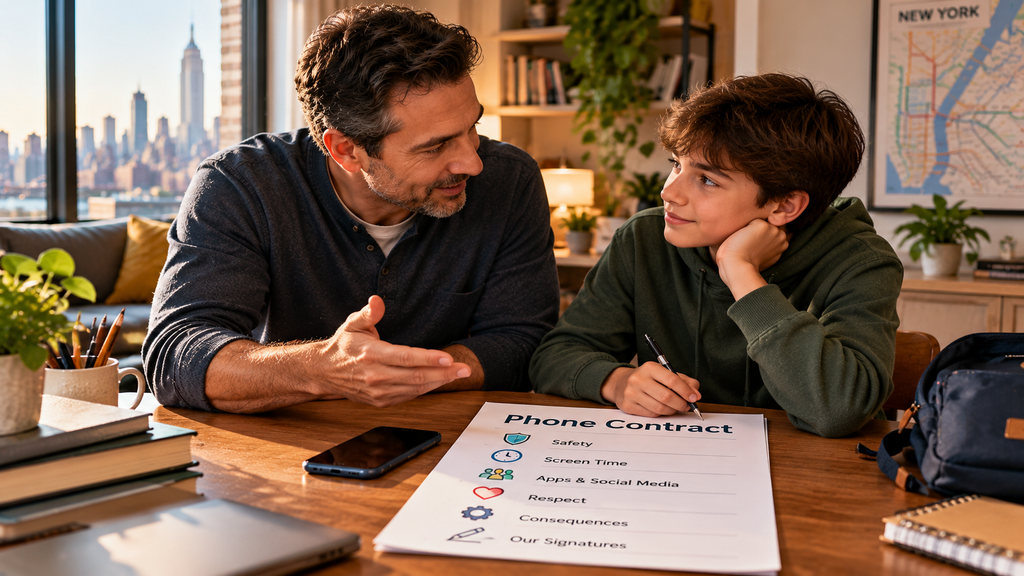
Does a phone contract actually work?
No study has tested the paper itself. Research on the habits a contract builds is encouraging. Clear rules agreed in advance link to less problem phone use and fewer family fights. Lectures about danger can make things worse.
Yaniv Efrati and colleagues followed 1,187 families in Israel for six months. Each family had a mother, a father and a teen aged 14 to 18. They published in Addictive Behaviors in 2024.
Three things stood out.
Clear rules from either parent went with less problem phone use.
Better talks about phones went with less problem use over time.
Repeated warnings about how dangerous phones are went the other way. When mothers leaned on them, problem use went up.
So the rule helps. The sermon does not.
A second study points the same way. Matea Bodrožić Selak presented research at a 2022 European conference on adolescence. Phone fights were more common when parents were very loose, very strict, or watching every move. Her advice was to agree on rules before the phone is handed over and then keep them steady.
That is what a contract is. Rules agreed ahead of time, written down, kept steady.
One mom described this on Common Sense Media. Her eighth grader pushed back on two rules: charging outside her room, and being tracked. The mom listened. Two days later, her daughter brought the contract back. Signed.
You do not have proof that paper works. You do have proof that the habits do.
What age should a child get a first phone?
There is no magic age. In a May 2025 Pew survey, 57% of parents of 11 and 12 year olds said their child had a smartphone. 68% of parents said 12 or older is the right age. Readiness matters more than the birthday.
Pew Research Center surveyed 3,054 US parents of kids 12 and under in May 2025. Among parents of 8 to 10 year olds, 29% said their child owned a smartphone. For 11 and 12 year olds it was 57%.
The reason parents gave most often was being able to reach their child. 92% of parents who allow a smartphone said so.
Here is the number that may help you breathe. A Harris Poll of 1,013 US parents in February 2025 asked if their child started smartphones at the right age. 22% said too young. Only 1% said too old.
Parents regret the phone they gave too early. Almost none regret waiting.
That is not a reason to feel bad if you already said yes. It is permission to say “not yet” if you have not.
Three questions to ask before you decide:
- Does your child already tell you when something goes wrong at school?
- Do they keep track of their things, like a lunchbox or a jacket?
- Can they stop a game or show when time is up, most days, without a fight?
If the answer is mostly no, a basic phone or a calling watch can cover the “I need to reach you” problem.
You are not alone in waiting. The Wait Until 8th pledge passed 60,000 signatures nationwide. Parents in the same grade agree to hold off together.
“Everyone in my class has one.” What do I say?
Your child is not inventing the feeling, even if “everyone” is really three loud kids. The ache is about the group chat and being left out. Name that feeling first. Then share your plan and a date. Kids take “not yet” far better than “no.”
The begging is not about the phone. It is about belonging.
When the jokes happen in a chat your child cannot see, they come to school a step behind. That hurts. Treat it as real.
What does not help is a list of dangers. Remember the Efrati study. Warnings tend to backfire.
What helps is three things in a row. You see the hurt. You have a plan. The plan has a date.
Say this tonight
“You feel left out of the group chat. That is real, and I am sorry it hurts. Here is our plan. On [date], we sit down and sign our phone agreement together. Until then, let’s find a way for you to stay close to your friends.”
Then make the bridge real. Have the friends over. Let your child text from a basic phone or a family device at set times. Being present in person still beats being present in a chat.
How do I sit down and sign it with my child?
Pick a calm evening, not the day you hand over the phone. Read the agreement out loud together and take turns. Let your child change at least one rule. A contract your child helped write is one they are far more likely to keep.
- Choose a quiet night. Not a school morning. Not after a fight. A full stomach helps.
- Open the free agreement. Use the button at the top of this page. Each rule shows the research beside it, so you are not the only voice in the room.
- Read it out loud, taking turns. You read a rule. They read the next one.
- Let them cross one out or change one. This is the moment they become a partner, not a suspect.
- Fill in your own promises. Part 6 is yours. Read it to them.
- Both of you sign. Put the date. Then pick a review date about three months away.
- Set up the charging spot the same night. The bedtime rule is the hardest one. Make it real before the first night.
Keep the agreement where you both can see it. A fridge door works fine.
What happens when my child breaks the contract?
Expect it. Plan for it. Stay steady. Use a short ladder everyone knows in advance. Talk first, then a short phone rest, then fix the rule together if it is not working. One promise never changes: telling you about something scary online never costs them the phone.
Every family breaks the agreement at some point. Usually in the first two weeks. That is not failure. That is the test of whether the rules were real.
The ladder in the agreement:
- You sit down and talk. Nobody yells. The phone lies face down on the table.
- The phone takes a rest, 24 hours by default.
- You read the agreement again. If a rule keeps breaking, maybe the rule is wrong.
- If the same rule breaks again, the rest gets longer, three days by default.
Why not rely on parental controls instead?
Because kids are better at phones than we are. Parents have reported kids getting past Apple’s Screen Time by changing the phone’s clock. Others re-downloaded deleted apps to dodge time limits. One Reddit thread about a kid beating Screen Time drew more than 400 comments.
Software is a fence. Kids climb fences. An agreement they signed is harder to climb, because they would be climbing over their own name.
Say this when a rule breaks
“You broke our rule about the phone at night. I am not going to yell. The phone rests until tomorrow. Then we will look at the rule together and see if it needs fixing.”
Notice what that script does not do. It does not call your child sneaky. It names what happened and separates the behavior from who they are.
Why should parents sign the phone contract too?
Kids copy what they watch. In a 2024 Pew survey, 46% of US teens said a parent is at least sometimes distracted by their phone when the teen is trying to talk. A parent’s promise makes the rules fair, and fair rules are the ones that get kept.
Pew surveyed US teens and their parents in 2024. About 4 in 10 parents and teens said they argue regularly about phone time. Half of parents said they have looked through their teen’s phone. 43% of teens think a parent checks theirs.
That is a lot of quiet tension in one house.
You might already feel a small sting reading that 46%. Most of us do. You are not a bad parent for checking your phone at dinner. You are a parent with a job, a group chat and a long day.
Your child just needs to see you try.
Promises worth signing:
- I will put my own phone away at meals and when you are talking to me.
- I will not read your messages in secret. If I need to check, I will tell you first.
- If you tell me something went wrong online, I will listen before I decide anything.
- I will explain why a rule exists.
- I will give you more freedom as you show me you are ready.
New York parents: what changed at school and online?
Two big things changed. From the 2025-26 school year, New York public schools keep personal phones put away from first bell to last bell. From January 25, 2027, the SAFE for Kids Act limits picked-for-you feeds and midnight-to-6 AM alerts for under-18s unless a parent agrees.
At school. New York State law now bans personal internet devices in public schools for the whole school day. NYC Public Schools apply it bell to bell. That covers homeroom, lunch, recess and study hall. Schools choose how to store phones, such as pouches, lockers or cubbies.
After-school activities are not clearly covered. That gap is where your contract does its work.
If your biggest fear is an emergency, you are not alone. A National Parents Union poll found 78% of parents wanted kids to have phones at school, mainly for safety. Under the NYC policy, every school must give families at least one way to reach their child in an emergency. Ask your school which one they use, and write it into your agreement.
Online. The New York Attorney General released final rules for the SAFE for Kids Act on July 28, 2026. The law takes effect January 25, 2027.
Here is what it means for your child:
- Social apps must show under-18s only accounts they follow, in a set order. No picked-for-you feed.
- No notifications from 12 AM to 6 AM.
- A parent can turn either one back on. The teen has to ask, and the parent has to pass an age check.
- You can take that consent back at any time.
So the law hands you a decision. The agreement has a section for it. Decide together, before the first request pops up at 11 PM.
Not in New York? At least eight other states had restricted phones in schools by April 2025, including California, Florida and Ohio. Check your district’s policy and adjust the school line in your agreement.
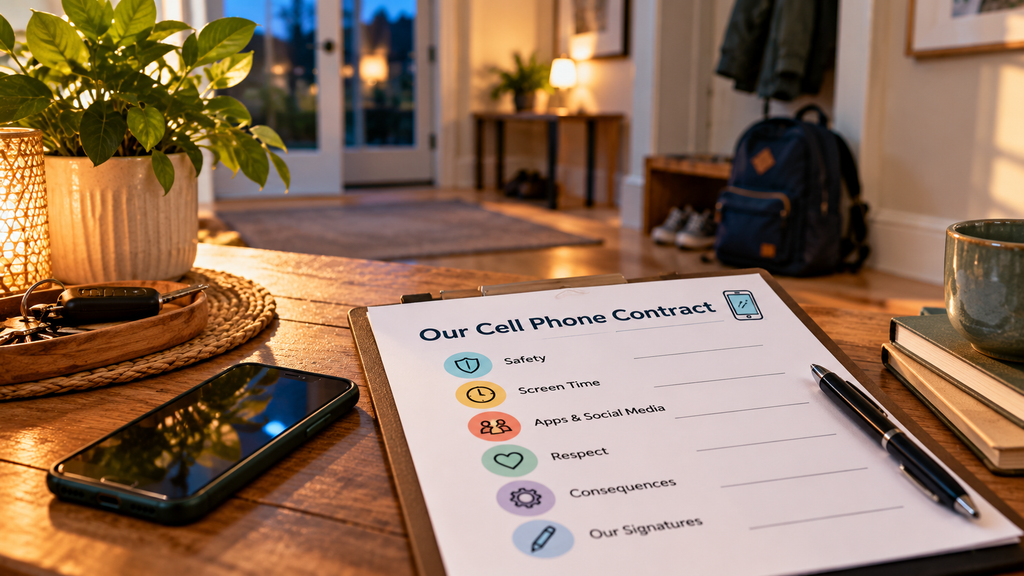
Already gave the phone? How to reset the rules
It is not too late. Pick a calm moment and own your part. Then sign the agreement together now. Expect pushback for a week or two. Start with the one rule that matters most: the phone sleeps outside the bedroom.
University of Washington psychologist Laura Kastner reminds parents that changing course is part of parenting, not proof you got it wrong. You are allowed to change your mind.
Say this to restart
“I gave you a phone without us agreeing on anything. That was on me, not you. I want to fix it with you, not do it to you. Can we sit down Sunday and write our rules together?”
Do not take everything back at once. That feels like punishment for your mistake. Add one rule. Let it settle. Then sit down with the full agreement.
A night I would rather not repeat
I got home after nine. The fan was on in the front room. I sat down with my phone to check one message from work. Then another. A small voice asked me something from the doorway. I said, “One minute.” I did not look up. When I did, the doorway was empty. The phone was still warm in my hand.
What this agreement cannot do
A contract is not a lock. A child who really wants to get around a rule will find a way. A friend’s phone, a school computer, a cleared history.
The agreement works because it is a promise, and that is also its limit. It holds as long as the relationship behind it holds.
Tracking and checking have a cost too. They can protect your child, and they can make your child feel watched. Decide openly, write down what you will do, and stick to it.
Very strict rules also have a price. In Bodrožić Selak’s 2022 research, very strict homes saw more phone fights, not fewer. Leave room to loosen rules as your child earns it.
The paper is not the point
The page with two names on it will get creased and stained. Someone will put a magnet on it crooked. That is fine.
What your child will remember is the night you sat down and asked what they thought. You let them cross something out. You signed your own promises first.
You are not handing over a phone. You are handing over a little more trust, on paper, with both your names on it.
Frequently asked questions
Is a cell phone contract for kids legally binding?
No. It is a family agreement, not a legal document. Its power comes from your child helping write it and signing their own name. Treat it like a promise between people who trust each other, and update it as your child grows.
Should I track my child’s location?
Many families do, especially for commutes. Decide openly and write it down. Some teens see tracking as distrust. One way to frame it is as a safety tool for travel, with a plan to loosen it as your child shows they check in reliably.
Should I read my child’s text messages?
Pew found in 2024 that half of parents have looked through their teen’s phone. If you plan to check, say so in the agreement. Checking together, with notice, protects safety without making your child feel spied on. Secret checking tends to teach kids to hide things better.
How often should we update the phone contract?
Every three months works well at first, then twice a year. Set the date when you sign. Use each review to loosen one rule your child has earned and fix any rule that keeps breaking. A contract that grows with your child is one they keep respecting.
What if my co-parent does not agree with the rules?
Agree on the few rules that matter most first, such as where the phone sleeps at night. Kids notice when parents disagree and will use the gap. Two homes can have different details, as long as the big rules match and both adults sign.
Sources
- Barzilay R. et al. Smartphone ownership, age of smartphone acquisition, and health outcomes in early adolescence. Pediatrics, December 2025.
- Efrati Y., Rosenberg H., Ophir Y. Effective parental strategies against problematic smartphone use among adolescents. Addictive Behaviors, 2024.
- Bodrožić Selak M. Parental mediation, parent-adolescent relationship quality, and conflicts about smartphone use. EARA Conference, 2022.
- Pew Research Center. How Parents Manage Screen Time for Kids. October 2025.
- Pew Research Center. How Teens and Parents Approach Screen Time. March 2024.
- The Harris Poll with Jonathan Haidt. Parent survey, February 2025.
- Schwebel D. et al. Effects of mobile Internet use on college student pedestrian injury risk. Accident Analysis and Prevention, 2013.
- New York City Public Schools. Personal device policy, 2025-26 school year.
- Office of the New York Attorney General. Final SAFE for Kids Act rules, July 28, 2026.
- Common Sense Media. Here’s Real Proof That a Cellphone Contract Works, 2018.
About the author
Muhammad Zubair Sarwar is a father and an Additional Project Director with twenty-two years at a national power utility in Lahore. He completed Yale’s Introduction to Psychology and the University of Sydney’s Positive Psychiatry and Mental Health (online, non-credit, 2025). He is not a clinician, and nothing on this site is medical or mental health advice.
Follow Me:
Public profile & URL
https://www.linkedin.com/in/muhammad-zubair-sarwar-8172a837b/
One Response