
You let the rules slide tonight. You are still a good parent. Here is how to choose which demands your family can carry, which ones to set down, and the few you never let go.
By Muhammad Zubair Sarwar · Published October 24, 2026 · This article is for education. It is not medical advice.

Quick answer: Low-demand parenting is an approach where you notice the daily demands on your child, drop the ones that don’t matter right now, and soften the ones that do. Safety and core values stay. It was shaped by author Amanda Diekman in her 2023 book. It is a choice, not a surrender.
Get Your Free Parenting Printable
It is 6:15. The pasta is cold. Your kid is under the kitchen table, and they will not come out.
You have asked four times. Nicely. Then not so nicely. Shoes off. Hands washed. Come and eat.
Each time, they went further back. Now they are pressed against the wall, knees up. The sound they are making is not words anymore.
You are on the floor too. You did not decide to sit down. Your legs just did it.
Somewhere in the house, your phone buzzes. It is the group chat. Another parent has posted a photo. Three kids at a table. Clean plates. Napkins folded.
You look at the cold pasta. You look at the one shoe still on one small foot.
And a thought arrives that scares you a little.
What if I just stopped asking?
What if they ate under the table tonight?
That thought is not you giving up. It has a name. Parents and researchers call it low-demand parenting.
It is not a house with no rules. It is choosing, on purpose, which rules your family can carry tonight. And setting the rest down.
This guide shows you how to choose. What to drop. What to bend. And the few things you never let go.
In this guide
- What is low-demand parenting?
- Is it just permissive parenting?
- Why everyday requests cause meltdowns
- Is it only for PDA, autism, or ADHD?
- The keep, bend, drop checklist
- A low-demand evening, hour by hour
- 12 low-demand parenting examples
- Low-demand parenting and parent burnout
- When it goes wrong
- What to say to family and school
- What the research says
- Terms, explained
- FAQs
- When to talk to a professional
Key takeaways
- Low-demand parenting is not permissive. You still hold the frame. Your child carries less inside it.
- Meltdowns over small requests are often anxiety, not defiance.
- You don’t need a diagnosis to lower the load in a hard season.
- Sort every demand into keep, bend, or drop. Safety is always keep.
- Lower the demands on yourself too. A depleted parent can’t hold a calm room.
By the numbers
- 48% of US parents say their stress is completely overwhelming most days, compared with 26% of other adults (US Surgeon General, 2024).
- 33% of parents reported high stress in the past month, compared with 20% of other adults (US Surgeon General, 2024, using 2023 data).
- 62% of parents say parenting is harder than they expected. That includes 30% of mothers and 20% of fathers who say it is a lot harder (Pew Research Center, 2023).
- 57% of parents with a child under 5 feel tired all or most of the time (Pew Research Center, 2023).
- 66% of working parents met the criteria for burnout in a 2021 survey: 68% of mothers and 42% of fathers (Ohio State University, 2022).
- About 5% of parents worldwide live with parental burnout (Roskam and Mikolajczak, 2021).
- 1 in 31 eight-year-olds had an autism diagnosis in 2022 (CDC, 2025).
What Is Low-Demand Parenting?
Low-demand parenting was shaped by Amanda Diekman, an autistic mother of three. She wrote the 2023 book Low-Demand Parenting. It asks you to spot every demand your child faces, the big, the tiny, and the invisible. Then you lower the load until your child can cope again.
Diekman did not start here. Before her middle child’s autism diagnosis, she used rewards and consequences. A psychologist told her to set higher expectations and firmer boundaries. She did, and things only got worse.
So she tried the opposite.
She was not the first to think this way. Psychologist Ross Greene, author of The Explosive Child, argues that kids behave well when they have the skills to. Hard behavior points to skills that are still growing, like handling frustration. It does not point to bad character or bad parenting.
If a skill is missing, more pressure won’t build it. Lower pressure gives it room to grow.
FREE TOOL · LOW-DEMAND PARENTING
The Household Demand Density Estimator
Tick the demands you usually make during the morning or evening rush. See how much pressure stacks up in that short window, and which three to set down first.
Set these down first
Sort every demand in your home with the free Keep, Bend, Drop Evening Audit printable.
Get the free printableThis is a reflection tool, not a test. The weights are our own estimate of how much each demand asks of a child in a rushed window. It does not measure or diagnose your child or you. Background: Amanda Diekman, Low-Demand Parenting (2023), and Lisa Stuart and colleagues (2019), who linked anxiety and intolerance of uncertainty with extreme demand avoidance.
Worried about aggression, school refusal, lost skills, or any talk of self-harm? Call your pediatrician. In a crisis in the US, call or text 988.
Diekman sorts demands into three kinds.
| Kind of demand | What it looks like |
| Big | School, homework, a birthday party, a doctor visit |
| Tiny | “Shoes on.” “Say thank you.” “Sit properly.” “Look at me.” |
| Invisible | A question. A noisy room. Being watched while eating. Even praise can feel like pressure for some kids. |
Most parents only count the big ones. Your child feels all three.
Diekman sums up where it took her family in five words: “I proudly follow my kids.”
Is Low-Demand Parenting Just Permissive Parenting?
No. Permissive parenting has few limits and little structure. Low-demand parenting keeps firm limits on safety and core values. It drops or softens everything else for a season. The parent still holds the frame. The child just carries less inside it.
The fear is real. Diekman says she once believed that one popsicle before dinner would set off a chain of bad outcomes. She thought her child would ask for more the next day, and then ten more things after that.
That fear is about trust. Trust in your child. Trust in yourself.
Here is how the styles compare.
| Low-demand | Permissive | Authoritarian | Neglectful | |
| Rules | Few, chosen on purpose | Few, by default | Many, fixed | Few, by absence |
| Who holds the frame | Parent | Nobody | Parent, tightly | Nobody |
| During a meltdown | Stay close, lower demands | Give in to end it | Punish or isolate | Walk away |
| Warmth | High | High | Low to medium | Low |
| Parent presence | Watchful and steady | Present but unsure | Present and controlling | Absent |
The difference is intention. A permissive parent drops rules because holding them is hard. A low-demand parent drops rules because they are reading the child in front of them.
Low-demand is a season. It is not a personality.
Why Does My Child Melt Down When I Ask Them to Do Anything?
For an anxious or overloaded child, a simple request can feel like a threat. Their stress response switches on before thinking does. A 2019 study by Lisa Stuart and colleagues found anxiety and intolerance of uncertainty predicted extreme demand avoidance. The meltdown is overwhelm, not defiance.
Clinical psychologist Dr. Megan Anna Neff, a parent of a PDA child, puts it simply: “Demands are only a problem insofar as they threaten autonomy.”
Look closer at that study. Stuart’s team surveyed families of 214 children aged 4 to 17 with diagnosed or suspected PDA. Both anxiety and intolerance of uncertainty significantly predicted extreme demand-avoidant behavior.
Intolerance of uncertainty means not knowing what comes next feels unbearable.
A request is a small piece of uncertainty. Will I do it right? What happens after? Who is in charge of me?
For some children, saying no is how they make the world predictable again.
When the brain’s alarm goes off, the thinking part steps back. Your child can’t reason with you in that moment. They can only get safe.
This is also why the hardest hours are often after school. Your child held it together all day. Home is where it finally comes out.
| What you see | What may be happening |
| “No!” to everything | The demand load is already full |
| Hiding under a table | Looking for a smaller, safer space |
| Arguing every step | Trying to get some control back |
| Sudden silly or wild behavior | Avoiding a demand that feels too big |
| Fine at school, falls apart at home | Home is the safe place to let go |
Your child is not the problem. The load is.
I got home a little after nine. His plate was on the rug by the sofa. Rice was pressed into the pattern. A spoon lay under the cushion.
His chair at the table was still pushed in.
I picked up the plate and set it at his place. I left it there so he would see it in the morning. I wanted him to see it.
In the morning the plate was gone. Somebody had washed it. He did not mention the table, and neither did I.
Is Low-Demand Parenting Only for PDA, Autism, or ADHD?
It started in PDA and autism communities, but the core idea fits any child in a hard season. That could be a new sibling, a move, school stress, or plain exhaustion. You don’t need a diagnosis to lower the load. If you suspect one, talk with your pediatrician.
PDA stands for pathological demand avoidance. British psychologist Elizabeth Newson and colleagues first used the term for children whose avoidance of everyday demands was extreme.
It is still debated.
- A 2021 systematic review led by Arvid Kildahl found PDA remains controversial and that the methods used to identify it were not clearly described.
- A 2018 viewpoint by Jonathan Green and colleagues in The Lancet Child and Adolescent Health concluded PDA is not supported as a separate syndrome. It still said the difficulties are real and can deeply affect families.
Many families are asking these questions now. In a CDC report released in 2025, an estimated 1 in 31 eight-year-olds had an autism diagnosis in 2022, up from 1 in 36 in 2020.
You do not need a label to notice your child is overloaded. You also should not give yourself one from a blog post.
If you see something that worries you, take it to a professional who can actually meet your child.
How Do I Decide Which Demands to Drop? A Low-Demand Parenting Checklist
Sort every demand into three groups: keep, bend, or drop. Keep anything about safety, health, or a value you would defend to anyone. Bend what matters but can change shape. Drop the rest for now. Ask one question of each: “Who is this rule really for?”
This is the step most guides skip. They tell you to drop demands. They don’t tell you how to choose.
Step 1: Write every demand down
Start at school pickup and stop at lights out. Every request, question, and rule. Most lists run longer than you expect.
Step 2: Ask four questions of each one
- Is anyone unsafe if this slides tonight?
- Who is this rule really for? My child, me, the neighbors, or my own parents?
- Will it matter a month from now?
- Can my child do this today? Not on their best day. Today.
Step 3: Sort each demand into keep, bend, or drop
| Keep (non-negotiable) | Bend (change the shape) | Drop (for now) |
| Seatbelts and car seats | Teeth: you brush, or they brush lying on the bed | Eating at the table |
| Medicine as prescribed | Homework: do part of it, sit together, or email the teacher | Pajamas at an exact time |
| No hurting people or pets | Bath: a quick rinse, or every other night | A clean room |
| Supervision near water, heat, and roads | Dinner: what’s served, or a safe food | Finishing the plate |
| A rough bedtime anchor | Screens off: a warning, then a calm show to wind down | Saying sorry on cue |
| Extra activities on hard days |
Your list will look different. That is the point.
Step 4: Make one big drop first
Diekman suggests starting with one big drop in a category that doesn’t matter to you. Pick something easy to let go. Watch what happens to the evening.
One drop you mean beats ten you resent. Diekman warns against dropping a demand in the moment while still believing in it underneath. She says that half-drop breeds resentment.
If you still think the rule matters, bend it. Don’t pretend to drop it.
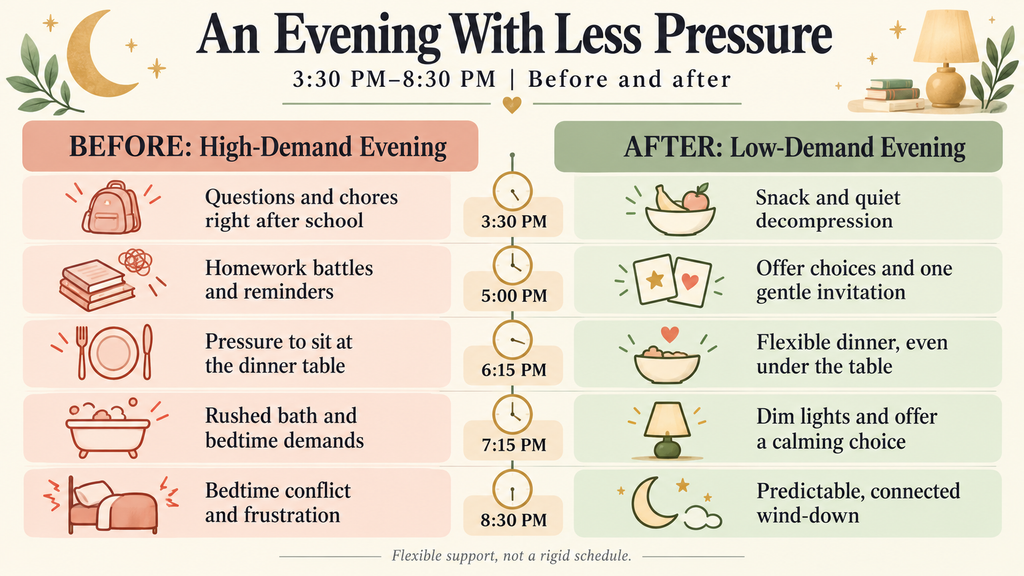
What Does a Low-Demand Evening Actually Look Like?
A low-demand evening protects the hours after school. Snack and quiet come first, before talk or homework. Dinner happens wherever it works tonight. Requests become comments, like “The bath is warm when you’re ready.” Bedtime keeps its anchor time but drops the extra steps.
Here is one evening, before and after.
| Time | High-demand evening | Low-demand evening |
| 3:30 | “How was school? Did you eat your lunch?” | Snack waiting. No questions. |
| 4:30 | Homework at the table, right now | Quiet time first. Homework later, or less of it. |
| 6:00 | Everyone at the table, phones away | Dinner wherever it works, even the floor |
| 7:00 | “Bath. Now.” | “The bath is warm when you’re ready.” |
| 7:45 | Pajamas, teeth, books, prayers, in order | Anchor time stays. Extra steps go. |
| 8:30 | Lights out after a fight | Lights out, or close to it |
Words that lower the pressure
The words matter as much as the schedule. A comment lands softer than a command. The PDA Society UK suggests statements and observations instead of direct requests. Another of its ideas is to ask your child for help, which hands them some control.
Try these.
- “Dinner’s on the coffee table tonight.”
- “Your pajamas are on the bed.”
- “I’m going to brush my teeth. Your toothbrush is next to mine.”
- “I can’t remember where the bath toys go. Can you show me?”
- “You don’t have to talk. I’ll just sit here.”
Say them once. Then let them sit in the air.
Your tone carries the message more than the words. Slow down. Lower your voice. Sit down if you can.
Low-Demand Parenting Examples: 12 Everyday Swaps
Low-demand parenting examples are small swaps, not big speeches. A command becomes a comment. A rule becomes a choice, or it waits for another day. Here are twelve real swaps for the hardest parts of the day, from the school run to lights out.
| Instead of | Try |
| “Put your shoes on now.” | Shoes by the door. “We leave in five minutes.” |
| “How was school?” | A snack and quiet. Talk later, if at all. |
| “Do your homework first.” | Rest first. Then one page, side by side. |
| “Sit at the table.” | Dinner on a tray, a picnic rug, or under the table. |
| “Eat your vegetables.” | One safe food on every plate. |
| “Say sorry.” | Repair later, when everyone is calm. |
| “Clean your room.” | One shelf together, or leave it this week. |
| “Get in the bath.” | “The bath is warm when you’re ready.” |
| “Turn it off now.” | “Two more minutes, then the calm show.” |
| “Look at me when I’m talking.” | Talk side by side, in the car or on a walk. |
| “Get dressed.” | Clothes laid out in the warmest room. |
| “Brush your teeth.” | “I’m brushing mine. Yours is next to it.” |
None of these swaps is about winning. Each one takes a little weight off the moment.
What About the Demands on Me? Low-Demand Parenting and Parent Burnout
Low-demand parenting includes you. In 2024, the US Surgeon General reported that 48 percent of parents feel overwhelming stress most days. An Ohio State report linked parental burnout with irritability and harsher parenting. Lowering your own load, with paper plates or simpler dinners, is part of the method.
The numbers are not small.
- The 2024 Surgeon General advisory reported that 48 percent of parents say their stress is completely overwhelming on most days, compared with 26 percent of other adults.
- In a Pew Research Center survey of 3,757 US parents, published in 2023, 62 percent said parenting has been harder than they expected. A quarter said a lot harder.
- In an Ohio State survey run in 2021 and released in 2022, 66 percent of working parents met the criteria for burnout. Burnout was linked with being irritable, getting easily angered with children, and punitive parenting.
- Psychologists Isabelle Roskam and Moïra Mikolajczak estimate that about 5 percent of parents worldwide live with parental burnout.
Read that Ohio State finding again. Burnout made calm parents harsher.
Your calm is not a personality trait. It is a resource. It runs out.
Diekman lowered her own load too. For a season, her family used paper plates and ate a lot of premade smoothies, frozen waffles, cheese and crackers, and sandwiches. That freed her to focus on her children.
Try a drop list for yourself.
- Cereal for dinner one night a week.
- Paper plates for a hard week.
- Laundry clean but unfolded.
- Say no to one obligation this month.
- Lower your own bar for what a good day looks like.
You are allowed to need less from yourself too.
When Does Low-Demand Parenting Go Wrong?
It goes wrong in four common ways. You drop demands for your child but none for yourself. Demands keep sliding until basic care slips. Siblings start to resent it. Or you stop too soon. Holding a boundary on safety is not failing at low-demand parenting.
1. Only your child gets relief
You carry every dropped demand yourself. You get more tired. Then you snap. The fix is the drop list above.
2. Demand creep
You drop one demand. Then the next. Then the next. Some professionals raise this concern. Over time, even basics like washing or eating can start to slide. Watch for it. Health and safety are never on the drop list.
3. Siblings feel left out
One child gets a softer evening. Another notices. Tell them plainly. “Your brother needs less right now. When you need less, you’ll get it too.” Then mean it.
4. Stopping too soon
A child in a hard season does not settle in three days. Coaches who work with burned-out families say the pulling back often needs to go further, and last longer, than feels comfortable.
And one more thing. Holding a boundary that protects safety, family needs, or your values does not mean you are being too strict or getting low-demand parenting wrong.
How to bring demands back
- Wait for a calm stretch of several good days.
- Bring back one demand at a time.
- Start with the smallest version. One page of homework, not five.
- Do it alongside your child at first.
- If the storm comes back, drop it again. That is information, not failure.
How Do I Explain Low-Demand Parenting to My Partner, Parents, or School?
Keep it short and calm. Name the goal, not the method. For example: “We’re lowering the pressure for a few weeks so things can settle. Safety rules haven’t changed.” You don’t owe anyone a full defense of your parenting.
Judgment is part of this. One Montana mom recalls being told she was too permissive while she was still searching for help for her son.
You can’t stop people thinking it. You can choose your reply.
To your partner: “Can we try this for three weeks and see? We keep safety and bedtime. Everything else we decide together.”
To a grandparent: “I know it looks soft. We’re doing it on purpose right now. I’d love your support.”
To a teacher: “Evenings are hard for us right now. Can we talk about shortening homework for a few weeks?”
If you and a co-parent disagree on the whole approach, see
Does Low-Demand Parenting Work? What the Research Says
The honest answer is that we don’t know yet. No large trials exist. A 2025 study of mothers found the approach anecdotally helpful. A small 2026 pilot parent program was feasible but had no comparison group. Psychologists report that compliance-based methods often escalate distress.
Here is what exists.
- In 2025, Sam Curtis and Elizabeth Izett noted there is little research on how parents can help PDA children. They called a low-demand approach “at least anecdotally effective.”
- In a 2023 study led by Lauren Haire, practising psychologists said compliance-based approaches often escalated distress. Flexible, low-demand, anxiety-aware strategies seemed to work better.
- A 2026 pilot of a 12-week parent program, led by Noelle Carlozzi, found it feasible and acceptable to parents. Parents reported a better quality of life. The study had no comparison group, so the findings are preliminary.
So here is the tradeoff.
The likely benefit is fewer fights and a calmer home.
The real costs are your time, more thinking in the moment, and other people’s opinions. One parent and counselor describes constantly weighing her child’s capacity, her own capacity, safety, and growth, all just to decide whether to push or let go.
You know your family. You get to weigh it.
Low-Demand Parenting Terms, Explained
- Low-demand parenting: Noticing the demands on a child, then dropping or softening the ones that aren’t essential right now.
- Demand: Any request, expectation, or pressure a child feels, spoken or not.
- Demand avoidance: Resisting or escaping demands. Everyone does this a little. Some children do it intensely.
- Pathological demand avoidance (PDA): A proposed profile of autism marked by extreme avoidance of everyday demands. It is not formally recognized in the DSM-5-TR or ICD-11. Many people prefer the name “pervasive drive for autonomy.”
- Declarative language: Statements and observations instead of commands. “The bath is warm” rather than “Get in the bath.”
- Intolerance of uncertainty: Finding it very hard to cope with not knowing what comes next.
- Low-arousal approach: A calm voice, calm body, and calm room, used to lower distress before it peaks.
- Parental burnout: Overwhelming exhaustion in the parent role, emotional distance from your children, and a sense of being ineffective as a parent.
Low-Demand Parenting FAQs
How long should I try low-demand parenting?
Think in weeks, not days. A child in a hard season needs time to trust that the pressure is really gone. Give one change at least a few weeks before you judge it.
Does low-demand parenting work for toddlers and teens?
The idea fits every age. The shape changes.
- Toddlers: fewer transitions, more choices between two things, and lots of help with routines.
- School-age kids: protect after-school time and shrink homework fights.
- Teens: more say in their own schedule, fewer check-ins, and clear limits on safety.
What about screen time?
Screens are a bend, not an automatic drop. Some families loosen limits during a hard season. If you do, keep a calm wind-down before bed and watch how sleep goes.
Will my child ever learn to do hard things?
Lowering demands in a hard season is not lowering them forever. Skills tend to grow when a child feels safe enough to try. You bring demands back slowly as capacity returns.
Is low-demand parenting the same as gentle parenting?
They overlap in warmth. Gentle parenting is a broad style for everyday life. Low-demand parenting is more specific. It deliberately reduces the number of demands, often for a season.
Is low-demand parenting good for kids with ADHD?
Some families of kids with ADHD find parts of it helpful, especially in a hard season. It does not replace care from your child’s doctor. Any treatment plan stays in the keep column.
Can low-demand parenting make behavior worse?
It can if demands keep sliding with no plan, or if safety limits drop. Watch for basics like eating, washing, and sleep slipping. If they do, bring one demand back, in its smallest form.
Is low-demand parenting lazy parenting?
No. It usually takes more thought, not less. You are reading your child’s capacity all day and choosing on purpose what to hold and what to set down.
When to Talk to a Professional
Low-demand parenting is not a treatment. Call your pediatrician or a child psychologist if you see:
- Aggression that puts anyone at risk
- School refusal that lasts more than a few days
- Lost skills, like talking, toileting, or sleeping
- Any talk of self-harm
If your child or you are in crisis, call or text 988 in the US. It is free, any hour, any day.
I am not a clinician. This guide is for understanding, not diagnosis.
Tonight, Set One Thing Down
Go back to that kitchen floor.
The pasta is still cold. The shoe is still on one foot. Nothing about the room has changed.
But you have.
You know now that the shoe can stay on. Dinner can happen under the table. The bath can wait an hour. The world will not end.
You don’t have to fix the whole evening tonight. Just pick one demand and set it down. Then watch what your child does with the space.
Tonight, the table can wait. Your child can’t.
About the Author
Muhammad Zubair Sarwar is a dedicated family wellness researcher, content creator, and the founder of familybloomhub.com.
Passionate about bridging the gap between clinical behavioral science and everyday parenting, he specializes in creating actionable, evidence-based frameworks that help parents navigate early childhood dynamics, toddler behavior challenges, and modern digital boundary-setting.
To ensure the highest level of authoritativeness and accuracy for the Family Bloom Hub community, Muhammad has built a robust foundation in behavioral sciences.
He successfully completed the foundational Introduction to Psychology curriculum from Yale University and holds a formal certification in Positive Psychiatry and Mental Health from the University of Sydney through Coursera.
By blending positive psychology principles with practical, real-world tools, his mission is to empower global parents to foster emotional regulation, build resilient relationships, and raise thriving children.
How this guide was written: This guide draws on 14 sources. They include peer-reviewed studies, a CDC report, Pew Research Center data, and the 2024 US Surgeon General advisory. Every number carries its year. Where the research is thin, we say so. The author is not a clinician. Read our Editorial standards and Medical disclaimer.
References
- Diekman, A. (2023). Low-Demand Parenting: Dropping Demands, Restoring Calm, and Finding Connection with Your Uniquely Wired Child. Jessica Kingsley Publishers.
- Stuart, L., Grahame, V., Honey, E., & Freeston, M. (2019). Intolerance of uncertainty and anxiety as explanatory frameworks for extreme demand avoidance in children and adolescents. Child and Adolescent Mental Health. doi.org/10.1111/camh.12336
- Kildahl, A. N., et al. (2021). Pathological demand avoidance in children and adolescents: A systematic review. Autism, 25(8), 2162–2176. PubMed
- Green, J., et al. (2018). Pathological Demand Avoidance: symptoms but not a syndrome. The Lancet Child & Adolescent Health. Summary at PDA Society
- Curtis, S., & Izett, E. (2025). The experience of mothers of autistic children with a pathological demand avoidance profile. Discover Mental Health. PMC
- Haire, L., Symonds, J. E., Senior, J., & Pace, U. (2023). Practising psychologists’ accounts of demand avoidance and extreme demand avoidance in children and adolescents. PDA Society
- Carlozzi, N. E., et al. (2026). The Paradigm Shift Program pilot study. Pediatric Investigation, 10(3), 249–257. PubMed
- Neff, M. A. Low-Demand Parenting: What It Is, Why It Helps PDA Kids, and How to Start. Neurodivergent Insights. Article
- Office of the US Surgeon General (2024). Parents Under Pressure: advisory on the mental health and well-being of parents. [LINK: official HHS page, verify URL]
- Pew Research Center (2023). Parenting in America Today. Report
- The Ohio State University (2022). Working parent burnout report. Ohio State College of Nursing
- Roskam, I., & Mikolajczak, M. (2026). Understanding Parental Burnout: Significance and Implications, citing their 2021 study across 42 countries. doi.org/10.15291/9789533316055.01
- CDC (2025). Prevalence and Early Identification of Autism Spectrum Disorder Among Children Aged 4 and 8 Years, ADDM Network, 2022. MMWR
- PDA Society UK. Helpful approaches for children. PDA Society
- Berney, J. (2024). Low-Demand Parenting Is All About Building Trust By Giving In. Romper. Article