
Physical Symptoms of Parental Burnout: 9 Signs Your Body Is Done Pretending

Why your jaw, shoulders, and stomach feel it first, what the research on stress hormones shows, and three free resets that take under two minutes tonight.
The short answer
Yes. Parental burnout can show up in your body before you name it in your mind. Common physical signs include exhaustion that sleep does not fix, a clenched jaw, tight shoulders, stomach trouble, headaches, and getting sick more often. In a 2020 study, parents with burnout had more than double the stress hormone of other parents.
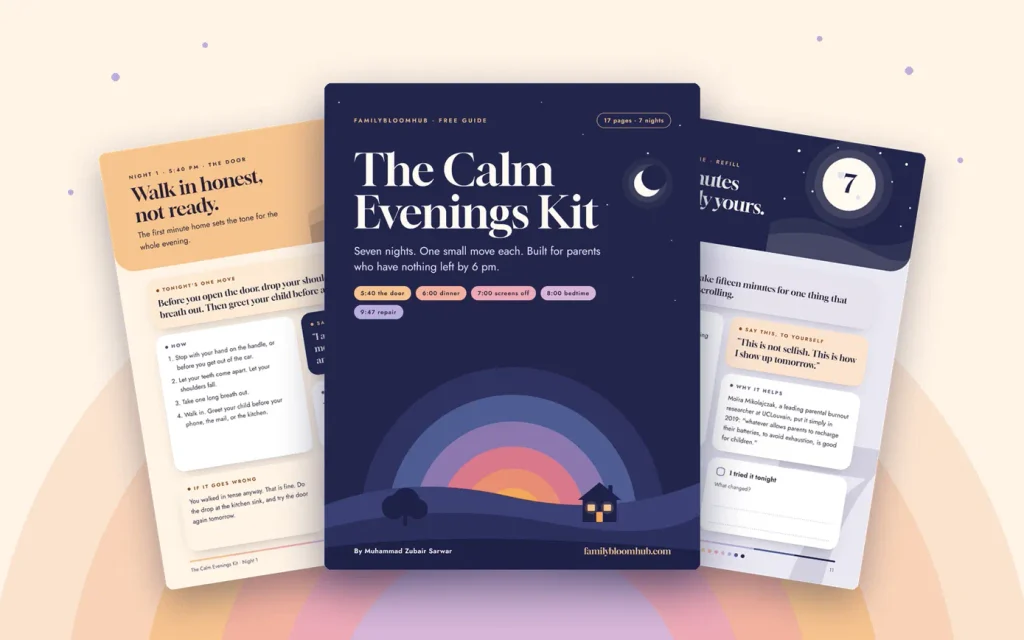
Get Your Free
The Calm Evening Kit
Free tool · 60 seconds
The 60-Second Body Check
Three quick questions about where stress hides: your jaw, your breath, and your shoulders. No sign-up. It does not diagnose anything. It shows what your body is doing right now and gives you one reset to match.
Your body is braced right now.
The tightest spots: . That is your stress response doing its job, just for longer than it should.
- Breathe in through your nose.
- At the top, take one more short sip of air through your nose.
- Breathe out slowly through your mouth, as long as you can.
- Repeat three times, then let your breath settle.
Source: Balban et al., 2023, Stanford University, Cell Reports Medicine. Five minutes a day of cyclic sighing improved mood more than mindfulness meditation.
Your body is half on alert.
Holding on most: . A quick release now can stop the tension building through the evening.
- Stop where you are. Let your arms hang.
- Let your shoulders fall away from your ears.
- Let your teeth come apart. Rest your tongue.
- Take one long, slow breath out.
- Repeat once more, then carry on.
Source: American Psychological Association, Stress effects on the body. Long stress keeps muscles guarded.
Your body is fairly settled right now.
Nice work. Keep this calm for the next hard hour.
- Close your lips.
- Breathe in through your nose.
- Hum one low note on the way out, as long as it lasts.
- Repeat four or five times.
Humming research is thin, so treat this as a gentle option. It stretches your out-breath, the part that made the 2023 Stanford sighing study work.
It is 5:40.
You are standing at the kitchen counter. The coffee you made at noon is still there. It is cold.
Then you notice your jaw.
Your teeth are pressed together. Hard. You do not know how long they have been like that. Since the school called, maybe. Since breakfast.
Your shoulders are up near your ears. Your stomach is a fist.
Someone calls your name from the next room.
You tell yourself you are just tired. Everyone is tired.
But tiredness goes away when you sleep.
This does not.
The short answer
Yes. Parental burnout can show up in your body before you name it in your mind. Common physical signs include exhaustion that sleep does not fix, a clenched jaw, tight shoulders, stomach trouble, headaches, and getting sick more often. In a 2020 study, parents with burnout had more than double the stress hormone of other parents.
I know that kitchen. I know the doorway too.
It was 9:30 when I got home. I stood in the doorway with my car keys still in my hand.
My son came to the bottom step. He was holding his drawing book.
“Dad, play with me.”
“Later, okay,” I said.
I did not move. I did not put the keys down. My jaw was tight. I could feel it.
He waited. Then he sat down alone on the step.
Later I found the book on the floor. It was still open.
Here is what I found. Your body is not failing you. It is telling the truth you have been too busy to say out loud.
In this guide:
- Why stress from parenting shows up in your body
- A 60-second body check you can take right now
- The 9 physical signs and why each one happens
- How to tell tired from burned out
- Why the hardest hour is the one at the door
- What dads need to hear about this
- Three free resets that take under two minutes
- When to see a doctor
Can parental burnout cause physical symptoms?

Yes. Parental burnout is a real, studied condition, and it lives in the body as well as the mind. In a 2020 study at UCLouvain in Belgium, parents with burnout had more than double the stress hormone cortisol in their hair. A long, high stress load like that is linked to aches, poor sleep, and getting sick.
You are not imagining this.
In 2020, researchers Maria Elena Brianda, Isabelle Roskam, and Moïra Mikolajczak studied 178 parents. They measured cortisol in a small piece of each parent’s hair.
Hair grows about one centimeter a month. So a strand keeps a record of stress over months, not minutes.
Here is what they found:
- Parents with burnout averaged 99.90 units of cortisol.
- Parents without burnout averaged 46.83.
- That is more than double.
The researchers were honest about the limits. About a third of the burned-out parents had normal levels. So this is a pattern across many parents, not a test you can take at home.
What cortisol does
Cortisol is your body’s alarm hormone.
It is meant to rise, carry you through a hard moment, and then fall.
In burnout, it does not fall. The alarm stays on.
The same Belgian team writes that this long alarm is most likely part of why burned-out parents report body pain and poor sleep.
You are not the only one.
In a 2023 survey by the American Psychological Association, 41% of US parents said most days they are so stressed they cannot function. Among adults without kids, it was 20%.
The US Surgeon General put that number in a national advisory in 2024.
If you keep telling yourself, “I should be able to handle this,” read that number again.
Four in ten parents.
That is not a weak parent. That is a heavy load.
What are the physical symptoms of parental burnout?
The most common physical symptoms of parental burnout are exhaustion that sleep does not fix, tight shoulders, a clenched jaw, stomach trouble, afternoon headaches, feeling touched out, shallow breathing, getting sick often, and lying awake at night. Kaiser Permanente lists several of these in a guide reviewed by a doctor in February 2026.
You may have one of these. You may have all nine.
Read them slowly. Notice which ones made your body react.
1. Exhaustion that sleep does not fix
You sleep. You wake up tired. You go to bed even more tired.
This is the sign parents name most often. They call it running on empty.
It is different from a late night. A late night gets better after a good sleep. This does not.
Writing in Psychology Today in February 2026, parenting researcher Jen Lumanlan named it as a key warning sign: rest stops working.
Why? Cortisol normally rises when you wake and falls slowly through the day, says the American Psychological Association. Under long stress, the alarm never fully switches off. So your body never fully rests, even in bed.
- Notice it: You wake up and feel like you never went to sleep.
2. Shoulders braced up by your ears
Touch your shoulders right now. Are they high?
When your body senses danger, your muscles tighten to protect you. The American Psychological Association calls this a reflex. It is the body bracing for a blow.
The trouble is, a parent’s danger never really ends. The next spill. The next fight. The next call from school.
So the muscles stay tight. For hours. For weeks.
That is why your neck aches at the end of the day.
- Notice it: Your shoulders drop an inch when you finally sit down at night.
3. A jaw that stays clenched
You catch yourself with your teeth pressed hard together.
Or you wake up and your jaw feels sore.
The jaw is one of the first places stress hides. It is the body holding back words it did not say.
If you grind your teeth at night or your teeth feel sore, see your dentist. They can check for damage and help protect your teeth.
- Notice it: Your tongue is pressed to the roof of your mouth right now.
4. A stomach in knots
Your stomach feels tight, sour, or upset. Food does not sit right.
This is not all in your head. Your brain and your gut talk to each other all day long. Scientists call this the brain-gut axis.
In a 2020 review, Alexandra Labanski and her team described how stress changes the signals running between the brain and the gut. That can change how your stomach feels and works.
Kaiser Permanente lists stomach upset as a physical sign of parental burnout.
- Notice it: Your stomach tightens when you hear the car seat buckle or the school bell app ping.
5. Headaches that start in the afternoon
The headache starts as a band. Then it squeezes.
Often it arrives after lunch, right as the second shift of the day begins.
Headaches are the physical sign named most across burnout guides. Kaiser Permanente lists them first among body signs.
The American Psychological Association links tension headaches to long-lasting muscle tension in the shoulders, neck, and head. By late afternoon, that tension has been building for hours.
- Notice it: Your headache eases on the rare day someone else does pickup.
6. Feeling touched out
Your child reaches for you. And your whole body wants to pull away.
Then comes the guilt.
Parents describe it the same way again and again. Little hands are always grabbing. Your body does not feel like your own.
Being touched out is not a lack of love. It is a full cup.
Your body has taken in more touch, noise, and need than it can hold. Pulling back is how it asks for space.
- Notice it: A hug you would have loved at noon feels like too much at 6 pm.
7. Holding your breath
You are buckling a car seat. Or running a bath. Or getting shoes on.
And you realize you have not breathed in a while.
Under stress, breathing turns fast and short. The American Psychological Association lists shortness of breath and rapid breathing among stress effects on the body.
Shallow breathing tells your brain the danger is still here. So the alarm stays on. It is a loop.
The good news? Breathing is also the fastest way out. The resets below show you how.
- Notice it: You let out a big breath the moment the kids are finally buckled in.
8. Catching every bug
The cold goes around the house. You catch it. Then you catch the next one too.
Kaiser Permanente lists getting sick more often as a sign of parental burnout. A long stress load can weaken the immune system.
Psychologists at the American Psychological Association’s clinical division point to the same Belgian burnout research. They link a long, high stress load to a weaker defense against viruses.
This does not mean every cold is a burnout. It means a body under constant alarm has less left over to fight back.
- Notice it: You get sick every time things slow down, like the first day of a break.
9. Wired at night, tired all day
The house is finally quiet. And your mind starts to race.
You replay the yelling. You plan tomorrow. You check the clock.
In a 2018 study of 1,551 parents, Mikolajczak and her team linked parental burnout to sleep problems.
The alarm that kept you going all day does not know the day is over.
- Notice it: You are exhausted on the couch but wide awake once your head hits the pillow.
Am I just tired, or is this burnout?
Tiredness gets better with rest. Burnout does not. If a good night’s sleep or a quiet weekend no longer helps, and you feel far from your kids or far from the parent you used to be, that points toward burnout, not normal tiredness. The table below shows the difference side by side.
| Question | Just tired | Burned out |
| Does a good night’s sleep help? | Yes | Not really |
| Does a free weekend help? | Yes, you feel like yourself again | Barely, or you feel worse |
| How long has it lasted? | Days | Weeks or months |
| How does your body feel? | Heavy, sleepy | Tight, wired, sore, on alert |
| How do you feel about your kids? | Close, just low on energy | Far away, numb, or touched out |
| Do you feel like a good parent? | Mostly yes | Not like the parent you used to be |
| What does the evening feel like? | Long | Like something to survive |
The last two rows matter most.
Belgian researchers Isabelle Roskam, Maria Elena Brianda, and Moïra Mikolajczak built a parental burnout scale in 2018. It looks at four things:
- Deep exhaustion from the parenting role
- Feeling emotionally far from your children
- Feeling fed up with being a parent
- A sharp contrast with the parent you used to be
That last one is the quiet heartbreak of burnout. You remember being the fun parent. Now you are the tired one.
If you saw yourself in the right-hand column, you are not a bad parent. You are a parent who has carried too much for too long.
Why does it hit hardest when you walk in the door?
The evening is when your body’s stress bill comes due. You have held it together all day at work or with the kids. Then you walk through the door into the busiest hour: dinner, homework, baths, and bedtime. Your body is already spent, and the hardest shift is just starting.
Maybe you held it together at work all day.
Or you held it together at home since 6 am.
Either way, the door is where the holding stops.
Your brain is full before the evening begins
The US Surgeon General’s 2024 advisory on parents names the hidden work of parenting. You track schedules. You guess what each child will need next. You make countless small choices for them every day.
The advisory says this load can shrink your working memory and drain your attention.
So by 5:40, your brain is already running hot.
Your body is in the wrong mode for the hour
The evening asks for patience, play, and a soft voice.
But a body on alert is built for speed and defense, not patience.
That is why a spilled cup at 6 pm can feel like an emergency. Your body is not reacting to the cup. It is reacting to the whole day.
What the door moment looks like
- You sit in the car for a few minutes before going inside.
- Your shoulders rise as you reach for the handle.
- You hear the noise inside and your stomach drops.
- You walk in already braced.
What to say at the door
You do not have to arrive ready. You can arrive honest.
Try this with your child:
- “I am so happy to see you. Give me two slow breaths, then I am all yours.”
Then take the two breaths. Out loud, if you like. Your child gets to watch you calm down. That is a lesson all by itself.
If evenings are the hard part, the free Six O’Clock Planner can map your dinner, screens-off, and bedtime around the hour you actually get home. [LINK: Six O’Clock Planner]
Is parental burnout different for dads?
Yes, dads get parental burnout too. In a 2021 Ohio State University survey of 1,285 working parents, 42% of fathers met the criteria for burnout, compared with 68% of mothers. Fathers often carry it differently: as guilt about time missed, and as a body that stays braced on the drive home.
This section is for you if you get home after the light has gone.
The time guilt
In a Pew Research Center survey, 46% of fathers said they do not spend enough time with their children. For mothers, it was 23%.
That guilt cuts deep. In Pew’s data, only 49% of working dads who felt they spent too little time with their kids said they were doing a good job as a parent. Among dads who felt their time was about right, 81% did.
So the dad who gets home late is often the dad grading himself hardest.
The doorway dread
Some fathers dread the door and feel ashamed of it.
The noise. The crying. The feeling that home should be rest, and it is not.
If that is you, hear this. Dreading the evening does not mean you do not love your kids. It means your body has nothing left by the time you get there.
What a dad’s burnout can look like in the body
- A jaw that is tight by the end of the commute
- Gripping the steering wheel or the car keys
- Snapping fast, then going quiet
- Zoning out on the phone after the kids are in bed
- Feeling numb when you wanted to feel close
One thing to try tonight
Before you get out of the car, put your keys in your lap. Let your hands go loose. Take three slow sighs. Then go in.
Your child does not need you perfect. They need you to put the keys down.
How do I calm my body down fast?
The fastest way to calm a stressed body is a long, slow out-breath. In a 2023 Stanford study, five minutes a day of “cyclic sighing” improved mood and slowed breathing more than mindfulness meditation. Below are three free resets that take under two minutes, and you can do every one of them with a child in the room.
First, permission
You may feel guilty taking two minutes for yourself.
So here is what the scientist who has studied parental burnout most closely told reporters in 2019. Moïra Mikolajczak said that “whatever allows parents to recharge their batteries, to avoid exhaustion, is good for children.”
Two minutes for you is two minutes for them.
Reset 1: The physiological sigh (under 1 minute)
This is the reset with the strongest research behind it.
- Breathe in through your nose.
- At the top, take one more short sip of air through your nose.
- Breathe out slowly through your mouth, as long as you can.
- Repeat three times.
Why it works: In 2023, Melis Yilmaz Balban, David Spiegel, Andrew Huberman, and their team at Stanford ran a month-long trial. People who practiced cyclic sighing for five minutes a day had better mood and slower breathing than people who meditated. The long out-breath was the key.
Honest note: The study used five minutes a day. Three sighs is a start, not the full dose. Add more when you can.
Reset 2: The shoulder drop at the door (30 seconds)
This one undoes the three tight spots from the body check.
- Stop with your hand on the door handle, or before you get out of the car.
- Let your shoulders fall away from your ears.
- Let your teeth come apart. Let your tongue rest.
- Take one long breath out.
- Then walk in.
There is no study for this exact routine. It simply releases the jaw and shoulder tension the American Psychological Association links to stress, at the moment the evening begins.
Reset 3: The slow hum (1 minute)
- Close your lips.
- Breathe in through your nose.
- Hum one low note on the way out, as long as it lasts.
- Repeat four or five times.
The research on humming itself is thin, so treat this as a gentle option. What it does for sure is stretch your out-breath, the same part that made the sigh study work.
Kids often join in. Let them. A humming kitchen is a calmer kitchen.
What to say while you reset
- “I need two slow breaths. Then I am all yours.”
- “My body is tight. I am going to let it go. Want to try with me?”
- “I am not mad at you. I am just tired. Give me one minute.”
Keep it where you can see it
Put the three resets on your fridge. Download the free Somatic Emergency Blueprint, a one-page reset card for the moments when the evening peaks.

GET YOUR FREE
Somatic Emergency Blueprint
When should I see a doctor?
See a doctor if your body symptoms last for weeks, keep getting worse, or stop you from doing daily tasks. Some symptoms, like chest pain or fainting, need care right away. Burnout is not a medical diagnosis, and many of its body signs can also come from other health problems a doctor should rule out.
This guide explains. It does not diagnose. Only a doctor who knows you can do that.
Book a visit with your doctor if:
- Your symptoms have lasted more than two weeks
- You feel dizzy, lightheaded, or off balance
- You hear ringing in your ears
- Your headaches are new, severe, or getting worse
- Your stomach pain, weight, or appetite has changed a lot
- Your teeth or jaw hurt every morning
- You can no longer do the basics, like showering, eating, or getting to work
- You are using alcohol or other substances to get through the evening
Get help right away if:
- You have chest pain, trouble breathing, or you faint. Call 911.
- You have thoughts of harming yourself, or of leaving and never coming back. Call or text 988, the Suicide and Crisis Lifeline, any time, day or night.
- You are pregnant or a new mom and struggling. Call or text the Maternal Mental Health Hotline at 1-833-TLC-MAMA (1-833-852-6262).
What to say to your doctor
It can be hard to start. You can simply read this out:
- “I have been exhausted for weeks, and sleep does not help.”
- “My body is tight and sore, and I think stress is part of it.”
- “I am a parent, and I am not coping the way I used to.”
Asking for help is not failing. It is the most grown-up thing a tired parent can do.
Frequently asked questions
Can stress from parenting make you physically sick?
It can play a part. Kaiser Permanente lists getting sick more often among the physical signs of parental burnout. The American Psychological Association explains that long-term stress can disrupt how the immune system and stress hormones work together. If you are sick often, see your doctor to rule out other causes.
How long does parental burnout last?
There is no set timeline. Burnout builds when the load on a parent outweighs their support for a long time. It usually eases when that balance changes: more rest, more help, less pressure. If you see no change after a few weeks, or things get worse, talk to your doctor or a counselor.
Why do I feel worse on weekends?
Weekends often mean more hours of parenting with fewer breaks. Researchers at UCLouvain have found that parental burnout is its own condition, separate from job burnout. So a weekend away from work may not feel like rest, because the part of life wearing you down is still there.
Is being touched out a sign of burnout?
On its own, no. Most parents feel touched out sometimes, especially with small children. It becomes a warning sign when it happens most days, comes with exhaustion that sleep does not fix, and leaves you feeling far from your kids. Then it is your body asking for real relief.
Can dads get parental burnout?
Yes. In Ohio State University’s 2021 survey of working parents, 42% of fathers met the criteria for burnout. Dads often show it as tight jaws and shoulders, snapping fast, going numb, or guilt about time missed. Burnout is about the load you carry, not whether you are a mom or a dad.
Your body has been on your side all along
Go back to the kitchen for a moment.
The cold coffee. The tight jaw. The shoulders up by your ears.
None of that was your body failing you. It was your body keeping count of everything you carried and never put down.
And here is the part the hard days hide. In Pew Research Center’s 2023 survey, about 8 in 10 US parents said parenting is enjoyable and rewarding most of the time. You can be worn out and still love this. Most parents are both.
You do not need a retreat. You do not need a new you.
You need two minutes, and one long breath out.
Tonight, try just this:
- Notice one tight spot: jaw, shoulders, or breath.
- Let it go, once.
- Take three slow sighs before the hardest hour.
- Tell your child, “Two breaths, then I am all yours.”
That is enough for today.
Your body was never against you. It was the only one still telling the truth.
Sources
- Brianda, M. E., Roskam, I., & Mikolajczak, M. (2020). Hair cortisol concentration as a biomarker of parental burnout. Psychoneuroendocrinology, 117.
- Mikolajczak, M., Roskam, I., and colleagues. Overview of parental burnout research. UCLouvain.
- Mikolajczak, M., Brianda, M. E., Avalosse, H., & Roskam, I. (2018). Consequences of parental burnout. Child Abuse and Neglect, 80.
- Mikolajczak, M., Gross, J. J., & Roskam, I. (2019). Parental burnout: What is it, and why does it matter? Clinical Psychological Science. ScienceDaily summary
- Roskam, I., Brianda, M. E., & Mikolajczak, M. (2018). The Parental Burnout Assessment. Frontiers in Psychology, 9. Framework paper
- Balban, M. Y., Spiegel, D., Huberman, A. D., and colleagues (2023). Brief structured respiration practices enhance mood and reduce physiological arousal. Cell Reports Medicine, 4(1).
- Labanski, A., Langhorst, J., Engler, H., & Elsenbruch, S. (2020). Stress and the brain-gut axis. Psychoneuroendocrinology.
- Office of the US Surgeon General (2024). Parents Under Pressure.
- American Psychological Association (2023). Stress of parents compared to other adults.
- American Psychological Association. Stress effects on the body. Last reviewed October 2024.
- Kaiser Permanente (2026). Preventing parental burnout. Reviewed by Silvia Teran, MD.
- Pew Research Center (2023). Parenting in America Today.
- Pew Research Center. Modern Parenthood and working dads and parenting.
- Gawlik, K., & Melnyk, B. (2022). Working parent burnout report. The Ohio State University.
- Lumanlan, J. (2026). Parental burnout symptoms and the shame cycle explained. Psychology Today.
Medical disclaimer
This article is for general education only. It is not medical advice, diagnosis, or treatment. The author is not a doctor or therapist. Always talk to a qualified health professional about your symptoms. If you are in crisis, call or text 988 in the US.
About the author
Muhammad Zubair Sarwar is a dedicated family wellness researcher, content creator, and the founder of familybloomhub.com.
Passionate about bridging the gap between clinical behavioral science and everyday parenting, he specializes in creating actionable, evidence-based frameworks that help parents navigate early childhood dynamics, toddler behavior challenges, and modern digital boundary-setting.
To ensure the highest level of authoritativeness and accuracy for the Family Bloom Hub community, Muhammad has built a robust foundation in behavioral sciences.
He successfully completed the foundational Introduction to Psychology curriculum from Yale University and holds a formal certification in Positive Psychiatry and Mental Health from the University of Sydney through Coursera.
By blending positive psychology principles with practical, real-world tools, his mission is to empower global parents to foster emotional regulation, build resilient relationships, and raise thriving children.
One Response