
Authoritative, authoritarian, permissive, or uninvolved? Most parents are one style at 4 p.m. and another at bedtime. Here is what 50 years of research says and how to find your way back tonight.
By Muhammad Zubair Sarwar | Trained in Psychology (Yale) & Positive Psychiatry (Univ. of Sydney) | Updated: November 2026 · 22 min read · Checked against 21 named, dated sources
Key takeaways
- The 4 parenting styles are authoritative, authoritarian, permissive and uninvolved.
- Diana Baumrind described three styles in 1966. Eleanor Maccoby and John Martin added the fourth in 1983.
- Styles sit on two dials: warmth (responsiveness) and structure (demandingness).
- Authoritative parenting, high warmth plus clear limits, has the strongest research record (Pinquart, 2017, 1,435 studies).
- The links are small, and they run both ways. One bad night decides nothing.
- Many parents slide between styles as stress builds. FamilyBloomHub calls this the Evening Slide.
The short answer
The four parenting styles are authoritative, authoritarian, permissive, and uninvolved. Psychologist Diana Baumrind described the first three in 1966. Eleanor Maccoby and John Martin added the fourth in 1983. Research links authoritative parenting, warm with clear limits, to the best child outcomes. Most parents slide between styles, especially when they are tired.
In this guide
- What are the 4 parenting styles?
- Who created the 4 parenting styles?
- Authoritative parenting: definition, examples, and effects
- Authoritarian parenting: definition, examples, and effects
- Permissive parenting style: definition, signs, and effects
- Uninvolved parenting: definition, examples, and effects
- Which parenting style is best?
- Free self-check: Which style shows up tonight?
- Why does my parenting style change when I’m tired?
- Is gentle parenting permissive or authoritative?
- How to stop being a permissive parent tonight
- When partners have different parenting styles
- Why late-home parents give in more
- Can you change your parenting style?
- Do the 4 parenting styles fit every culture?
- Key facts and statistics
- FAQ
The four parenting styles are authoritative, authoritarian, permissive, and uninvolved. Psychologist Diana Baumrind described the first three in 1966. Eleanor Maccoby and John Martin added the fourth in 1983. Research links authoritative parenting, warm with clear limits, to the best child outcomes. Most parents slide between styles, especially when they are tired.
Jump to the free tools:
Which Style Shows Up Tonight? (self-check) · One Moment, Four Styles (printable card)
Free tool · Private · No sign-up
Start a 14-night mood and sleep log tonight
The 14-Night Mood and Sleep Log is a free, private notebook for your family. Each night, you spend one minute writing down sleep, mood, energy and anything you noticed. After two weeks, you print a one-page summary to bring to a doctor. It does not score anyone or suggest a diagnosis.
- Choose who the log is about.
- Each night, add one short entry.
- Watch the sleep and mood chart build.
- Print the summary and take it to the appointment.
FamilyBloomHub · 14-Night Mood and Sleep Log
Your log so far
No entries yet. Add tonight’s entry above to start your chart.
Summary for the appointment
Every entry
| Date | Sleep | Mood | Energy | Irritable | Noticed | Note |
|---|
Questions to ask the doctor
- Could these patterns be linked to a mood condition, sleep, a medicine, or something physical?
- What should we watch for before the next visit?
- What should we do if things get worse at night?
- Is there a family support program near us?
This log records what a family noticed. It is not a test and does not suggest any diagnosis. Made with the free 14-Night Mood and Sleep Log at familybloomhub.com.
How this log works, and where your notes are kept
The log follows advice from the National Institute of Mental Health, which suggests keeping a life chart or mood journal to help recognize mood swings. It records five things each night: sleep, mood, energy, irritability, and what you noticed. The ten “things you noticed” come from the plain-language symptom lists the National Institute of Mental Health publishes.
Sleep sits next to mood on the chart for a reason. In a 2017 study of 3,140 people with bipolar disorder, Katie Lewis and colleagues at Cardiff University found that about one in four said sleep loss had triggered an episode of high mood.
The log never adds up a score and never names a condition. Only a licensed health professional can do that.
Privacy: your entries are saved only in this browser, on this device. Nothing is sent to FamilyBloomHub or anyone else. If you clear your browser data, the log is erased. Use “Download as a spreadsheet” to keep a copy.
Sources: National Institute of Mental Health, Bipolar Disorder (publication and health topic pages). Lewis, K. J. S., et al. (2017), Sleep loss as a trigger of mood episodes in bipolar disorder, British Journal of Psychiatry.
Questions about the mood and sleep log
Can this log tell me if someone has bipolar disorder?
No. It records what you notice. Only a licensed health professional can diagnose bipolar disorder. What a log can do is give that professional two weeks of clear notes instead of a fuzzy memory.
Why does the log track sleep?
The National Institute of Mental Health lists a decreased need for sleep among the signs of a manic episode. In a 2017 Cardiff University study of 3,140 people with bipolar disorder, about one in four said sleep loss had set off high mood.
Where are my notes stored?
Only in your own browser on this device. Nothing is sent anywhere. You can download a copy or delete everything at any time.
It is 9:47 on a school night.
You said no to the tablet at 8:30.
You said it kindly. You said it twice.
Now the tablet is glowing under a blanket.
And you are the one who handed it over.
Not because you forgot the rule.
Because you had nothing left to hold it with.
You stand in the dark hallway and think it.
Am I a permissive parent now?
Here is what nobody tells you.
At four in the afternoon, you might be the parent the research praises.
Warm. Clear. Calm.
By ten at night, you might be one of the other three.
The four parenting styles are not four kinds of people.
They are four places a tired parent can land in one evening.
You can learn where you land.
And you can learn the way back.
From my own evenings
I got home at 9:40 with my work shoes still on.
He was awake. He reached for my phone.
“Dad, one more cartoon.”
I said no. I said it from the doorway, in my office voice.
He cried. Not loud. The tired kind.
I stood there with one shoe off and the other still tied.
Then I took the phone out of my pocket and gave it to him.
He watched three.
At 10:25 I found him asleep with the phone on his chest.
It was still playing.
What are the 4 parenting styles?
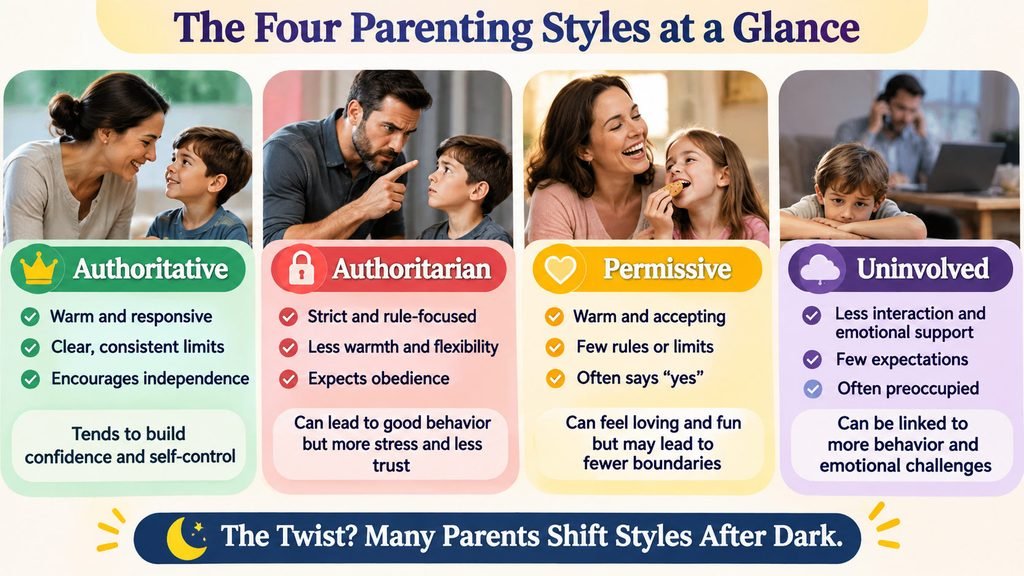
The 4 parenting styles are authoritative, authoritarian, permissive and uninvolved. Psychologists sort parents on two dials. One is warmth: how much you respond to your child’s feelings. The other is structure: how much you expect and follow through. Each style is one mix of those two dials.
Psychologists call the dials responsiveness and demandingness.
You can call them heart and edges.
The parenting styles chart
| Low structure | High structure | |
| High warmth | Permissive · warm, few limits | Authoritative · warm, clear limits |
| Low warmth | Uninvolved · little warmth, few limits | Authoritarian · firm limits, little warmth |
The 4 types of parenting styles compared
| Style | Also called | Warmth | Structure | Sounds like | Child may learn |
| Authoritative | Balanced, democratic | High | High | “Screens are done. I know that’s hard.” | Rules and love live together |
| Authoritarian | Strict, disciplinarian | Low | High | “Because I said so.” | Rules come from power |
| Permissive | Indulgent, lenient | High | Low | “Okay. Just one more.” | Rules bend if I push |
| Uninvolved | Neglectful, disengaged | Low | Low | Silence, or “Do whatever.” | I am on my own |
Who created the 4 parenting styles?
Diana Baumrind, a developmental psychologist at the University of California, Berkeley, created the parenting styles model. In 1966 she described three styles: authoritative, authoritarian and permissive. In 1983, Stanford psychologists Eleanor Maccoby and John Martin split permissive into two groups. That added the fourth style, uninvolved.
How the 4 parenting styles model grew
| Year | Researcher | What changed |
| 1966 | Diana Baumrind | Named three styles: authoritative, authoritarian, permissive |
| 1983 | Eleanor Maccoby & John Martin | Built the two-dial model and added uninvolved |
| 1991 | Susie Lamborn, Laurence Steinberg & colleagues | Tested all four styles in about 4,100 US teens |
| 2017 | Martin Pinquart | Pooled 1,435 studies on styles and behavior |
| 2018 | Martin Pinquart & Rubina Kauser | Tested the styles across cultures in 428 studies |
Authoritative parenting: definition, examples and effects
Authoritative parenting is a parenting style that combines high warmth with high, clearly explained expectations. Authoritative parents set firm limits, give reasons, and listen to their child’s feelings. The rule stays, and so does the connection. Research links this style to the best child outcomes of the four.
Authoritative parenting examples
- “Bedtime is 8. You can pick the book.”
- “You can be angry. You can’t hit. Let’s find another way.”
- “Homework comes before screens. Want help with the first problem?”
- “I hear you want to stay longer. We’re leaving in five minutes.”
- “Phone charges in the kitchen. That part isn’t up for debate.”
Effects of authoritative parenting
- Fewer behavior problems (Pinquart, 2017, 1,435 studies).
- Stronger school competence and self-confidence in teens (Lamborn et al., 1991, about 4,100 US teens).
- Good outcomes in every world region studied (Pinquart & Kauser, 2018, 428 studies).
What does authoritative parenting look like at each age?
Authoritative parenting by age
| Age | Warmth looks like | Structure looks like | One line to say |
| 2 to 4 | Naming big feelings out loud | Two choices, same routine every night | “Blue pajamas or red? Bed is next.” |
| 5 to 8 | Listening before answering | Short reasons, steady consequences | “We stop at 7:30 so your body can rest.” |
| 9 to 12 | Asking their opinion first | Rules written together, on the fridge | “You helped make this rule. Let’s keep it.” |
| 13 to 17 | Respecting privacy and views | A few firm non-negotiables: safety, sleep, honesty | “That part isn’t up for debate. The rest we can talk about.” |
The older the child, the more voice they get.
The limits never disappear. They get fewer and firmer.
Authoritarian parenting: definition, examples and effects
Authoritarian parenting is a parenting style that combines high demands with low warmth. Authoritarian parents expect obedience without explanation. Questions can feel like defiance. Rules are firm, but feelings get little room. Research links this style to more behavior problems and lower self-confidence in teens.
Authoritarian parenting examples
- “Because I said so.”
- “Stop crying or I’ll give you something to cry about.”
- “No dinner until homework is done.”
- “Don’t you dare talk back to me.”
Effects of authoritarian parenting
- More behavior problems (Pinquart, 2017).
- Teens follow rules but show lower self-confidence (Lamborn et al., 1991).
What is the difference between authoritative and authoritarian parenting?
Both keep firm rules. The difference is warmth and reasons. An authoritarian parent says, “Because I said so.” An authoritative parent says, “The answer is no. I know you’re upset. Here is why.” Same limit. One closes the conversation. The other keeps it open.
Authoritative vs authoritarian: same limit, two styles
| The moment | Authoritarian | Authoritative |
| Bedtime pushback | “I don’t care. Bed.” | “You want more time with me. Bed is at 8. Let’s make the story a good one.” |
| Talking back | “Don’t you dare speak to me like that.” | “You can be angry. You can’t call me names. Try again.” |
| Homework refusal | “No dinner till it’s done.” | “Homework before screens. Want help with the first one?” |
Many parents in their thirties and forties grew up with the left column. If you hear your father’s voice come out of your mouth at night, you are not a fraud. You are tired, and that is the habit your brain learned first.
Permissive parenting style: definition, signs and effects
The permissive parenting style is high in warmth and low in structure. Permissive parents are loving and close. They avoid conflict, rarely enforce rules, and often give in when a child pushes. Psychologists also call it indulgent parenting. The warmth is real. What slips is follow-through.
What are the signs of permissive parenting?
The clearest sign is a no that turns into a yes. Here are eight signs:
- Your no becomes a yes after the third ask.
- The bedtime rule depends on how tired you are.
- Every request turns into a negotiation.
- Your child decides when screens end.
- You explain a rule over and over, hoping they will agree.
- You avoid saying no because you dread the meltdown.
- You feel guilty when your child is upset with you.
- You say yes to make up for a long day apart.
If three or more fit, you are not a bad parent.
You are a warm parent whose edges get tired.
Permissive parenting examples
- “Fine. One more episode, but that’s the last.”
- “You don’t have to eat dinner. I’ll make you something else.”
- “Okay, you can stay up. Just this once.” (Again.)
- “I don’t want to fight tonight. Do what you want.”
What does permissive parenting do to a child?
The research is mixed, and the mix matters.
Permissive parenting effects: what the research shows
| Area | Finding | Source |
| Self-control | Children under 8 with more permissive parents showed weaker self-control | Piotrowski et al., 2013 |
| Sleep | Lax or permissive parenting linked to more sleep problems in toddlers and young school kids | Newton et al., 2020 |
| Grades | Slightly lower grades, with a very small link | Pinquart, 2016 |
| Behavior | More behavior problems than in authoritative homes | Pinquart, 2017 |
| The surprise | In Spain, teens from warm, less strict homes did as well as or better than teens from authoritative homes | Garcia & Gracia, 2009 |
Warmth is never the risk. Lost follow-through is. Keep the warmth. Rebuild one edge at a time.
Uninvolved parenting: definition, examples and effects
Uninvolved parenting is a parenting style that is low in both warmth and structure. Uninvolved parents give little emotional support and few rules. In research, many are depleted, not cold. Diana Baumrind noted in 1991 that most parents in this group still fall within the normal range. Neglect is something more serious.
What uninvolved evenings can look like
- A parent on the couch, phone in hand, with nothing left.
- Dinner on the counter, no one at the table.
- No bedtime, because no one has the energy to start one.
Effects of uninvolved parenting
- The weakest outcomes of the four styles in teens (Lamborn et al., 1991).
- More behavior problems (Pinquart, 2017).
Is uninvolved parenting the same as neglect?
Not always. Uninvolved is a research category. Neglect means a child’s food, safety, health or supervision goes missing over time. Burnout can look uninvolved. It is a sign you need support, not a verdict on your love.
If safety is at risk
If you are worried a child’s basic needs or safety are not being met, call the Childhelp National Child Abuse Hotline at 1-800-422-4453.
If you are a parent in crisis, call or text 988, any hour.
This article is education, not diagnosis. If you are worried about your child or yourself, talk to your pediatrician or a licensed professional.
Which parenting style is best, according to research?
Authoritative parenting has the strongest research record. Martin Pinquart’s 2017 review of 1,435 studies linked it to fewer behavior problems. It linked authoritarian, permissive and uninvolved styles to more. The effects are small, and they are links, not proof. Your style is one force on your child, not the only one.
What the research links each style to
| Style | Behavior | School | Inner life |
| Authoritative | Fewer problems (Pinquart, 2017) | Stronger competence in teens (Lamborn et al., 1991) | Higher self-confidence in teens (Lamborn et al., 1991) |
| Authoritarian | More problems (Pinquart, 2017) | Teens follow school rules (Lamborn et al., 1991) | Lower self-confidence in teens (Lamborn et al., 1991) |
| Permissive | More problems (Pinquart, 2017) | More school misconduct in teens (Lamborn et al., 1991) | Socially confident teens (Lamborn et al., 1991) |
| Uninvolved | More problems (Pinquart, 2017) | Weakest school results (Lamborn et al., 1991) | Most struggles across areas (Lamborn et al., 1991) |
Now the part that should let you breathe.
- The effects are small. In a 2016 review, Pinquart found parenting style had a very small link to grades.
- The arrows go both ways. Pinquart’s 2017 review found children shape parents too. A child who pushes hard pulls a parent toward the edges.
- One night decides nothing. Research measures patterns over months and years. Not one bad bedtime.
Which style shows up at your house tonight? (Free parenting style quiz)
This free parenting style self-check shows where you land on warmth and structure. You answer twice: once as your rested 4 p.m. self, once as your tired 9:47 p.m. self. Most parents find two different dots. The gap between them is where the work is.
[FREE TOOL: Which Style Shows Up Tonight?]
How it works: You read 10 ordinary evening moments. Screens off. Bedtime stalling. “You’re the worst.” Homework tears. You answer each one twice, once rested and once tired.
What you get: Two dots on the parenting styles chart, one script for closing the gap, and a printable result card.
Based on: Baumrind (1991) and Maccoby & Martin (1983). This is a reflection tool, not a diagnosis.
Email me my result · Print my card
Two sample moments from the self-check
| The moment | Rested answer | Tired answer |
| Your child begs for “one more episode” | “Not tonight. Pick one book instead.” | “Fine. Just one.” |
| Your child slams a door after a no | “You’re mad. Doors stay open. Let’s talk in five.” | “That’s it! No TV for a week!” |
Why does my parenting style change when I’m tired?
Stress pushes parents away from authoritative and toward the edges. In a 2012 study, Michael Lorber linked how mothers handled their own emotions to both overreacting and giving in. Stress weakens the brain’s planning center. So a depleted parent snaps strict or slides permissive. FamilyBloomHub calls this the Evening Slide.
The Evening Slide (FamilyBloomHub term)
The Evening Slide is the drift of a parent’s style away from authoritative as stress and tiredness build through the evening. Rested parents tend to hold warmth and limits together. Depleted parents tend to drop one: the warmth (authoritarian) or the limit (permissive).
Most articles treat your style like eye color, something you are.
For most parents, style behaves more like a battery.
Here is the mechanism, in plain words.
The front of your brain plans, waits and chooses your words. Amy Arnsten, a neuroscientist at Yale, explained in a 2009 review that stress chemicals weaken this planning area. Older, faster habits take over.
So at night you do not choose your style.
Your habits choose it for you.
If you grew up with yelling, the habit may be “Bed. Now.”
If you swore you would never yell, the habit may be “Okay, one more.”
Both are the same tired brain, landing in different places.
You are not the only one running on empty.
- In his 2024 advisory, US Surgeon General Vivek Murthy reported that 48% of parents say their stress is completely overwhelming on most days, compared with 26% of other adults.
- In a December 2023 Lurie Children’s Hospital survey of 1,000 US millennial parents, 46% said they feel burned out.
The Evening Slide: your evening, two styles
| Time | Rested you (authoritative) | Depleted you (sliding) |
| 4:00 p.m. | “Snack first, then homework. You pick the order.” | (Not here yet) |
| 6:00 p.m. | “Two more bites of anything, then you’re done.” | “Eat it or go to bed hungry.” |
| 7:00 p.m. | “Timer says screens are done. Want to set it next time?” | “Fine, keep watching. I need quiet.” |
| 8:00 p.m. | “Pajamas, teeth, two books. Same as always.” | “WHY are you not in bed?” |
| 9:47 p.m. | “I’m going to sit by your door till you settle.” | “Okay. One more cartoon.” |
Pull quote: “Your parenting style is not who you are. It is what time it is.”
This changes the question you ask yourself.
Not “What kind of parent am I?”
But “What kind of parent am I at the hour it gets hard?”
That second question has an answer you can work on.
Is gentle parenting permissive or authoritative?
Gentle parenting is not a research category. Done well, it is authoritative. It pairs warm words with a limit you keep. It becomes permissive when the limit goes. In a September 2025 QuestionPro survey of 1,002 US adults, 38% called their parenting gentle and 13% called it permissive.
Gentle done well vs gentle that drifted
| Gentle with limits (authoritative) | Gentle that drifted (permissive) | |
| Feelings | “You’re sad screens are done.” | “You’re sad screens are done.” |
| The limit | “They’re still done.” | “Okay, five more minutes.” |
| Explaining | One short reason | A 20-minute negotiation |
| After protest | You stay close. The rule stays. | The rule moves. |
The first row is the same in both columns.
The warmth was never the problem. The second row is where it slips.
How US parents describe their style today
| Survey | Finding |
| QuestionPro, Sept 2025 (1,002 US adults) | 38% gentle · 36% authoritative · 13% permissive · 10% authoritarian · 3% uninvolved |
| Morning Consult, July 2025 (2,210 US parents) | About 3 in 10 follow gentle parenting. Only 14% say their own parents did. |
| Talker Research for Kiddie Academy, Aug 2025 (2,000 parents of children 0 to 6) | 85% say there is no one-size-fits-all approach. Parents blend about three approaches. |
For the deeper comparison, read
Gentle Parenting vs Authoritative: How to Hold the Line Without the Guilt.
How do I stop being a permissive parent tonight?
To stop being a permissive parent, pick one limit for tonight and keep it warmly. Say it once. Name your child’s feeling, keep the limit, and stop explaining. Expect protest. Protest is not proof you are wrong. It is your child feeling the edge of a rule that keeps them safe.
How to stop being a permissive parent: 5 steps for tonight
- Choose one limit. Screens off at 7:30 is enough.
- Decide it before 6 p.m. Tired brains should not make new rules.
- Say it once. Short. Warm. No speech.
- Name the feeling, keep the limit. Their feeling is allowed. The rule stays.
- Stay close for the protest. You are not leaving. You are not changing your mind.
Try this, word for word
“You really want more. The tablet is done for tonight. I’ll sit with you while you’re mad.”
If they push again:
“I heard you. Still done. I’m right here.”
One moment, four styles: the tablet at bedtime
| Style | What gets said | What happens next |
| Authoritarian | “Give it here. Now. Or you lose it all week.” | Tablet off. Child scared or furious. |
| Permissive | “Okay, but this is the last one.” | Three more episodes. |
| Uninvolved | (Parent is on their own phone.) | Child falls asleep with the screen on. |
| Authoritative | “Tablet’s done. You’re upset. I’m staying.” | Tears, then sleep. The rule holds. |
What if my partner and I have different parenting styles?
Different parenting styles between partners are common, and kids can still do well. In a 1999 study, Anne Fletcher, Laurence Steinberg and Elizabeth Sellers found teens with one authoritative parent did better in school than teens whose parents were consistent but not authoritative. Aim to agree on three rules, not to match personalities.
You are not the only couple arguing about this.
In a 2023 Pew Research Center survey, 52% of married or cohabiting parents said they feel judged by their partner for how they parent, at least some of the time.
What the research says about mixed parenting styles
| Study | Finding |
| Fletcher, Steinberg & Sellers, 1999 | Teens with one authoritative parent showed stronger school competence than teens with two consistent, non-authoritative parents |
| McKinney & Renk, 2008 | Late teens with at least one authoritative parent were better adjusted |
One honest note: both studies looked at teenagers. We do not know yet whether the same holds for young children.
Get on the same page in ten minutes
- Pick three rules you both will hold. Bedtime, screens and how we speak.
- Agree on one script for each. The same words from both of you.
- Never overrule in front of the child. Talk it out later, after bedtime.
Why do late-home parents give in more?
Late-home parents often give in because guilt makes every no feel too expensive. In 2015, the Pew Research Center found 48% of working fathers felt they spent too little time with their kids, against 26% of working mothers. Those fathers rated their own parenting far lower. A yes feels like repair. It is not the same thing.
This section is for the parent who walks in after dark.
Often it is a father. Sometimes it is a nurse, a shift worker or a long commuter.
What Pew Research Center found in 2015
| Working fathers who said… | Rated their parenting excellent or very good |
| “I spend too little time with my kids” | 49% |
| “I spend the right amount of time” | 81% |
When you only get an hour, you want it to be a happy hour.
So you say yes to the cartoon, the candy, the late night.
But your child does not need a yes from you.
They need you, plus the same rules as the rest of the day.
Try this, word for word
“Bedtime is still bedtime. But I get ten minutes with you first. Your pick: a story or a game.”
Ten warm minutes inside the rule beats an hour of yes outside it.
For more on this, read Ten Minutes, Not Ten Habits.
Can you change your parenting style, or is it too late?
Yes, you can change your parenting style at any age. A style is a pattern, not a trait. Martin Pinquart’s 2017 review found parents and children shape each other over time, so a change in you can shift the pattern between you. Start with one evening routine, not a new identity.
Many parents of tweens fear the window has closed.
It has not.
Small changes in you get noticed. A calmer no. A rule that holds two nights in a row. Your child starts to test less, because the test keeps giving the same answer.
A seven-night plan to rebuild one edge
| Night | Your one job |
| 1 | Choose one limit. Write it down before dinner. |
| 2 | Say it once. Stay close for the protest. |
| 3 | Say it again. Same words. |
| 4 | Notice the protest getting shorter. |
| 5 | Add ten warm minutes before the limit. |
| 6 | Let your child repeat the rule back to you. |
| 7 | Keep it. Then choose the next edge. |
For seven guided nights, download the free Calm Evenings Kit below.
Do the 4 parenting styles fit every culture?
The 4 parenting styles hold up across cultures, with differences in strength. In 2018, Martin Pinquart and Rubina Kauser reviewed 428 studies. They found authoritative parenting linked to at least one good child outcome in every world region. The size of the links changed by culture. Warmth plus clear limits travels well.
- The core held up: warmth plus clear limits was linked to better outcomes in every region Pinquart and Kauser studied.
- The details varied: in countries that value the group over the individual, strict parenting showed weaker negative links.
- Within the US: authoritative parenting was linked to fewer behavior problems in European American, African American, Hispanic and Asian American families.
So honor your family’s culture.
Keep the two dials: heart and edges.
Key facts and statistics about parenting styles
| Fact | Source |
| Diana Baumrind described three parenting styles in 1966. | Baumrind, 1966 |
| Maccoby and Martin added the fourth style, uninvolved, in 1983. | Maccoby & Martin, 1983 |
| A review of 1,435 studies linked authoritative parenting to fewer behavior problems. | Pinquart, 2017 |
| A review of 428 studies found authoritative parenting linked to at least one good outcome in every world region. | Pinquart & Kauser, 2018 |
| Teens from authoritative homes did best and teens from uninvolved homes did worst, in a study of about 4,100 US teens. | Lamborn et al., 1991 |
| 48% of US parents say most days their stress is completely overwhelming, compared with 26% of other adults. | US Surgeon General, 2024 |
| 52% of partnered US parents feel judged by their partner for how they parent, at least sometimes. | Pew Research Center, 2023 |
| 48% of working fathers say they spend too little time with their kids, compared with 26% of working mothers. | Pew Research Center, 2015 |
| 38% of US adults surveyed called their parenting gentle and 13% called it permissive. | QuestionPro, 2025 |
| 46% of US millennial parents surveyed said they feel burned out. | Lurie Children’s Hospital, 2023 |
Frequently asked questions about parenting styles
What are the 4 types of parenting styles?
The 4 types of parenting styles are authoritative, authoritarian, permissive and uninvolved. They are based on two dials: warmth and structure. Authoritative is high on both. Uninvolved is low on both.
Who created the 4 parenting styles?
Psychologist Diana Baumrind described three styles in 1966. Eleanor Maccoby and John Martin added the fourth, uninvolved, in 1983.
Which parenting style is best?
Authoritative parenting has the strongest research record. Martin Pinquart’s 2017 review of 1,435 studies linked it to fewer behavior problems. The links are small, and children shape parents too.
What is the most common parenting style in the US?
It depends on how you ask. In a September 2025 QuestionPro survey of 1,002 US adults, 38% called their style gentle and 36% authoritative.
What is the difference between authoritative and authoritarian parenting?
Both set firm rules. Authoritative parents add warmth and reasons. Authoritarian parents expect obedience without explanation.
Is gentle parenting the same as permissive parenting?
No. Gentle parenting with firm limits is authoritative. It becomes permissive when the limits stop holding.
What are examples of permissive parenting?
A no that turns into a yes. Letting a child choose when screens end. Cooking a second dinner after a refusal. Skipping bedtime to avoid a fight.
Can you be two parenting styles at once?
Yes. Most parents mix styles. In an August 2025 Talker Research survey, parents said they blend about three approaches. Many shift with time of day or energy.
How do I know my parenting style?
Use the free self-check above. Answer once as your rested self and once as your tired self. The gap shows you where to start.
Is strict parenting always bad?
No. Structure helps children. The risk comes when strictness has no warmth or reasons. Pinquart’s 2017 review linked harsh control, not firm rules, to more behavior problems.
Can you change your parenting style?
Yes, at any age. Martin Pinquart’s 2017 review found parents and children shape each other over time. Start with one limit, kept warmly, for seven nights.
Is uninvolved parenting the same as neglect?
Not always. Uninvolved means low warmth and low structure, often from burnout. Neglect means a child’s basic needs or safety go unmet. For help, call Childhelp at 1-800-422-4453.
Tonight, one small thing
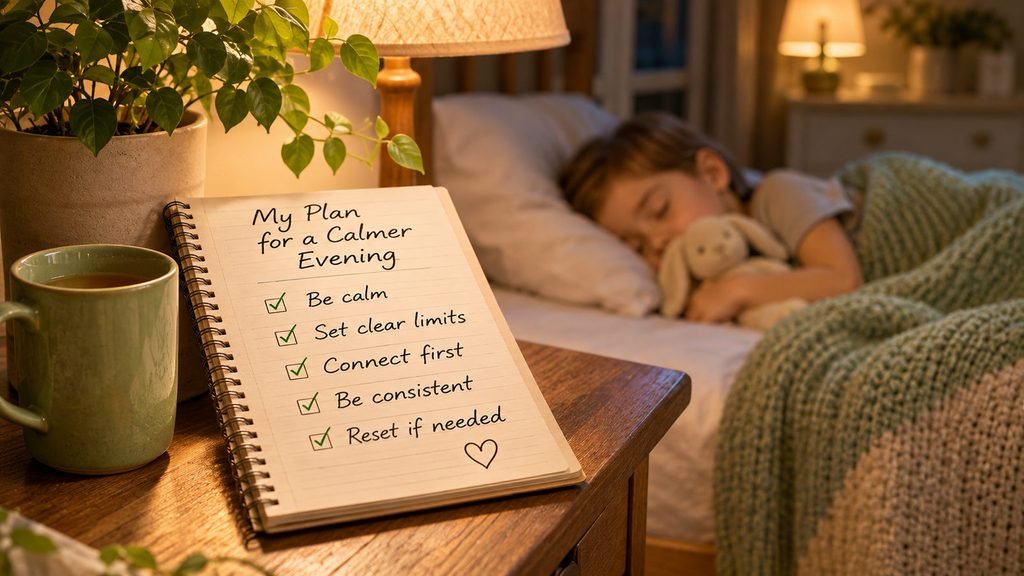
You do not need a new parenting style tonight.
You do not need to read three more books.
You do not need to be a different person.
You need one no.
Said softly. Said once.
At the hour you are most tired.
And then you need to stay in the room while it lands.
That is all authoritative parenting is, at 9:47 p.m.
Warmth that stays. A limit that stays.
Your parenting style is not who you are. It is what time it is.
Keep reading
- No Patience Left Tonight? How to Parent From the Couch
- Gentle Parenting vs Authoritative: How to Hold the Line Without the Guilt
- What Time Should My Child Go to Bed? (Free Bedtime Calculator)
Sources
- Arnsten, A. F. T. (2009). Stress signalling pathways that impair prefrontal cortex structure and function. Nature Reviews Neuroscience.
- Baumrind, D. (1966). Effects of authoritative parental control on child behavior. Child Development.
- Baumrind, D. (1991). The influence of parenting style on adolescent competence and substance use. Journal of Early Adolescence.
- Fletcher, A. C., Steinberg, L., & Sellers, E. B. (1999). Adolescents’ well-being as a function of perceived interparental consistency. Journal of Marriage and the Family.
- Garcia, F., & Gracia, E. (2009). Is always authoritative the optimum parenting style? Evidence from Spanish families. Adolescence.
- Lamborn, S. D., Mounts, N. S., Steinberg, L., & Dornbusch, S. M. (1991). Patterns of competence and adjustment among adolescents from authoritative, authoritarian, indulgent, and neglectful families. Child Development.
- Lorber, M. F. (2012). The role of maternal emotion regulation in overreactive and lax discipline. Journal of Family Psychology.
- Lurie Children’s Hospital (2024). Millennial Parenting Statistics. Survey of 1,000 US millennial parents, December 2023.
- Maccoby, E. E., & Martin, J. A. (1983). Socialization in the context of the family. In Handbook of Child Psychology.
- McKinney, C., & Renk, K. (2008). Differential parenting between mothers and fathers. Journal of Family Issues.
- Morning Consult (July 2025). Modern Parenting: Today’s Practices and Priorities. Survey of 2,210 US parents.
- Newton, A. T., et al. (2020). Review of parenting and child sleep.
- Pew Research Center (2015). Working-mom guilt? Many dads feel it too.
- Pew Research Center (2023). Parenting in America Today.
- Pinquart, M. (2016). Associations of parenting styles and dimensions with academic achievement in children and adolescents. Educational Psychology Review.
- Pinquart, M. (2017). Associations of parenting dimensions and styles with externalizing problems of children and adolescents. Developmental Psychology.
- Pinquart, M., & Kauser, R. (2018). Do the associations of parenting styles with behavior problems and academic achievement vary by culture? Cultural Diversity and Ethnic Minority Psychology.
- Piotrowski, J. T., Lapierre, M. A., & Linebarger, D. L. (2013). Investigating correlates of self-regulation in early childhood. Journal of Child and Family Studies.
- QuestionPro (September 2025). The New Rules of Parenting. Survey of 1,002 US adults.
- Talker Research for Kiddie Academy (August 2025). Survey of 2,000 US parents of children aged 0 to 6.
- US Surgeon General (2024). Parents Under Pressure: The US Surgeon General’s Advisory on the Mental Health and Well-Being of Parents.
About the author
Muhammad Zubair Sarwar is a dedicated family wellness researcher, content creator, and the founder of familybloomhub.com.
Passionate about bridging the gap between clinical behavioral science and everyday parenting, he specializes in creating actionable, evidence-based frameworks that help parents navigate early childhood dynamics, toddler behavior challenges, and modern digital boundary-setting.
To ensure the highest level of authoritativeness and accuracy for the Family Bloom Hub community, Muhammad has built a robust foundation in behavioral sciences.
He successfully completed the foundational Introduction to Psychology curriculum from Yale University and holds a formal certification in Positive Psychiatry
and Mental Health from the University of Sydney through Coursera. By blending positive psychology principles with practical, real-world tools, his mission is to empower global parents to foster emotional regulation, build resilient relationships, and raise thriving children.
How this article was made: Every claim names its researcher and year. FamilyBloomHub is written by a parent, not a clinician. This guide is education, not medical or psychological advice. Last reviewed November 2026.
One Response