
PART ONE: THE GUIDE
By Muhammad Zubair Sarwar · Published [October 10, 2026] · 14-minute read
The box is still sealed on the counter.
Your child has asked about it four times since dinner.
You already know the phone is the easy part.
The hard part is everything that comes inside it. The group chats. The apps. A message at eleven at night from someone you have never met.
This guide gives you the rules before the first fight. Three age versions. Twenty printables. And the exact words to say when it gets loud.
All of it is free. No email needed to read or print a single page.
Quick answer
A cell phone contract for kids is a written family agreement. It sets when, where and how your child uses a phone, and how they earn more freedom over time. The American Academy of Pediatrics recommends a written family media plan with phone-free times, phone-free places, and a bedtime.
In this guide
- What is a cell phone contract for kids?
- What age should a child get a phone?
- How do I know if my child is ready?
- What should a cell phone contract include by age?
- Where should my child’s phone sleep at night?
- Does a phone mean social media too?
- Should I check my child’s phone?
- What should my child do if a stranger messages them?
- What happens when a phone rule gets broken?
- What to say when phone rules become a fight
- The printables, all twenty
What is a cell phone contract for kids?
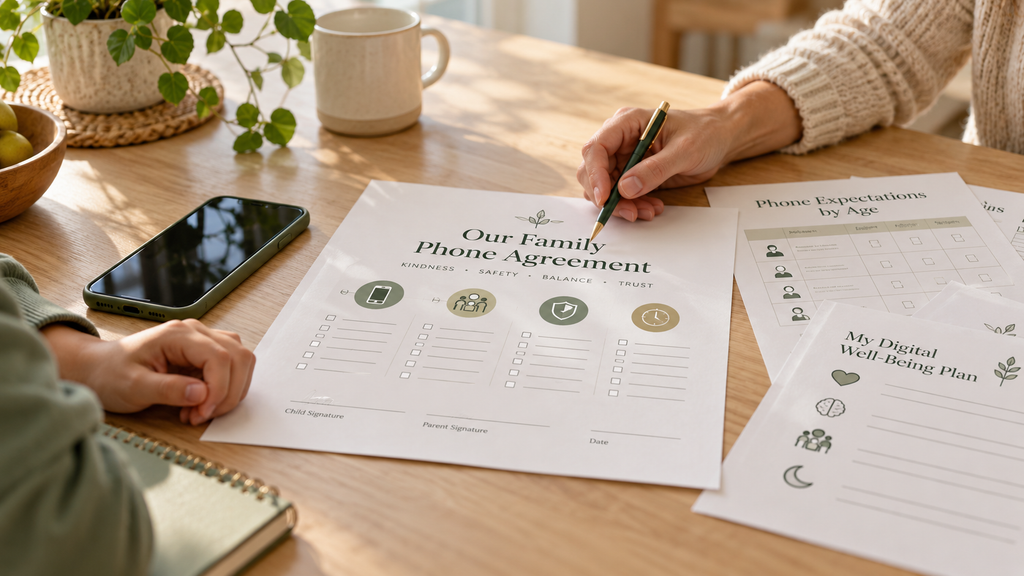
A cell phone contract for kids is a short written agreement between you and your child. It covers when the phone is used, where it sleeps, which apps are allowed, and what happens when a rule is broken. It also lists your own promises and a date to sit down and review it together.
A good contract does not say “I don’t trust you.”
It says “You are learning something hard, and I am going to help.”
Most contracts only bind the child. Yours should bind you too.
Children notice when the phone rule at the table is only for them.
What age should a child get a phone?
There is no proven best age. A Stanford study followed more than 250 children for five years. It found no meaningful link between the age a child got a first phone and their grades, sleep, or depression symptoms. Readiness matters more than the birthday.
In that study, the average first phone arrived at 11.6 years old.
Half the children got one somewhere between about 10.7 and 12.5.
The senior author, Thomas Robinson, offered a possible reason. Parents may already be matching the phone to the child and the family.
That matching is exactly what this guide is for.
Know the limit of this study. It followed one group of low-income Latino children. It does not prove phones are harmless. It suggests the date on the calendar is not the thing to watch.
So when you hear “Everyone else has one,” you can answer the real question.
Not “How old are you?”
But “What are you ready for right now?”
How do I know if my child is ready for a phone?
Your child is likely ready for some kind of phone when they look after their things, can stop a fun activity with help, tell you when something goes wrong, and understand that a screenshot can travel. Ready for some phones is not ready for every app. Start smaller than you think, then grow.
There is more than one first step. Think of it as a ladder.
- A watch or basic phone that calls and texts approved people.
- A smartphone with no app store access and no social media.
- A smartphone with apps you approve one at a time.
- A smartphone with more freedom, earned over months.
Your child does not have to start at the top.
And you get checked too. Before the box is opened, ask yourself three things.
Can you hold the rules on a tired Tuesday?
Will you follow the phone-free times yourself?
If your child tells you something scary happened online, will you listen before you react?
If the honest answer is “not yet,” that does not mean no phone. It means the grown-ups need a little time to prepare as well.
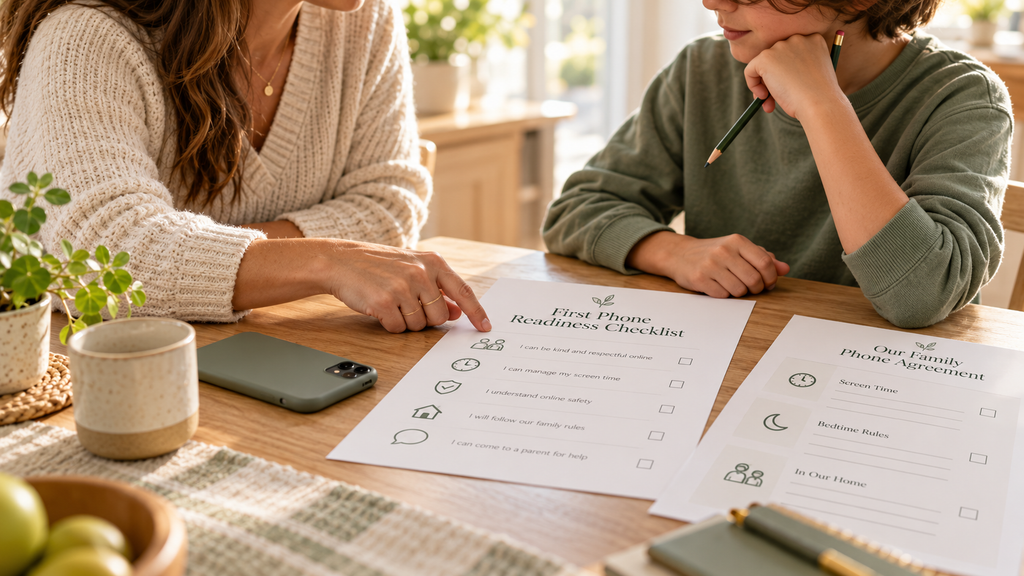
Use Printable 4, Printable 5, and Printable 6 to decide together.
What should a cell phone contract include by age?
Every contract should cover the same areas. When and where the phone is used, bedtime, school, apps, purchases, privacy, strangers, parent access, consequences, and a review date. What changes with age is how much your child decides. Younger children ask first. Teens earn more say by showing they can handle it.
| Area | Ages 8 to 10 | Ages 11 to 13 | Ages 14 to 17 |
| Who they contact | A family-approved list only | Approved list plus friends you know | Their own choice, strangers off-limits |
| New apps | Ask every time | Ask every time, check the app together | Tell a parent first, parent can say not yet |
| Social media | Not yet | A separate decision, made later | Agreed apps, privacy set together |
| At night | Charges outside the bedroom | Charges outside the bedroom | Outside on school nights, reviewed as trust grows |
| School | Follows school policy | Follows school policy | Follows school policy |
| Purchases | A parent buys | Ask first, every time | A monthly budget they manage |
| Parent checks | Open, any time | Agreed checks, child knows what | Lighter checks, more privacy |
| Review | Every 30 days | 30 days, then every 90 | Every 90 days |
Read the table from left to right. That is the path.
Each column is a little more freedom than the last.
Your child moves right by showing responsibility, not by having a birthday.
Printables 1, 2 and 3 are ready-to-sign contracts for each age.
Where should my child’s phone sleep at night?
Outside the bedroom, on a charger you can both see. The American Academy of Pediatrics says children should not sleep with devices in their bedrooms, smartphones included .One charging spot in the kitchen ends most midnight arguments before they begin.
The research behind this is strong but careful.
Lauren Hale and Stanford Guan reviewed 67 studies in 2015. In 90% of them, more screen time was linked to shorter or later sleep. The authors were honest about the gap. These studies show a link. They do not prove the screen caused the short night.
You do not need proof to see it at home, though.
A phone in the bedroom keeps buzzing after the lights go off.
A short night leaves less patience the next day. For your child, and for you.
If the phone is their alarm, a cheap alarm clock fixes that.
Printable 9 sets the time, the place, and the exceptions.
Does a phone mean social media too?
No. A phone and social media are two separate decisions. Most social media platforms set 13 as their minimum age. In his 2023 advisory, US Surgeon General Vivek Murthy said he believes 13 is too early. You can say yes to the phone and not yet to the apps.
The same advisory reported that teens on social media more than three hours a day may face double the risk of poor mental health outcomes.
That is a link in the data, not a sentence handed down on your child.
The advisory also noted that social media can help some young people. The honest picture has both sides.
What you can control is the order.
Phone first. Social media later, as its own conversation, with its own worksheet.
When your child says “All my friends are on it,” you can agree that it matters to them. And still decide on your family’s timeline.
Printable 12 walks through the questions to ask before you say yes.
Should I check my child’s phone?
If you check, say so first. Tell your child what you will look at and why. Checks should shrink as trust grows. A Pew Research Center survey published in March 2024 found that 64% of parents of 13 and 14 year olds look through their teen’s phone, compared with 41% of parents of 15 to 17 year olds.
Those numbers show something parents already sense. Oversight drops as children get older.
The question is whether it drops by plan or by accident.
A secret check feels like a trap when it is found. And it usually is found.
An open check feels like a seatbelt. Annoying, expected, and not personal.
The behaviour you are watching is not who your child is. A child who hides one message is not a liar by nature. They are a child who did not yet feel safe telling you.
Write down what you will check in the contract. Then do only that.
What should my child do if a stranger messages them?
Teach five steps before it ever happens. Share nothing. Do not move to another app. Save the message. Block. Tell a grown-up. The last step matters most, and it only works if your child believes you will not take the phone forever for telling you.
- Share nothing. No school, no address, no photos.
- Stay put. Never move the chat to another app.
- Save it. Take a screenshot.
- Block the account.
- Tell a grown-up you trust.
Practice these out loud with Printable 13. Children remember what they have rehearsed.
One promise belongs in every contract.
“If you tell me something went wrong online, you will not lose your phone for telling me.”
The phone may still need new limits later. But telling the truth is never the thing that gets punished.
If someone threatens to share a private image of your child, report it to the CyberTipline at the National Center for Missing & Exploited Children, at or 1-800-843-5678. Their free service helps remove images of anyone under 18.
This is a crime against your child. It is not something your child did wrong.
If your child is in immediate danger, call 911.
What happens when a phone rule gets broken?
Decide consequences before the phone arrives, not in the middle of a fight. Good consequences are linked to the rule, sized to the mistake, short, and end with a clear way back. A broken rule tells you what support is missing. It is not proof your child cannot handle a phone.
Use four moments.
- Before. Agree on rules and consequences while everyone is calm.
- During. Use fewer words. Follow the agreement.
- After. Ask what happened. Was the rule too hard? Was a friend pushing?
- Next time. Change one support. The phone charges in the kitchen again. App approval comes back. A review date gets set.
In the moment, your child’s body is flooded. So is yours.
A flooded brain cannot learn a lesson. It can only win or lose.
That is why the talking waits until later. Not as a punishment. Because later is when the learning can happen.
Printable 14 plans consequences ahead of time. Printable 20 turns a “not yet” into a plan.
What to say when phone rules become a fight
You do not need a speech. You need one calm sentence you have already practiced.
Script box: the words to say tonight
When they say “Everyone else has a phone”: “I know that matters to you. We’re deciding based on what you’re ready for, not what other families do.”
When they say “You don’t trust me”: “Trust is part of this. More responsibility will lead to more freedom. I want to get you there.”
When they say “Just five more minutes”: “I know you want more time. We agreed on this time. You can turn it off, or I can help.”
When they say “Why are you checking my phone?”: “We agreed on what I would check while you’re learning. I’ll always tell you what I look at and why.”
When they say “All my friends are on social media”: “Being ready for a phone and being ready for every app are two different decisions.”
When they say “You’re on your phone all the time”: “That’s fair. If dinner is phone-free for you, it’s phone-free for me too.”
The last one is the hardest to say.
It is also the one that makes every other rule believable.
Printable 17 puts these on cards you can keep by the charger.
The night my own phone was the problem
I got home a little after nine. My work phone was still in my hand when I sat down to eat. He was telling me about a game at school. Something about a ball and a wall. The phone buzzed. A message about a feeder fault. I typed a reply with one thumb and said “Hmm” with my mouth. He stopped talking. I did not notice that he had stopped. When I looked up, his plate was gone from the table. My rice had gone cold. The phone lay face up beside it, still lit.
What this costs you
A phone contract is not free. It costs you an hour to write it, and many evenings to hold it.
It costs your own phone at dinner.
It costs a few fights you could avoid by saying yes to everything.
And it will not make your child safe by itself. Paper does not protect anyone. Conversations do. The contract only gives those conversations a place to start.
The research cuts both ways too. Hale and Guan found a strong link between screens and short sleep. Sun and Robinson found no link between first phone age and wellbeing. Anyone who tells you the science is settled is selling something.
What you are buying with this effort is simpler.
Fewer rules made up in anger.
And a child who knows exactly where the lines are, and how to earn the next step.
If you remember one thing
You do not have to predict every problem a phone will bring.
You only have to start with enough structure. And keep talking.
Be firm where safety is involved. Bend where you can.
Let responsibility earn the next step.
A good phone contract is meant to get shorter over time. Rules come off the page as your child carries them on their own.
One day the paper will be gone.
The judgment your child built while it was there is what stays.
The goal was never to control the phone. It was to raise a child who can put it down.
Get the whole kit as one printable PDF
Every printable on this page is free to read and print right now.
If you want them in one tidy file, formatted for US Letter, leave your email below. You will also get the full kit in Spanish, for a grandparent or co-parent who reads it more easily.
[Email field] [Send me the kit]
Frequently asked questions
Is a cell phone contract for kids legally binding?
No. It is a family agreement, not a legal document. Its power comes from three things. It is written down before any fight. Everyone signs it, parents included. And you review it on a set date. That makes it feel fair to your child, which is what makes it work.
How often should we review the phone contract?
Review it 30 days after the phone arrives, while habits are still forming. After that, every 90 days works for most families. Review sooner after any big event, like a new school, a new app request or a broken rule. Each review is a chance to add freedom, not only limits.
What if my child’s other parent has different phone rules?
Agree on the safety rules first. Strangers, private images, and where the phone sleeps should match in both homes if you can manage it. Smaller rules, like weekend screen time, can differ. Tell your child plainly which rules travel with the phone and which belong to each house.
Should my child’s first phone be a smartphone?
It does not have to be. A watch or basic phone can cover calls and texts with approved people. A smartphone with the app store locked is another middle step. Choose the smallest device that meets the real need, then move up as your child shows they can handle more.
Sources
- American Academy of Pediatrics. Family Media Plan. HealthyChildren.org.
- American Academy of Pediatrics. Where We Stand: Screen Time. HealthyChildren.org.
- Sun, X. and Robinson, T. (2022). Age of first mobile phone and child wellbeing, a five-year study. Child Development. Stanford Medicine summary, November 2022.
- Hale, L. and Guan, S. (2015). Screen time and sleep among school-aged children and adolescents: a systematic literature review. Sleep Medicine Reviews, 21, 50 to 58.
- Office of the US Surgeon General (2023). Social Media and Youth Mental Health advisory, May 2023.
- Pew Research Center (2024). How Teens and Parents Approach Screen Time, March 2024.
- National Center for Missing & Exploited Children. CyberTipline and Take It Down.
About the author
Muhammad Zubair Sarwar is an Additional Project Director and a father in Lahore. He has worked for twenty-two years at a national power utility. In 2025, he completed two online non-credit courses, Introduction to Psychology from Yale and Positive Psychiatry and Mental Health from the University of Sydney.
He is not a clinician. Nothing on FamilyBloomHub is diagnosis or treatment. Read the medical disclaimer and editorial standards.
Related reading
- Why Is My Child So Emotional All of a Sudden?
- How to Raise a Confident Child Who Talks About Feelings
- Do I Have to Be a Perfect Parent
PART TWO: THE PRINTABLES
Twenty pages. US Letter. Print the ones your family needs and skip the rest.
| No. | Printable | Who fills it in |
| 1 | My First Phone Agreement, ages 8 to 10 | Parent and child |
| 2 | My Tween Phone Agreement, ages 11 to 13 | Parent and child |
| 3 | My Teen Smartphone Agreement, ages 14 to 17 | Parent and teen |
| 4 | First Phone Readiness Checklist | Parent |
| 5 | Am I Ready for a Phone? | Child |
| 6 | Are We Ready? Parent Checklist | Parent |
| 7 | Family Screen-Time Rules | Together |
| 8 | Phone-Free Zones Planner | Together |
| 9 | Bedtime Phone Plan | Together |
| 10 | School Phone Rules | Parent |
| 11 | Before You Download That App | Together |
| 12 | Social Media Readiness | Child, then together |
| 13 | What Would You Do? Online Safety Scenarios | Child |
| 14 | Phone Rule Consequence Planner | Parent, then together |
| 15 | Parent Phone Promises | Parent |
| 16 | Family Gaming Agreement | Together |
| 17 | Phone Conflict Script Cards | Parent |
| 18 | 30-Day First Phone Review | Together |
| 19 | 90-Day Independence Review | Together |
| 20 | My Path to Phone Readiness | Child and parent |
Printable 1: My First Phone Agreement (Ages 8 to 10)
My name: ______________________ Phone start date: ______________
I have this phone so I can: ____________________________________
My promises
☐ I will answer when my parent calls, when I can.
☐ I will only call and text people on our approved list.
☐ I will ask before I download any app or game.
☐ I will follow my school’s phone rules.
☐ My phone goes to sleep at ________ PM on school nights.
☐ My phone charges in the ______________, not in my bedroom.
☐ I will not share my address, my school, my passwords or photos of me with anyone I do not know.
☐ If someone I do not know messages me, I will tell a grown-up.
☐ I will ask before buying anything, even if it says free.
☐ I will look after my phone. If it breaks or gets lost, we will: ______________________
☐ I will tell the truth when something goes wrong.
No phones during: ☐ meals ☐ homework ☐ family time ☐ ______________
My parent’s promises
☐ I will follow the phone-free times too.
☐ I will tell you what I check on your phone.
☐ I will listen first if you tell me something went wrong online.
☐ You will not lose your phone for telling me the truth.
If a rule is broken, this will happen: ________________________________
Child signature: ______________________ Parent signature: ______________________
We will review this on (30 days from today): ______________
Printable 2: My Tween Phone Agreement (Ages 11 to 13)
My name: ______________________ Phone start date: ______________
What I hope this phone helps me do: ____________________________
Everyday use
☐ I will follow my school’s phone policy.
☐ My phone is away during: ☐ meals ☐ homework ☐ ______________
☐ On school nights my phone goes to the charger at ________ PM. Weekends: ________ PM.
☐ My phone charges in the ______________, not in my bedroom.
Apps, games and money
☐ I will ask before downloading any app, and we will check it together first.
☐ I will ask before any purchase, subscription or free trial.
☐ Online voice chat in games only with: ______________________
Group chats and photos
☐ If I would not say it face to face, I will not type it.
☐ I will ask before posting or sharing a photo of someone else.
☐ If a group chat turns cruel, I can leave it and tell a grown-up.
☐ I will not forward screenshots meant to embarrass someone.
Privacy and safety
☐ I will not share passwords, except with my parent.
☐ Location sharing is on with: ______________________ and off for everyone else.
☐ If a stranger messages me, I will share nothing, save it, block, and tell a grown-up.
☐ If anyone says “Don’t tell your parents,” I will tell my parents.
Social media
☐ Social media is a separate decision. We will talk about it on: ______________
What my parent will check, and how often: ______________________________
My parent’s promises
☐ I will follow the phone-free times too.
☐ I will tell you what I check and why.
☐ I will listen first, and you will not lose your phone for telling me something went wrong.
☐ I will give you more privacy as you show more responsibility.
If a rule is broken once: ______________________________
If it keeps happening: ______________________________
Child signature: ______________________ Parent signature: ______________________
30-day review: ______________ 90-day review: ______________
Printable 3: My Teen Smartphone Agreement (Ages 14 to 17)
My name: ______________________ Date: ______________
This agreement is about earning trust in both directions.
School and sleep
☐ I will follow my school’s phone policy.
☐ On school nights my phone goes to the charger at ________ PM, in the ______________.
☐ Weekend plan: ______________________________
Driving
☐ I will never use my phone while driving. Navigation is set before I start.
☐ I will not text someone I know is driving.
Privacy and relationships
☐ I will never send, ask for or forward a private or sexual image of anyone.
☐ If anyone pressures or threatens me about an image, I will tell a trusted adult. I will not be punished for telling.
☐ I will ask before posting anyone else’s private moment.
☐ I will treat people online the way I would face to face.
Apps, social media and money
☐ I will tell a parent before adding a new app. My parent can say not yet.
☐ Agreed social media apps: ______________________ Privacy settings checked together: ☐
☐ My monthly budget for apps and games is: $______. Anything above it, I ask first.
Location and contact
☐ Location sharing with: ______________________
☐ I will answer or reply to my parent within ______ minutes when I am out, unless I can’t.
☐ If I am ever somewhere unsafe, I can call and my parent will come, with questions later, not then.
Parent access
What my parent will check, and when: ______________________________
What stays private: ______________________________
My parent’s promises
☐ I will respect more privacy as you show more responsibility.
☐ I will not change the rules in the middle of an argument.
☐ I will follow our phone-free times myself.
☐ I will listen first when something goes wrong.
The next freedom I can earn: ______________________________
What earns it: ______________________________
Teen signature: ______________________ Parent signature: ______________________
Review every 90 days. Next review: ______________
Printable 4: First Phone Readiness Checklist
For the parent. Rate each line honestly. Nobody passes all of them.
| My child… | Usually | Sometimes | Not yet |
| Takes reasonable care of their things | ☐ | ☐ | ☐ |
| Follows important house rules | ☐ | ☐ | ☐ |
| Can stop a fun activity with some help | ☐ | ☐ | ☐ |
| Tells me when something has gone wrong | ☐ | ☐ | ☐ |
| Understands what should stay private | ☐ | ☐ | ☐ |
| Knows not to share passwords | ☐ | ☐ | ☐ |
| Knows not to tell strangers their address or school | ☐ | ☐ | ☐ |
| Understands a screenshot can be saved and shared | ☐ | ☐ | ☐ |
| Handles disappointment without becoming unsafe | ☐ | ☐ | ☐ |
| Follows school rules | ☐ | ☐ | ☐ |
| Understands apps and games can cost real money | ☐ | ☐ | ☐ |
| Knows when to ask an adult for help | ☐ | ☐ | ☐ |
Our decision for now
☐ Ready for a smartphone
☐ Ready for a limited smartphone
☐ Ready for a watch or basic phone
☐ Almost ready
☐ Not yet
We will look at this again on: ______________
A “not yet” always comes with a date. Use Printable 20 to plan the path.
Printable 5: Am I Ready for a Phone?
For the child. There are no wrong answers.
Why I want a phone: ________________________________________
What I think a phone will help me do: ______________________________
Three jobs that come with having a phone:
1.
2.
3.
If a stranger messages me, I will: ______________________________
If I see something online that scares or embarrasses me, I will: ______________________________
If I break a family phone rule by accident, I will: ______________________________
One phone rule I think is fair: ______________________________
One phone rule I want to talk about: ______________________________
Printable 6: Are We Ready? Parent Checklist
The phone is not only a test for your child.
Are we ready to…
☐ agree on the rules before we buy the phone?
☐ hold those rules on tired days too?
☐ follow the same phone-free times ourselves?
☐ explain any parental controls instead of using them in secret?
☐ talk calmly about uncomfortable online topics?
☐ keep a small mistake from becoming a huge punishment?
☐ learn how the apps our child wants actually work?
☐ read our child’s school phone policy?
☐ make it safe for our child to tell us when something goes wrong?
☐ review the agreement as our child grows?
If several answers are “not yet,” the grown-ups need a little preparation too. That is normal.
Printable 7: Family Screen-Time Rules
Fill this in together.
| Time | Phone allowed? | Our rule |
| School mornings | ☐ Yes ☐ No ☐ Only for ______ | |
| Homework | ☐ Yes ☐ No | Phone stays: ______ |
| Dinner | ☐ Yes ☐ No | |
| Weekends | ☐ Yes ☐ Some | |
| Family outings | ☐ Yes ☐ No | |
| Car rides | ☐ Yes ☐ No |
The grown-ups in this house agree to: ______________________________
Printable 8: Phone-Free Zones Planner
In our family, phones are put away during:
☐ meals ☐ homework ☐ family meetings ☐ bedtime routine ☐ car conversations ☐ visits with relatives ☐ ______________
Phones stay out of:
☐ bedrooms ☐ the dining table ☐ bathrooms ☐ ______________
The adults will follow these rules too: ☐ Yes
Parent initials: ______ Child initials: ______
Printable 9: Bedtime Phone Plan
School nights, the phone goes to the charger at: ________ PM
Weekends, the phone goes away at: ________ PM
The charging spot is: ______________________
Do Not Disturb starts at: ________
Alarm: ☐ alarm clock ☐ other: ______________
Exceptions (travel, sleepovers, holidays): ______________________________
If I need to reach my child urgently at night: ______________________________
Printable 10: School Phone Rules
Check the school’s current policy yourself. Do not rely on “everyone does it.”
School name: ______________________
The current phone policy: ______________________________
Where the phone stays during class: ______________________
Phones at lunch? ☐ Yes ☐ No
What happens if the policy is broken: ______________________________
How to reach my child in an emergency during school: ______________________________
Printable 11: Before You Download That App
Answer these together before saying yes.
| Question | Yes | No | Not sure |
| Can strangers contact users? | ☐ | ☐ | ☐ |
| Does it use location? | ☐ | ☐ | ☐ |
| Does it allow private messages? | ☐ | ☐ | ☐ |
| Does it have in-app purchases? | ☐ | ☐ | ☐ |
| Can users post photos or videos? | ☐ | ☐ | ☐ |
| Is the profile public by default? | ☐ | ☐ | ☐ |
Minimum age set by the app: ______
Why my child wants this app: ______________________________
Our decision: ☐ Yes ☐ Yes, with these limits: ______________ ☐ Not yet
We will look again on: ______________
Printable 12: Social Media Readiness
A phone and social media are two different decisions. Ask your child to answer first, then talk it through.
Why do you want this app? ______________________________
Who do you expect to follow, and who will follow you? ______________________________
What would you do if a stranger messaged you? ______________________________
What would you do if someone posted something cruel about you? ______________________________
What would you do if a friend shared a photo of you that you did not want shared? ______________________________
What should never be posted in public? ______________________________
Can you accept a “not yet” from your parent? ☐ Yes ☐ Not sure
Our decision: ☐ Yes, with these settings: ______________ ☐ Not yet. We will talk again on: ______________
Printable 13: What Would You Do? Online Safety Scenarios
Write or say your answer. Then practice it out loud with a parent.
Scenario 1. Someone you do not know asks, “Where do you go to school?”
I would: ______________________________
Scenario 2. A friend asks for your password.
I would say: ______________________________
Scenario 3. Someone sends you a picture that makes you feel uncomfortable.
The first thing I would do: ______________________________
Scenario 4. Someone says, “Don’t tell your parents we’re talking.”
I would: ______________________________
Scenario 5. Someone threatens to share something embarrassing about you.
The adults I could tell: ______________________________
Five steps to remember: share nothing, stay put, save it, block, tell a grown-up.
If anyone threatens to share a private image: CyberTipline.org or 1-800-843-5678. It is never too late to ask for help.
Printable 14: Phone Rule Consequence Planner
Fill this in while everyone is calm. One box per rule.
| Rule | Why it matters | If broken once | If it keeps happening | What brings full access back | Review date |
A good consequence is linked to the rule, sized to the mistake, short, and has a clear way back.
Telling the truth about a problem is never the thing that gets punished.
Printable 15: Parent Phone Promises
As your parent, I agree to:
☐ follow our phone-free family times
☐ put my own phone away during important conversations
☐ explain what I check and why
☐ listen first when you tell me something went wrong online
☐ never post anything meant to embarrass you
☐ not change the rules in the middle of an argument
☐ give you more privacy as you show more responsibility
☐ review this agreement as you grow
☐ admit it when my own phone is getting in the way of our family
Parent signature: ______________________ Date: ______________
Printable 16: Family Gaming Agreement
Gaming is allowed on: ☐ school days ☐ weekends
Gaming ends at: ________ PM
Before gaming, these jobs are done: ______________________________
Voice chat allowed with: ______________________________
Purchases: ☐ not allowed ☐ ask first ☐ monthly budget: $______
If a game leads to repeated yelling or unsafe behaviour, we will: ______________________________
Child initials: ______ Parent initials: ______
Printable 17: Phone Conflict Script Cards
Cut along the lines. Keep them by the charger.
| When they say | You can say |
| “Everyone else has a phone.” | “I know that matters to you. We’re deciding based on what you’re ready for, not what other families do.” |
| “You don’t trust me.” | “Trust is part of this. More responsibility will lead to more freedom. I want to get you there.” |
| “Just five more minutes.” | “I know you want more time. We agreed on this time. You can turn it off, or I can help.” |
| “Why are you checking my phone?” | “We agreed on what I would check while you’re learning. I’ll always tell you what and why.” |
| “All my friends are on social media.” | “Being ready for a phone and being ready for every app are two different decisions.” |
| “You’re on your phone all the time.” | “That’s fair. If dinner is phone-free for you, it’s phone-free for me too.” |
| (After a hard moment) | “I hear that you’re angry. We’re following the agreement tonight. We’ll talk when we’re both calmer.” |
Printable 18: 30-Day First Phone Review
Thirty days in. Sit down together.
What has gone well? ______________________________
What has caused the most arguments? ______________________________
Which rule is hardest to follow? ______________________________
Has anything happened online we should talk about? ______________________________
Does any rule feel unnecessary now? ______________________________
Does any rule need to be stronger? ______________________________
More independence earned? ☐ Yes ☐ Not yet
One change for the next 60 days: ______________________________
Printable 19: 90-Day Independence Review
| Area | Strong | Improving | Needs more support |
| Caring for the phone | ☐ | ☐ | ☐ |
| School rules | ☐ | ☐ | ☐ |
| Bedtime | ☐ | ☐ | ☐ |
| Apps and purchases | ☐ | ☐ | ☐ |
| Honesty | ☐ | ☐ | ☐ |
| Online safety | ☐ | ☐ | ☐ |
Based on the last 90 days:
☐ add independence ☐ keep current limits ☐ add support for a while
New freedom earned: ______________________________
New responsibility: ______________________________
Next review: ______________
Printable 20: My Path to Phone Readiness
For a child who heard “not yet.” This is the plan, not the punishment.
Before we talk about a phone again, I will work on:
☐ taking care of my things
☐ following our routines
☐ stopping screens when it is time
☐ telling the truth when something goes wrong
☐ handling disappointment safely
☐ learning the online safety steps
☐ following school rules
My own goal: ______________________________
My parent will help me by: ______________________________
We will talk about my phone again on: ______________
Child signature: ______________________ Parent signature: ______________________